



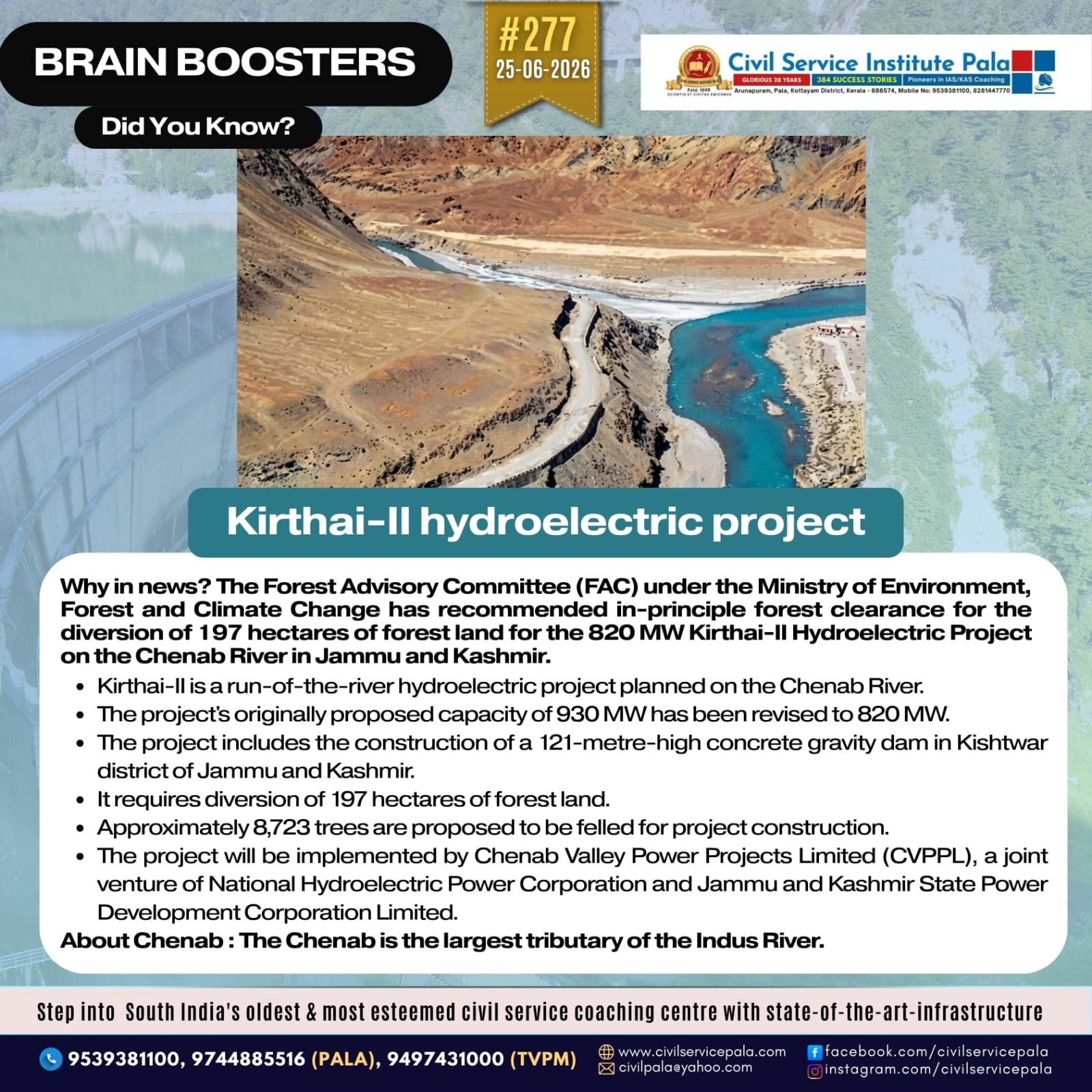
Kirthai-II Hydroelectric Project & the Chenab Basin
Kirthai-II Hydroelectric Project & the Chenab Basin
Why in News?
• The Forest Advisory Committee (FAC) of the Ministry of Environment, Forest and Climate Change has recommended in-principle approval for diversion of 197 hectares of forest land for the 820 MW Kirthai-II Hydroelectric Project on the Chenab River in Jammu and Kashmir.
• Kirthai-II has become the third hydroelectric project on the Chenab River to receive environmental approvals since the suspension of the Indus Water Treaty (IWT) following the Pahalgam terror attack.
• The development reflects the Centre’s efforts to accelerate hydroelectric projects in the Indus basin and maximise utilisation of river waters available to India.
Kirthai-II Project at a Glance
• Kirthai-II is a run-of-the-river hydroelectric project planned on the Chenab River in Jammu and Kashmir.
• The project’s originally proposed capacity of 930 MW has been revised to 820 MW.
• A 121-metre-high concrete gravity dam will be constructed in the Padder tehsil of Kishtwar district.
• The project is located in a moderate to dense high-mountain forest area and therefore required forest clearance before implementation.
• The project will be developed by Chenab Valley Power Projects Limited (CVPPL), a joint venture of the National Hydroelectric Power Corporation (NHPC) and the Jammu and Kashmir State Power Development Corporation Limited (JKSPDC).
Chenab River: Origin and Course
• The Chenab is the largest tributary of the Indus River.
• It is formed by the confluence of the Chandra and Bhaga rivers at Tandi near Keylong in Himachal Pradesh.
• Owing to its origin from the Chandra and Bhaga rivers, it is also known as Chandrabhaga.
• The river flows for approximately 1,180 kilometres before entering Pakistan.
• The Chenab basin has emerged as one of India's most important regions for hydroelectric development.
Chenab and the Indus Water Treaty (1960)
• The waters of the Chenab basin are governed by the Indus Water Treaty (IWT), 1960, signed between India and Pakistan.
• Under the treaty, Pakistan controlled the waters of the Indus, Jhelum and Chenab rivers, while India controlled the waters of the Ravi, Beas and Sutlej rivers.
• Following the Pahalgam terror attack of April 2026, in which 26 people were killed, the Government of India placed the treaty in abeyance.
• After the suspension of the treaty, the Centre initiated measures to expedite hydroelectric projects across the Indus basin, particularly in the Chenab basin.
• Projects that have gained renewed attention include Sawalkote, Ratle, Pakal Dul, Kwar, Kiru, Kirthai-I and Kirthai-II, among others.
• The Jammu and Kashmir administration has also dispensed with the requirement for cumulative impact assessments and carrying-capacity studies for projects on the Indus, Jhelum and Chenab rivers.
• This decision has been justified on the basis of the strategic importance of these rivers and the objective of fully utilising available water resources.
Hydropower Projects on the Chenab River
Operational Projects
• Dulhasti-I Hydroelectric Project – 390 MW
• Baglihar Hydroelectric Project – 890 MW
• Salal Hydroelectric Project – 690 MW
Projects Under Construction
• Ratle Hydroelectric Project – 850 MW
• Kiru Hydroelectric Project – 624 MW
• Kwar Hydroelectric Project – 540 MW
Other Major Planned Projects
• Pakal Dul Hydroelectric Project – 1,000 MW (largest capacity project mentioned in the source)
• Kirthai-I Hydroelectric Project
• Kirthai-II Hydroelectric Project – originally 930 MW, now revised to 820 MW
• Dulhasti-II Hydroelectric Project – 260 MW
• Sawalkote Hydroelectric Project
Environmental and Biodiversity Concerns
• The Kirthai-II project requires diversion of 197 hectares of forest land.
• Approximately 8,723 trees are proposed to be felled for project construction.
• The affected forests contain Pine species, Silver Fir, Oak species and other temperate broadleaf trees.
• The project site is a natural habitat of the Chilgoza Pine, an ecologically important tree species.
• Wildlife reported from the area includes the Himalayan Tahr, Asiatic Black Bear, Himalayan Brown Bear and Asiatic Ibex.
• The Forest Advisory Committee has directed the implementation of a Wildlife Biodiversity Management Plan, Habitat Management Plan, and an Animal Passage Plan to mitigate ecological impacts.
Kishtwar as a Future Power Hub
• According to the Union Government, Kishtwar district is expected to emerge as a major power hub of North India.
• Ongoing and planned hydroelectric projects in the district are expected to generate around 6,000 MW of electricity.
• The surplus power generated from Kishtwar is expected to support not only Jammu and Kashmir but also other States.
• The concentration of multiple hydroelectric projects in the district reflects its growing importance in India’s hydropower strategy.
