



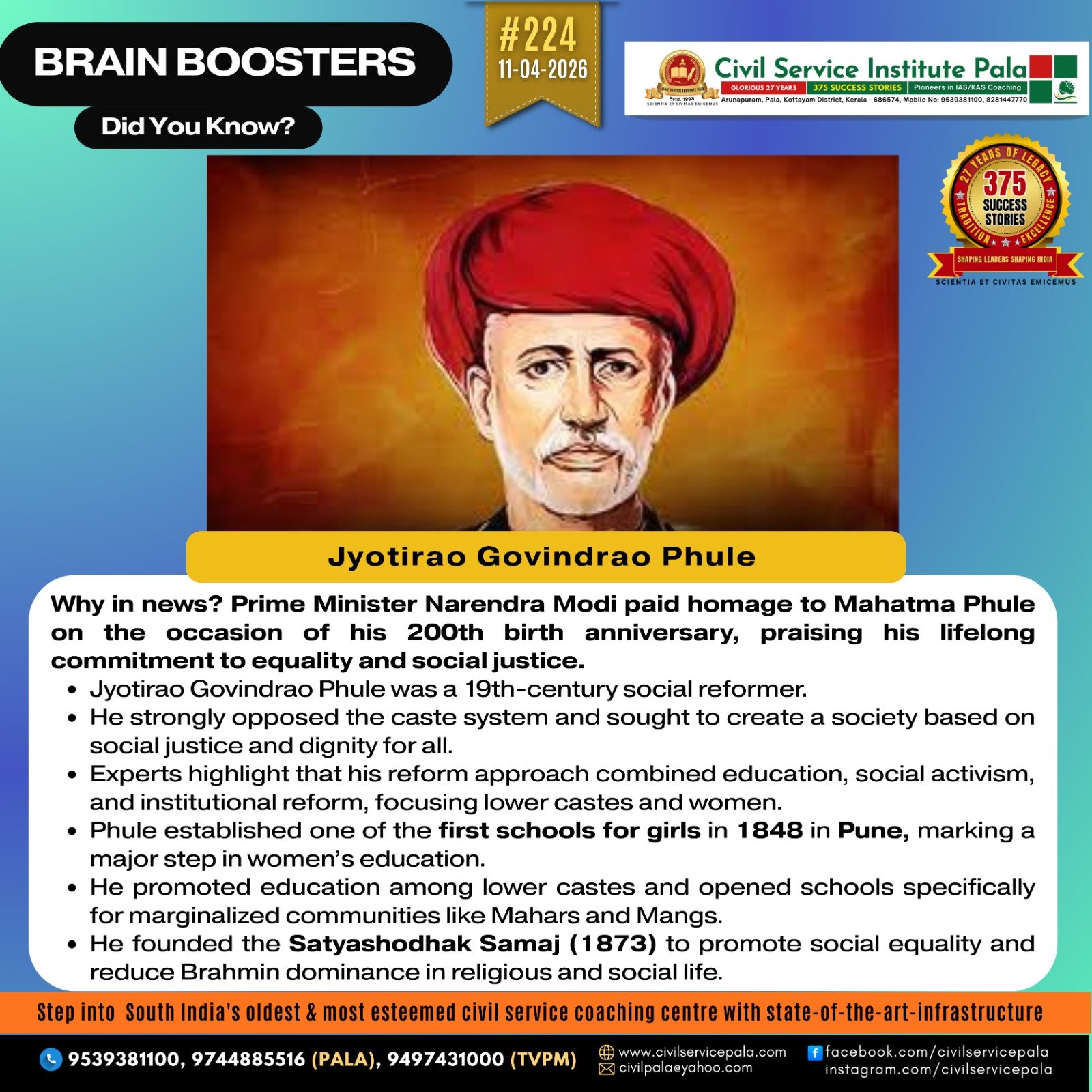
Jyotirao Govindrao Phule
Jyotirao Govindrao Phule Background
• Jyotirao Govindrao Phule was a 19th-century social reformer who worked for equality, especially for lower castes and women.
• He strongly opposed the caste system and sought to create a society based on social justice and dignity for all.
• Experts highlight that his reform approach combined education, social activism, and institutional reform.
• He was born on April 11, 1827, in present-day Maharashtra.
• His wife, Savitribai Phule, was one of India’s first female teachers and a key collaborator in his work.
• He was conferred the title “Mahatma” in 1888.
Key Issues / Challenges
The following were the major social challenges addressed by Jyotirao Govindrao Phule during his reform movement:
• The caste system created deep social inequality, particularly affecting Shudras and present-day Dalits.
• Women faced severe discrimination, including lack of education, child marriage, and denial of widow remarriage.
• Orthodox social groups resisted reforms and opposed efforts to change traditional hierarchies.
Contributions
• Phule established one of the first schools for girls in 1848 in Pune, marking a major step in women’s education.
• He promoted education among lower castes and opened schools specifically for marginalized communities like Mahars and Mangs.
• He founded the Satyashodhak Samaj (1873) to promote social equality and reduce Brahmin dominance in religious and social life.
• The Samaj encouraged non-Brahmin-led rituals, including marriages without priests, to break caste-based control.
• He worked for widow remarriage and against child marriage, and established homes for widows and orphaned children.
• His book Gulamagiri (1873) compared caste oppression in India with slavery in the United States.
• He symbolically promoted equality by opening his private well to all castes, challenging untouchability practices.
Legacy
• His ideas inspired later anti-caste movements, including those led by B. R. Ambedkar.
• Experts suggest that Phule laid the foundation for modern social justice movements in India.
• His emphasis on education continues to influence policies aimed at inclusive development.
• Experts highlight that Phule’s model shows that education is the most effective tool for social transformation.
• His approach underscores the need for institutional reforms along with social awareness.
• Contemporary policies on gender equality, caste justice, and inclusive education reflect his vision.
