



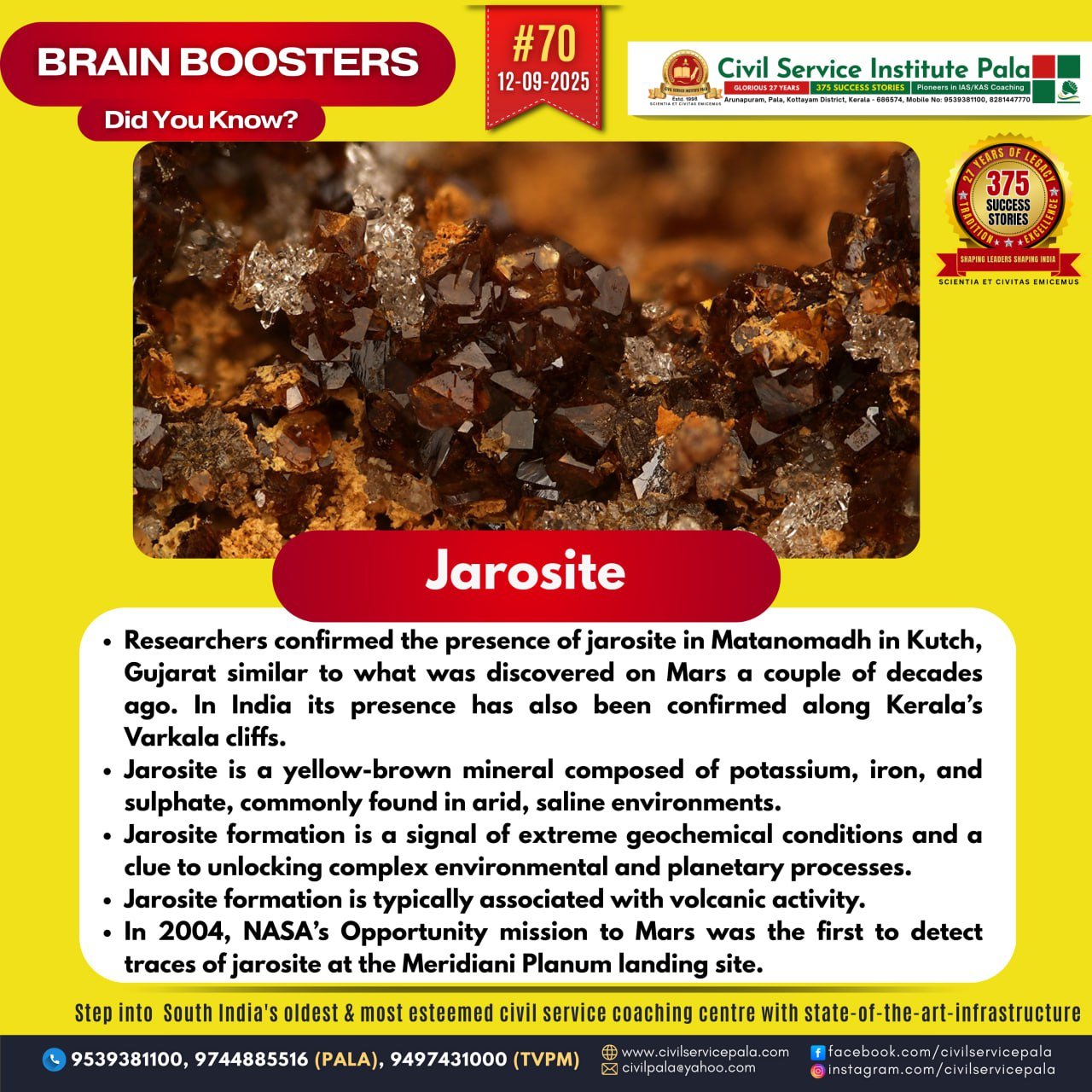
Jarosite
Jarosite is a mineral that belongs to the sulfate group. It is typically a hydrous sulfate of potassium and iron, with the chemical formula: KFe₃(SO₄)₂(OH)₆
Characteristics Color:
Yellow to brownish-yellow (gives soils a distinctive yellow staining). Crystal system: Trigonal. Formation: Occurs as a secondary mineral in the oxidation zones of sulfide ore deposits (especially pyrite). Stability: Forms in acidic, oxidizing environments, often linked to acid mine drainage. Solubility: Moderately soluble, which means it can influence acidity and metal mobility in soils and waters. Occurrence Found in mine tailings, acid-sulfate soils, volcanic environments, and areas where sulfide minerals weather. Common in arid or semi-arid regions where evaporation helps concentrate sulfate minerals. Also detected on Mars by NASA’s Opportunity rover — evidence of past acidic, water-rich conditions on the planet.
Environmental Significance Indicator of acid mine drainage: Its presence often signals acidic, metal-contaminated environments. Soil and water impact: Can store toxic metals (like lead or arsenic), which may later be released, affecting ecosystems. Geochemical marker: Used in environmental studies to trace sulfur cycling and oxidation processes.
Uses/Scientific Importance Helps geologists understand oxidation of sulfide ores and environmental contamination. In planetary science, its discovery on Mars provided clues about the planet’s water history and surface geochemistry.
