



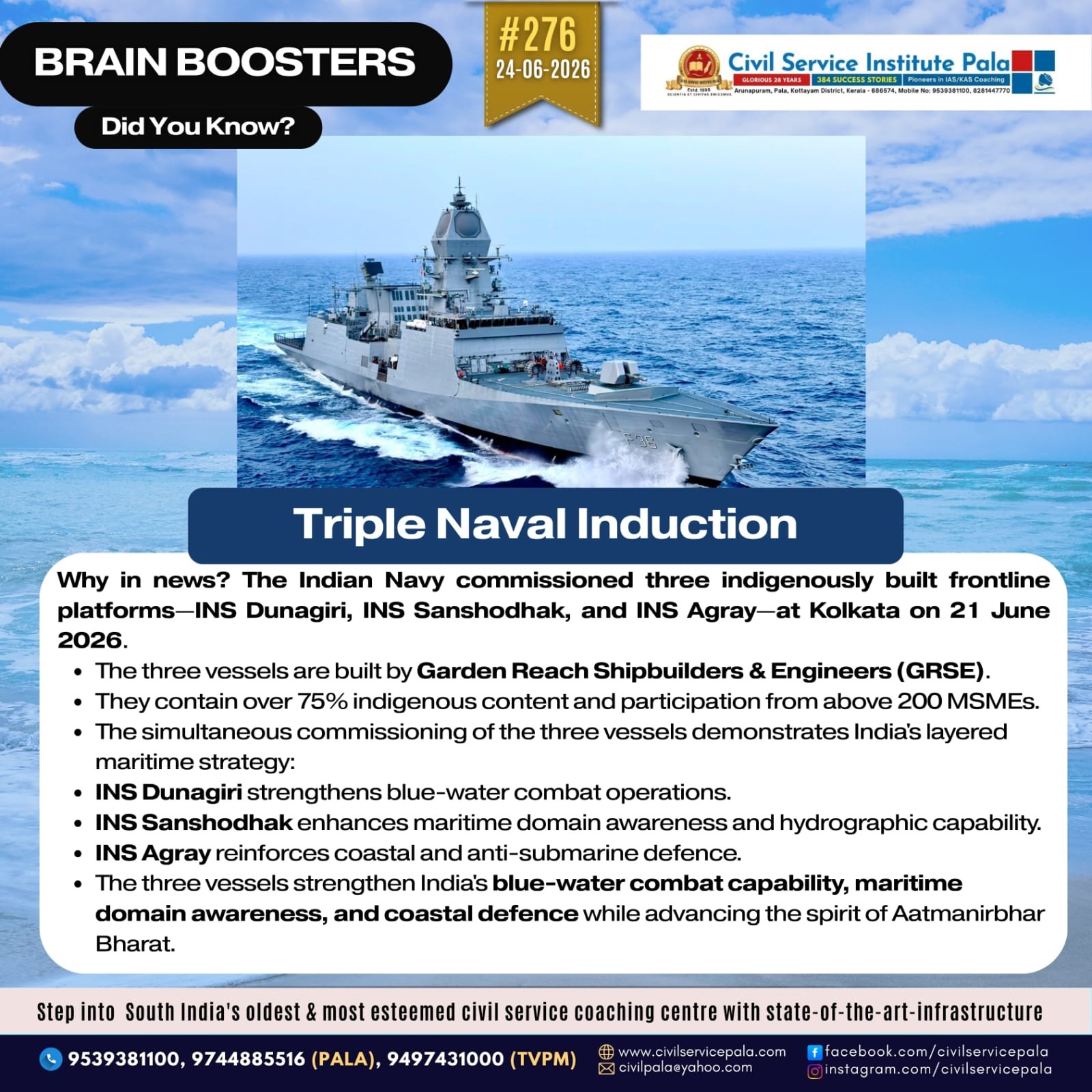
INS Dunagiri (Project 17A Stealth Frigate)
Why in news? The Indian Navy commissioned three indigenously built frontline platforms—INS Dunagiri, INS Sanshodhak, and INS Agray—at Kolkata on 21 June 2026. Built by Garden Reach Shipbuilders & Engineers (GRSE) with over 75% indigenous content and participation from more than 200 MSMEs, the vessels strengthen India's blue-water combat capability, maritime domain awareness, and coastal defence while advancing the objectives of Aatmanirbhar Bharat.
INS Dunagiri (Project 17A Stealth Frigate)
• INS Dunagiri is the fifth frigate of the Project 17A class and represents the Navy's next generation of stealth-guided missile warships.
• A frigate is a major surface combatant capable of operating far from the coast in deep-sea or "blue-water" environments.
• Project 17A deals with a new generation of stealth guided-missile frigates are being built in India.
• The vessel is equipped with BrahMos surface-to-surface missiles, Medium Range Surface-to-Air Missile (MRSAM) system, Multi-Function Surveillance, Track And Guidance Radar (MFSTAR) radar, sonar systems, electronic warfare suites, and anti-submarine warfare weapons.
• Its stealth features reduce detection by enemy radar and sensors, enhancing survivability during combat operations.
• The ship is designed to tackle conventional and non-conventional maritime threats and significantly strengthens India's long-range naval strike and air-defence capabilities.
INS Sanshodhak (Survey Vessel Large)
• INS Sanshodhak is the fourth and final vessel of the Sandhayak-class Survey Vessel Large programme.
• The ship is designed to conduct coastal and deep-water hydrographic surveys and collect oceanographic and geophysical data for both defence and civilian applications.
• It is equipped with advanced survey technologies including Autonomous Underwater Vehicles (AUVs), Remotely Operated Vehicles (ROVs), and Multi-Beam Echo Sounders.
• The vessel maps seabed features, underwater channels, coastal approaches, navigational routes, and ocean conditions essential for safe maritime operations.
• The data generated supports naval operations, submarine navigation, maritime safety, port development, disaster management, ocean research, and coastal infrastructure planning.
• By improving understanding of the underwater domain, the ship strengthens India's maritime domain awareness.
• Sanshodhak is the last ship of the Sandhayak-class of SVLs.
• The contract for four SVLs was signed in October 2018. The other ships of this class are INS Sandhayak, INS Nirdeshak and INS Ikshak, commissioned in February 2024, December 2024 and November 2025.
INS Agray (Arnala-Class ASW Shallow Water Craft)
• INS Agray is the fourth vessel of the Arnala-class Anti-Submarine Warfare Shallow Water Craft programme.
• It is a specialised platform designed to detect, track, and neutralise submarines operating in shallow coastal waters, ports, naval bases, and critical sea approaches.
• The vessel is equipped with lightweight torpedoes, indigenous anti-submarine rocket launchers, and shallow-water sonar systems.
• It is specifically designed for operations in littoral waters, where submarine detection is particularly difficult due to heavy maritime traffic, fishing activity, seabed clutter, and coastal noise.
• The ship enhances India's capability to secure coastal waters against underwater threats and strengthens anti-submarine warfare operations close to shore.
Strategic Significance
• The simultaneous commissioning of the three vessels demonstrates India's layered maritime strategy:
o INS Dunagiri strengthens blue-water combat operations.
o INS Sanshodhak enhances maritime domain awareness and hydrographic capability.
o INS Agray reinforces coastal and anti-submarine defence.
• Together, the ships reflect the growing maturity of India's indigenous naval shipbuilding ecosystem and support India's expanding maritime responsibilities across the Arabian Sea, Bay of Bengal, island territories, and the wider Indo-Pacific region.
