



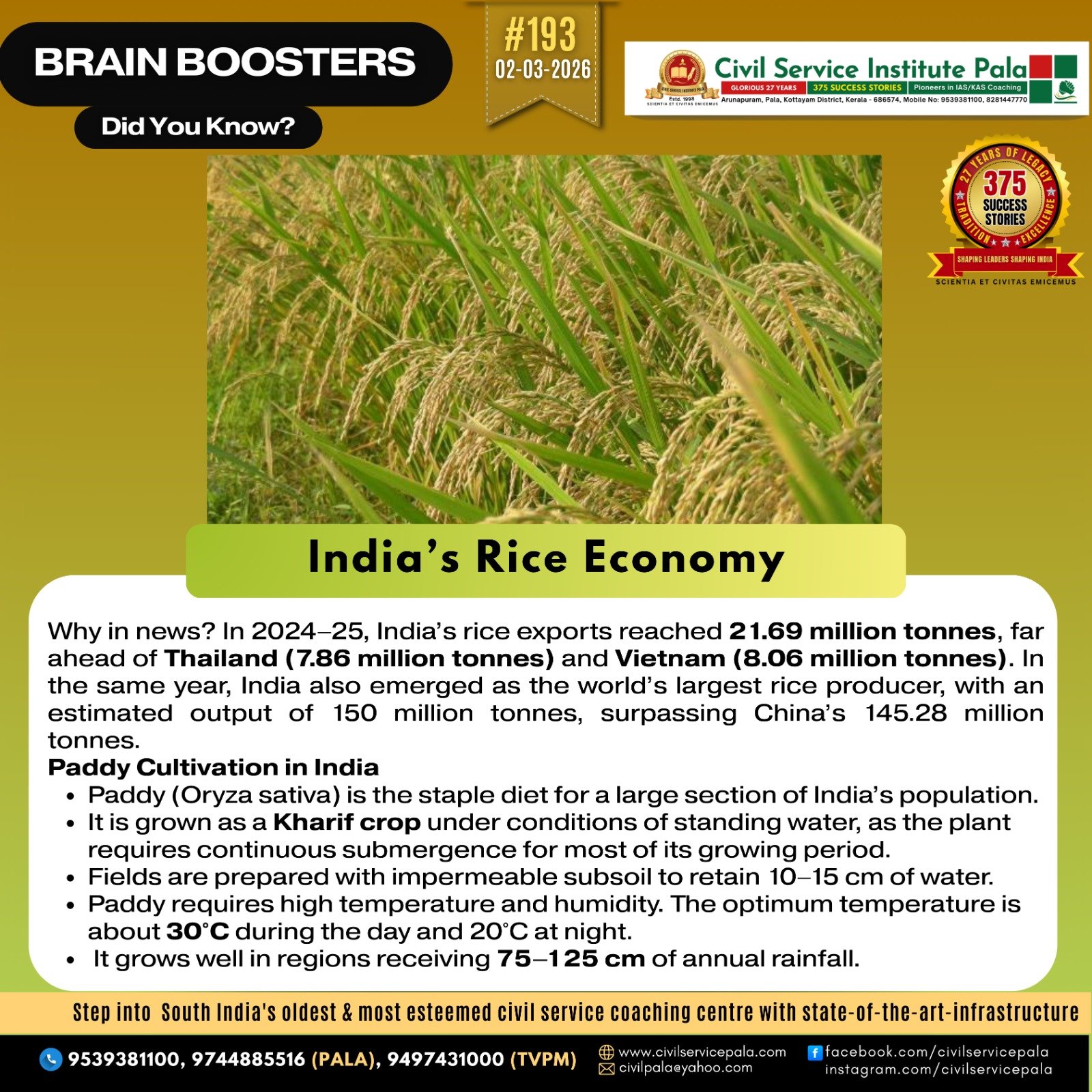
India’s Rice Economy
In 2024–25, India’s rice exports reached 21.69 million tonnes, far ahead of Thailand (7.86 million tonnes) and Vietnam (8.06 million tonnes). In the same year, India also emerged as the world’s largest rice producer, with an estimated output of 150 million tonnes, surpassing China’s 145.28 million tonnes.
India has been the world’s largest rice exporter continuously since 2011–12.
While this reflects India’s strong agricultural base, it also raises concerns about the sustainability of water-intensive paddy cultivation, especially in ecologically stressed regions.
Paddy Cultivation
Paddy (Oryza sativa) is a major food crop and the staple diet for a large section of India’s population. It is mainly grown as a Kharif crop under conditions of standing water, as the plant requires continuous submergence for most of its growing period. Fields are prepared with impermeable subsoil and surrounded by earthen bunds to retain 10–15 cm of water.
Paddy requires high temperature and humidity. The optimum temperature is about 30°C during the day and 20°C at night. It grows well in regions receiving 75–125 cm of annual rainfall or where irrigation facilities are available. Bright sunshine with relatively lower temperatures during the ripening stage improves grain quality and yield.
The crop grows best in fertile soils with good water-holding capacity and a pH range of 5.5 to 6.5.
In India, paddy is widely cultivated in eastern, southern and northeastern states. In northwestern states such as Haryana, Uttarakhand, Uttar Pradesh, Gujarat, Rajasthan and Maharashtra, only one Kharif crop is grown because winter temperatures are too low for paddy cultivation.
Although paddy is widely cultivated across India, the concentration of irrigated rice in northwestern states has intensified pressure on groundwater resources.
Challenge
• Rice cultivation is highly water-intensive, as paddy fields are kept submerged (around 5 cm water level) to control weeds, requiring nearly 20–30 irrigations per crop cycle.
• A typical crop may consume about 5 million litres of water per acre.
• On average, producing 1 kg of rice requires nearly 3,000 litres of water.
• Therefore, rice exports also imply indirect export of large quantities of water, which is a concern for groundwater-stressed states like Punjab and Haryana.
Emerging Shift Towards High-Value and Relatively Sustainable Rice Exports
Basmati rice offers a more sustainable pathway for maintaining India’s leadership in global rice exports. It fetches significantly higher export earnings per kilogram and is transplanted during the monsoon in July, reducing irrigation stress compared to non-basmati varieties grown in peak summer. Its grain development occurs in cooler October temperatures, which enhances the formation of 2-acetyl-1-pyrroline, the compound responsible for its characteristic aroma, thereby improving export quality naturally.
In addition to basmati, there is increasing emphasis on promoting short-grain aromatic GI-protected varieties such as Kalanamak and Adamchini (eastern Uttar Pradesh), Katarni (Bihar), Gobindobhog (West Bengal), Badshah Bhog (Chhattisgarh), Koraput Kalajeera (Odisha), Wayanad Jeerakasala and Gandhakasala (Kerala), and Seeraga Samba (Tamil Nadu). Moving from bulk commodity rice exports to high-value aromatic rice exports can help enhance foreign exchange earnings while reducing pressure on groundwater resources.
