



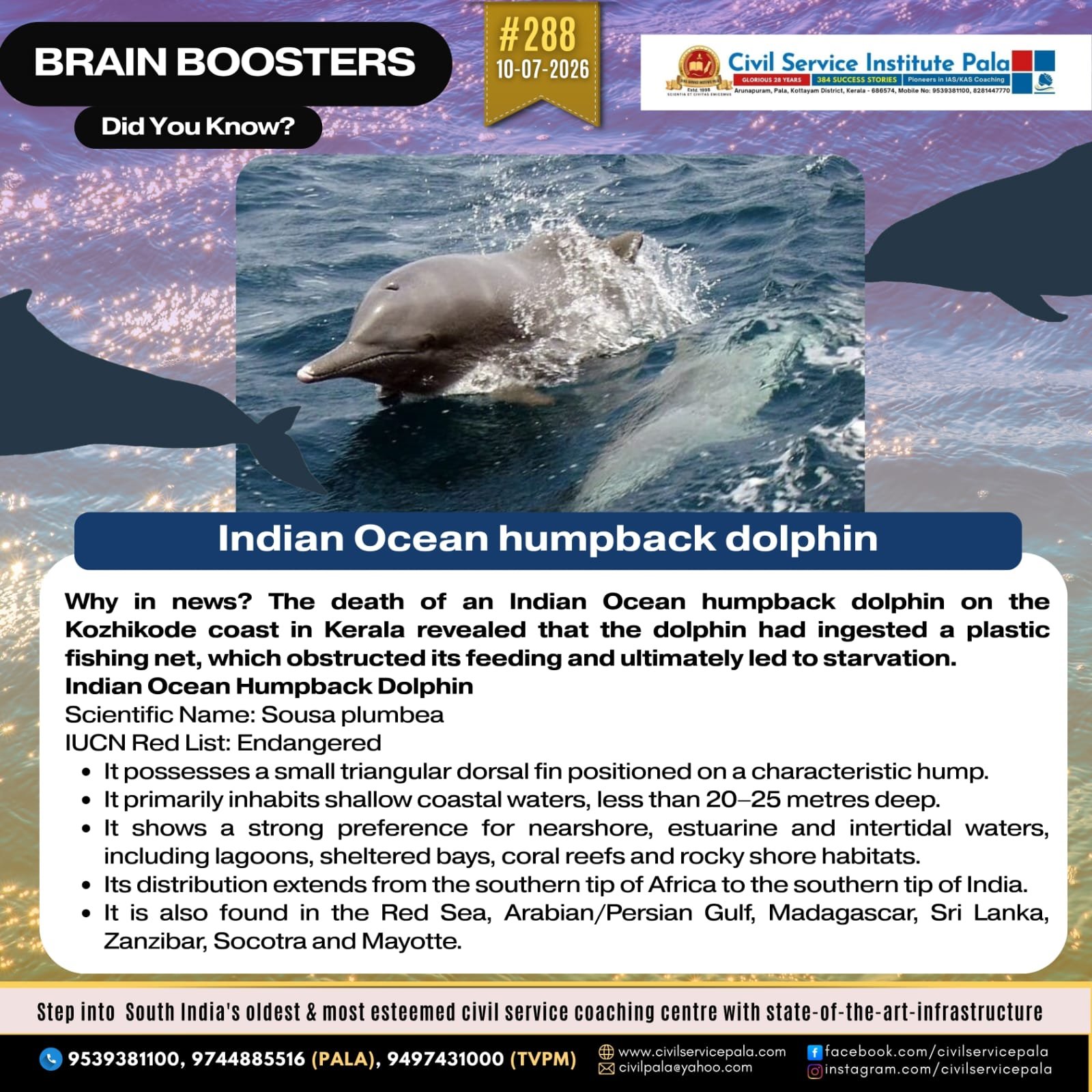
Indian Ocean humpback dolphin
Why in news? The death of an Indian Ocean humpback dolphin on the Kozhikode coast in Kerala revealed that the dolphin had ingested a plastic fishing net, which obstructed its feeding and ultimately led to starvation.
Indian Ocean Humpback Dolphin
Scientific Name: Sousa plumbea
IUCN Red List: Endangered
• It possesses a small triangular dorsal fin positioned on a characteristic hump.
• It primarily inhabits shallow coastal waters, less than 20–25 metres deep.
• It shows a strong preference for nearshore, estuarine and intertidal waters, including lagoons, sheltered bays, coral reefs and rocky shore habitats.
• Its distribution extends from the southern tip of Africa to the southern tip of India.
• It is also found in the Red Sea, Arabian/Persian Gulf, Madagascar, Sri Lanka, Zanzibar, Socotra and Mayotte.
Key Characteristics
Distinctive Appearance
• The species possesses a small triangular dorsal fin positioned on a characteristic hump, giving rise to the name "humpback dolphin."
• Individuals are mostly grey in colour, reflecting the Latin species name "plumbea," meaning "lead."
Habitat Preference
• The species primarily inhabits shallow coastal waters, generally less than 20–25 metres deep.
• It shows a strong preference for nearshore, estuarine and intertidal waters, including lagoons, sheltered bays, coral reefs and rocky shore habitats.
• It is commonly found only a few kilometres from the shoreline, bringing it into frequent contact with human activities.
Geographical Distribution
• Its range extends from the southern tip of Africa to the southern tip of India.
• The species is also found in the Red Sea, Arabian/Persian Gulf, Madagascar, Sri Lanka, Zanzibar, Socotra and Mayotte.
• Along the Indian coast, humpback dolphins occur in shallow coastal waters of all maritime States, although populations on the east coast are more discontinuously distributed than those on the west coast.
Feeding Behaviour
• Indian Ocean humpback dolphins are opportunistic feeders, feeding on a variety of available fish species.
• Their preferred prey includes mackerel, mullet and sardines.
Behaviour
• The species belongs to the cetaceans (whales and dolphins), which are known for their advanced cognitive abilities, complex social structures and strong analytical behaviour.
• They exhibit a high degree of site fidelity, frequently returning to previously occupied habitats.
Major Threats
Plastic Pollution
• Dolphins may accidentally ingest plastic while feeding or mistake floating plastic for prey.
• Plastic ingestion can cause digestive blockages, starvation and eventually death.
Ghost Nets
• Abandoned, lost or discarded fishing gear continues trapping marine animals for years.
• Entanglement can restrict movement and breathing, cause severe injuries, starvation or drowning.
Fishing Gear Interaction
• The species frequently encounters fishing nets because it inhabits shallow coastal waters where fishing activity is intense.
Human-induced Coastal Pressure
• Coastal development, marine pollution and increasing human activities have emerged as major drivers of population decline.
Unethical Tourism
• Researchers have also identified irresponsible tourism practices as an emerging threat to the species.
Conservation Concerns
• The species was recognised as a distinct species only in 2014.
• Populations are generally small, localised and declining across much of their range.
• Significant knowledge gaps remain regarding their ecology, distribution and population status.
• In 2024, researchers established the Indian Ocean Humpback Dolphin Conservation Network (HuDoNet) to strengthen research and conservation efforts across the species' range.
Why is the Species Highly Vulnerable?
• It spends most of its life in shallow coastal waters where human activities are concentrated.
• Small and fragmented populations have limited capacity to recover from additional mortality.
• Persistent threats such as plastic pollution, ghost nets and fishing gear interactions continue to exert pressure on already declining populations.
