



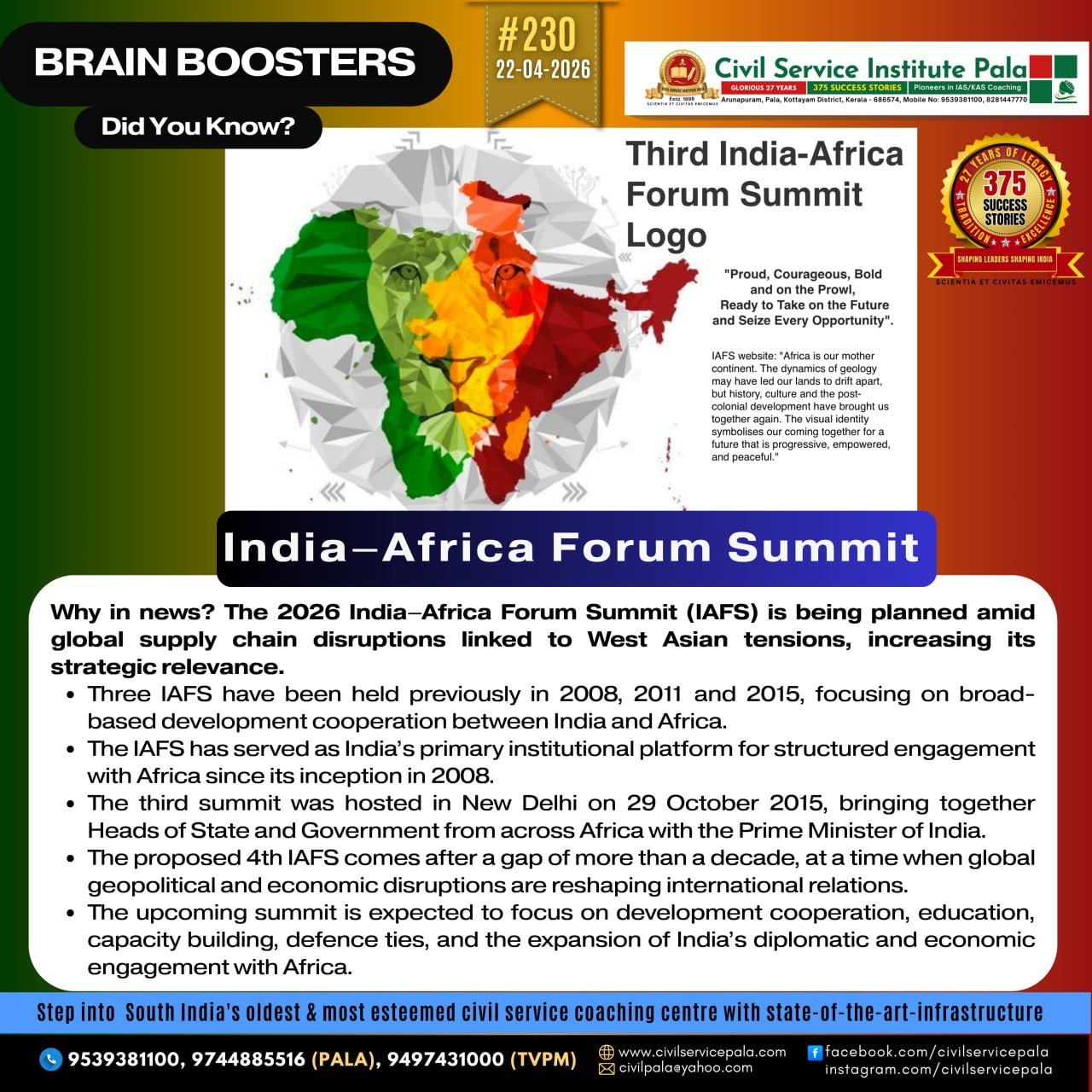
India–Africa Forum Summit
India–Africa Forum Summit Why in news? The 2026 India–Africa Forum Summit (IAFS) is being planned amid global supply chain disruptions linked to West Asian tensions, increasing its strategic relevance.
• Three IAFS have been held previously in 2008, 2011 and 2015, focusing on broad-based development cooperation between India and Africa.
• The IAFS has served as India’s primary institutional platform for structured engagement with Africa since its inception in 2008.
• The third summit was hosted in New Delhi on 29 October 2015, bringing together Heads of State and Government from across Africa along with the Prime Minister of India.
• The proposed 4th IAFS comes after a gap of more than a decade, at a time when global geopolitical and economic disruptions are reshaping international relations.
• The upcoming summit is expected to focus on development cooperation, education, capacity building, defence ties, and the expansion of India’s diplomatic and economic engagement with Africa.
Present Challenges
• Recent global crises such as the COVID-19 pandemic and the Russia–Ukraine War have exposed structural vulnerabilities in supply chains, energy security, and global governance systems.
• India remains highly dependent on West Asia for energy, with nearly 50% of crude oil and about 70% of LNG imports passing through the Strait of Hormuz, making it vulnerable to geopolitical disruptions.
• India’s economic exposure is further deepened by its reliance on fertiliser imports and remittances from nearly 10 million Indians working in the Gulf region.
• African economies are facing rising fuel prices, inflationary pressures, and increasing debt burdens, while infrastructural limitations constrain their ability to fully benefit from favourable commodity cycles.
Strategic Developments & Opportunities
• India has expanded its diplomatic footprint by opening 16 new missions since 2018, now covering 45 African countries, reflecting a renewed strategic focus on the continent.
• Initiatives such as the IIT Madras campus in Zanzibar highlight India’s emphasis on education, skill development, and capacity building in Africa.
• Platforms like the Voice of Global South Summit (VOGSS) complement India–Africa engagement, although they do not substitute the need for a dedicated institutional mechanism like IAFS.
• Africa offers India a viable alternative for energy and resource diversification, helping reduce dependence on volatile West Asian supply routes.
• Africa’s geographical position ensures relatively stable maritime trade routes, with alternatives such as the Cape of Good Hope providing continuity during disruptions.
• Enhanced cooperation in fertilisers and agriculture can strengthen India’s food security while supporting industrial and agricultural growth in Africa.
• Cluster-based industrial partnerships and integrated supply chains can improve resilience and promote diversification of global value chains.
Policy Initiatives
• India has supported the inclusion of the African Union in the G20, strengthening Africa’s voice in global governance.
• India’s engagement includes Lines of Credit, capacity-building programmes, and development partnerships aimed at long-term cooperation.
• There is an increasing policy emphasis on promoting Foreign Direct Investment (FDI), infrastructure development, and technology transfer to align with evolving African expectations.
Way Forward
• The 4th IAFS should move beyond symbolic diplomacy towards implementation-focused and outcome-oriented partnerships.
• India needs to improve execution rates and align its investments with Africa’s growing demand for large-scale infrastructure and industrial development.
• Strengthening institutional platforms like IAFS is essential for ensuring consistent and structured engagement in a rapidly evolving global order.
• The summit provides an opportunity for India and Africa to jointly shape a new leadership model for the Global South amid weakening multilateral institutions.
