



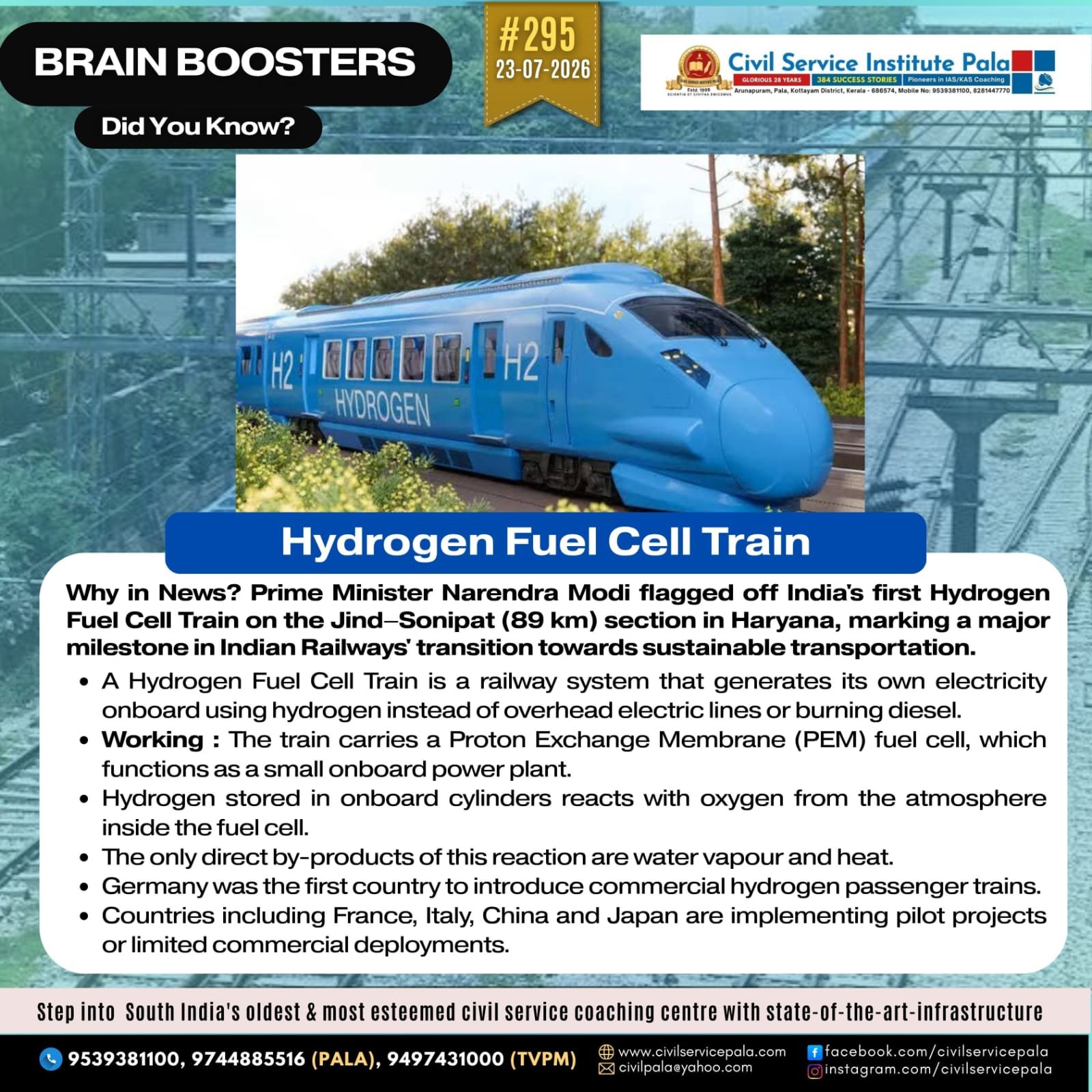
Hydrogen-Powered Trains
Hydrogen-Powered Trains
Why in News? Prime Minister Narendra Modi flagged off India's first Hydrogen Fuel Cell Train on the Jind–Sonipat (89 km) section in Haryana, marking an important milestone in Indian Railways' transition towards cleaner and more sustainable modes of transport.
What is a Hydrogen Fuel Cell Train?
• A hydrogen-powered train generates its own electricity onboard instead of drawing power from overhead electric lines.
• It produces electricity through an electrochemical reaction between hydrogen and oxygen inside a Proton Exchange Membrane (PEM) fuel cell.
• The electricity generated powers the train's traction motors, while the only direct by-products of the reaction are water vapour and heat, making the system free from tailpipe carbon emissions.
• Unlike diesel locomotives, hydrogen fuel cell trains do not burn fuel through combustion, resulting in quieter and cleaner operation.
How does the train work?
• Hydrogen is stored onboard in high-pressure cylinders and is supplied to the PEM fuel cell.
• Inside the fuel cell, hydrogen reacts with oxygen drawn from the surrounding air to generate electricity.
• The electricity powers the traction motors that drive the wheels, while Lithium Iron Phosphate (LFP) batteries store surplus energy and supply additional power whenever required.
• India's first hydrogen train consists of two Hydrogen Driving Power Cars (DPCs) and eight Trailer Coaches.
• Each Driving Power Car generates 1,200 kW (1,600 hp) of power, providing sufficient traction for the entire train to attain a design speed of 110 km/h, although it currently operates at 75 km/h on the Jind–Sonipat section.
• The ten-coach train has the capacity to carry approximately 2,600 passengers.
How is hydrogen supplied to the train?
• A dedicated hydrogen production and refuelling facility has been established at Jind to support regular train operations.
• Hydrogen is produced on-site through electrolysis, in which electricity is used to split water into hydrogen and oxygen.
• The hydrogen is then compressed to 500 bar for efficient storage before being dispensed into the train at 350 bar through specialised refuelling stations.
• The facility can store nearly 3,000 kg of hydrogen, enabling uninterrupted operation of the train service.
• The entire hydrogen storage and dispensing system has been approved by the Petroleum and Explosives Safety Organisation (PESO).
How is safety ensured?
• Since hydrogen is highly inflammable, the entire system has been designed with multiple layers of safety.
• The train and refuelling facility are equipped with continuous hydrogen leak detectors, flame detectors, smoke detectors and temperature monitoring systems.
• Continuous ventilation prevents leaked hydrogen, if any, from accumulating by rapidly dispersing it into the atmosphere.
• Automatic shutdown mechanisms immediately isolate the hydrogen supply whenever an abnormal condition is detected.
• The locomotive pilot is provided with a dedicated monitoring system that continuously displays the operational status of the train and supports emergency operation whenever required.
• The complete hydrogen train system underwent an independent safety assessment by TÜV SÜD (Germany) before commissioning.
Institutional support
• The Research Designs and Standards Organisation (RDSO) formulated the technical specifications and led the design approval process for the project.
• Medha Servo Drives integrated the hydrogen trainset, while the Integral Coach Factory (ICF) developed its theme and exterior design.
Global status of Hydrogen Trains
• Hydrogen-powered trains remain at an early stage of commercial deployment worldwide.
• Germany became the first country to introduce commercial hydrogen passenger trains.
• Countries such as France, Italy, China and Japan are currently operating pilot projects or limited hydrogen train services.
• Most hydrogen trains operating globally are relatively small regional trains comprising only two to four coaches.
Future prospects in India
• Indian Railways plans to extend hydrogen-powered train technology to selected heritage railways, including the Kalka–Shimla Railway.
• The experience gained from the Jind–Sonipat project will support the development of a broader national programme for hydrogen-powered rolling stock.
• The initiative contributes to the objectives of the National Green Hydrogen Mission and India's long-term Net Zero emissions targets.
