



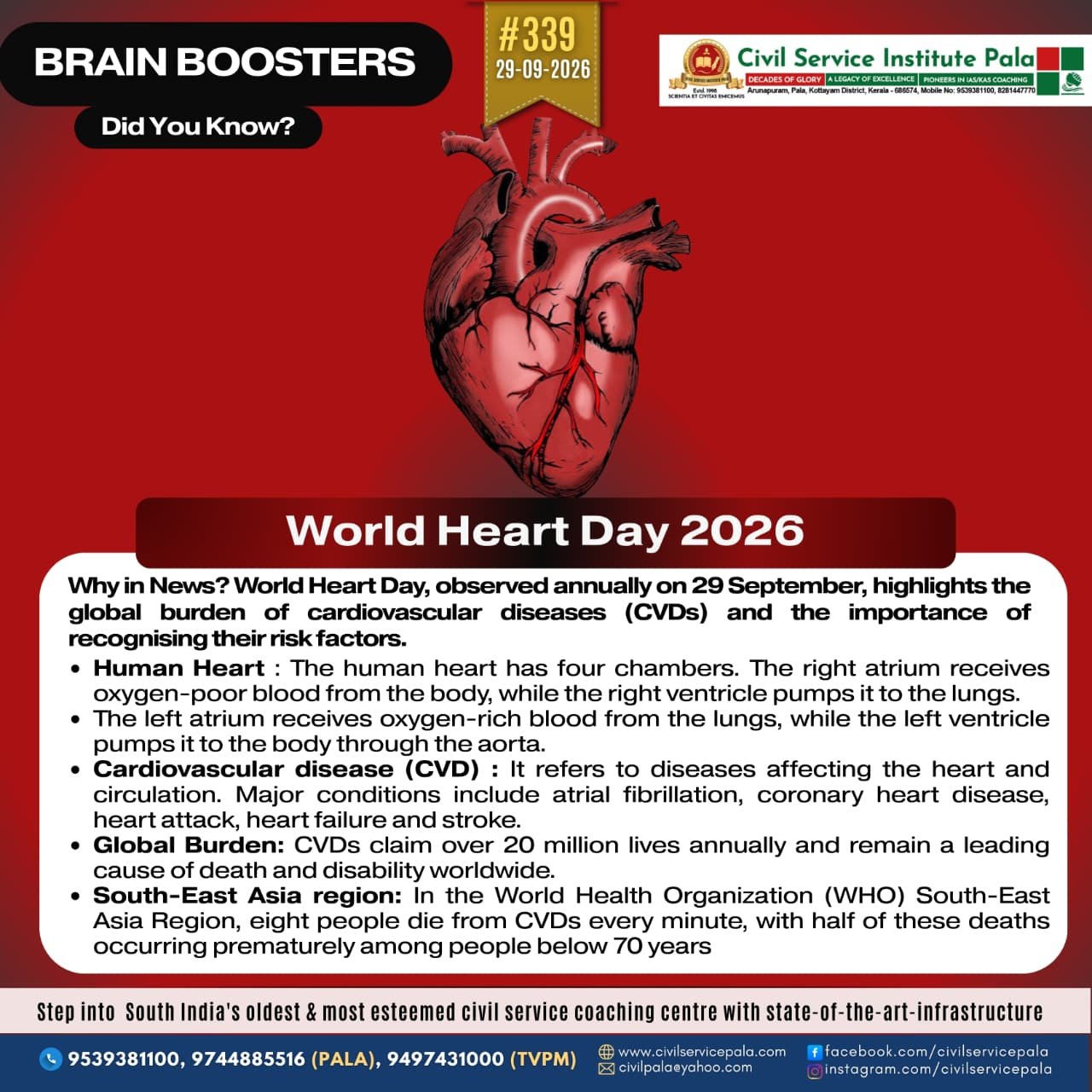
Human Heart and Cardiovascular Health: World Heart Day 2026
Human Heart and Cardiovascular Health: World Heart Day 2026
Why in News?
World Heart Day 2026 highlights the global burden of cardiovascular diseases (CVDs) and the importance of recognising risk factors, preventing disease and strengthening heart care.
Cardiovascular Disease Burden
• Global burden: Cardiovascular diseases claim over 20 million lives annually and remain a leading cause of death and disability worldwide.
• South-East Asia: In the World Health Organization (WHO) South-East Asia Region, eight people die from CVDs every minute, with half of these deaths occurring prematurely among people below 70 years.
Heart: Structure and Function
• Location: The heart lies in the front of the chest, behind and slightly to the left of the breastbone, between the lungs. The left lung is slightly smaller to accommodate the heart, while the ribcage provides protection.
• Walls: The heart wall has three layers — endocardium, the inner layer; myocardium, the muscular middle layer; and epicardium, the protective outer layer. A muscular septum separates the right and left sides.
• Chambers: The heart has four chambers. The right atrium receives oxygen-poor blood from the body, while the right ventricle pumps it to the lungs. The left atrium receives oxygen-rich blood from the lungs, while the left ventricle pumps it to the body through the aorta.
Valves and Blood Flow
• The heart has four valves: tricuspid, mitral, aortic and pulmonic. They open and close during each heartbeat to maintain one-way blood flow.
• Arteries carry blood away from the heart, veins return blood to the heart, and capillaries connect them and allow the exchange of oxygen, nutrients and waste products with tissues.
• The heart itself receives oxygen-rich blood through the coronary arteries rather than directly from the blood passing through its chambers.
Electrical Conduction
• Sinoatrial (SA) node: Located in the right atrium, it acts as the heart’s natural pacemaker and initiates the electrical impulse that sets the heartbeat.
• Atrioventricular (AV) node: Located between the atria and ventricles, it slows the electrical signal before it reaches the ventricles, allowing the atria to contract first.
• His-Purkinje network: It carries the electrical impulse through the ventricular walls, causing the ventricles to contract and pump blood to the lungs and body.
Cardiovascular Diseases
Cardiovascular disease refers to diseases affecting the heart and circulation. Major conditions include atrial fibrillation, coronary heart disease, heart attack, heart failure and stroke.
• Atrial fibrillation: An irregular heartbeat condition associated with one in three strokes.
• Coronary heart disease: Narrowing or blockage of the coronary arteries restricts oxygen-rich blood reaching the heart.
• Heart attack: Occurs when a blocked artery deprives the heart of oxygen.
• Heart failure: Occurs when the heart cannot pump blood and oxygen around the body as effectively as it should.
• Stroke: Occurs when the blood supply to the brain is suddenly interrupted, such as by a blood clot blocking an artery.
Atherosclerosis
Atherosclerosis is a major underlying cause of CVD. Fat, cholesterol, calcium and other substances accumulate as plaques on artery walls. These plaques can harden and narrow the arteries, restricting blood flow. If a plaque breaks, it can form a thrombus, which may further restrict or block blood flow.
Major Risk Factors
The major risk factors highlighted for CVD include hypertension, diabetes, tobacco use, alcohol consumption, unhealthy diets high in salt and fats, and physical inactivity.
• In the WHO South-East Asia Region, as many as 85% of people living with hypertension and diabetes do not have their conditions under control.
• Ageing populations and increasing urbanisation are increasing vulnerability and placing additional pressure on resource-constrained health systems.
Regional Response
• As of June 2025, public health facilities in the region were providing protocol-based management to more than 90 million people with hypertension and diabetes.
• Legislation protecting more than 1.7 billion people from industrially produced trans-fatty acids had been enacted across the region.
• More than 103 million people were covered by at least three WHO MPOWER tobacco-control measures.
