



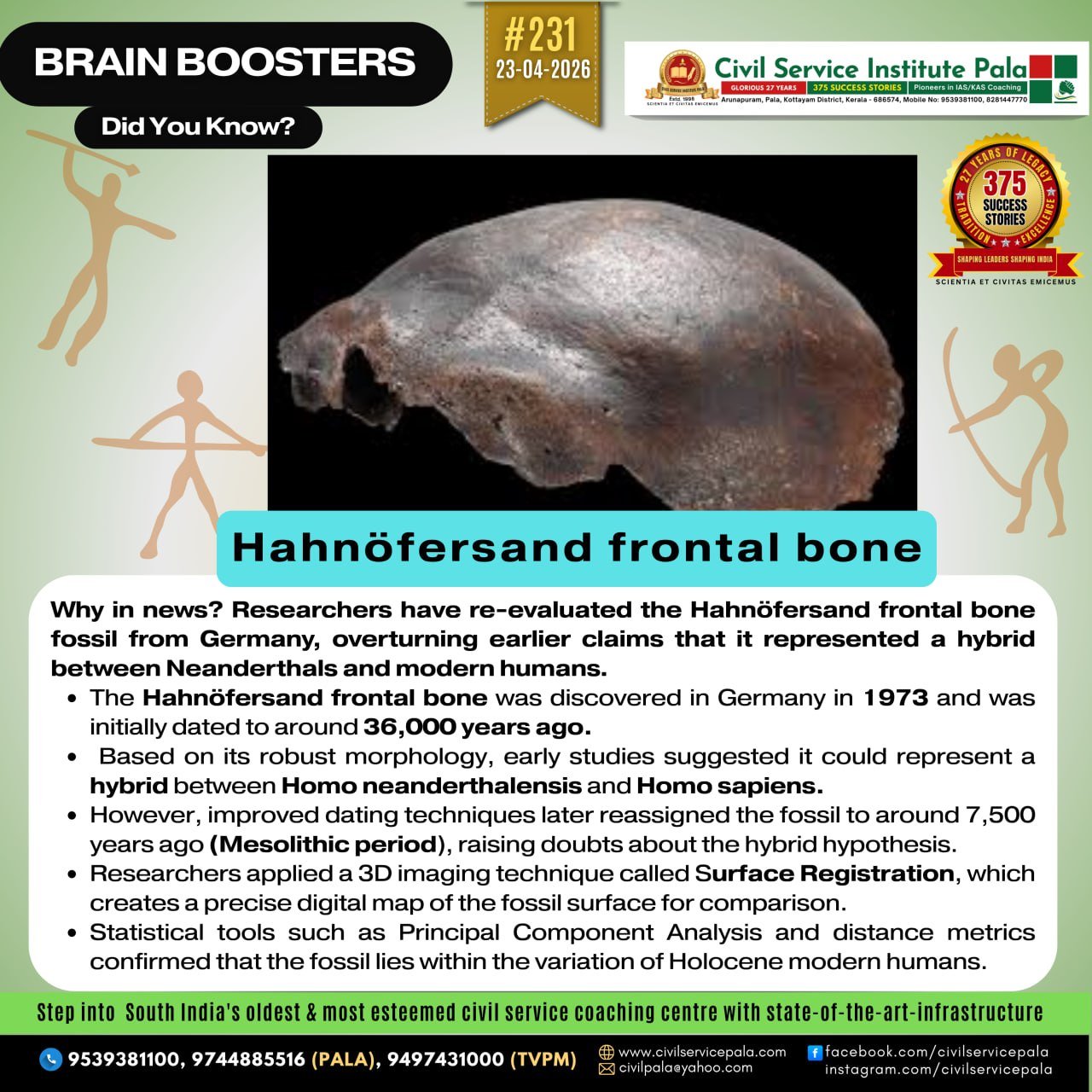
Hahnöfersand frontal bone
Hahnöfersand frontal bone
Why in News?
* Researchers have re-evaluated the Hahnöfersand frontal bone fossil from Germany, overturning earlier claims that it represented a hybrid between Neanderthals and modern humans.
* Advanced 3D analytical techniques have now reclassified the specimen as belonging to a modern human, refining our understanding of human evolution.
Background
* The Hahnöfersand frontal bone was discovered in Germany in 1973 and was initially dated to around 36,000 years ago.
* Based on its robust morphology, early studies suggested it could represent a hybrid between Homo neanderthalensis and Homo sapiens.
* However, improved dating techniques later reassigned the fossil to around 7,500 years ago (Mesolithic period), raising doubts about the hybrid hypothesis.
Findings
* Researchers applied a 3D imaging technique called Surface Registration, which creates a precise digital map of the fossil surface for comparison.
* The fossil was analysed against datasets of Neanderthals, Middle Pleistocene European hominins, and modern humans.
* Statistical tools such as Principal Component Analysis, Mahalanobis distances, and pairwise Procrustes distance metrics confirmed that the fossil lies within the variation of Holocene modern humans.
* No evidence of intermediate or hybrid morphology was found.
* The earlier “hybrid” classification was attributed to subjective visual interpretation and incorrect fragment orientation.
Conclusion of the Study
* The Hahnöfersand specimen is conclusively identified as a modern human fossil, not a Neanderthal–human hybrid.
* The study highlights the importance of advanced quantitative methods over traditional qualitative assessments in paleoanthropology.
* Surface registration has proved to be a reliable technique for analysing fragmentary fossils and improving taxonomic accuracy.
Neanderthals
* Homo neanderthalensis lived in western Eurasia from about 400,000 to 40,000 years ago.
* Genetic evidence shows interbreeding with modern humans, with 1–4% Neanderthal DNA present in non-African populations today.
* Some inherited genes aided adaptation (climate, immunity), while others had negative effects.
Similarities Between Neanderthals and Modern Humans
* Both had large brain sizes, with overlapping cranial capacity.
* Genetic interaction through interbreeding indicates biological compatibility.
* Both exhibited cultural and adaptive behaviours suited to their environments.
Key Differences
Cranial Features
* Neanderthals had elongated, low skulls, unlike the rounded skulls of modern humans.
* Presence of occipital bun and supraorbital ridge (brow ridge) in Neanderthals.
* Mid-facial prognathism (projecting face) in Neanderthals vs flatter modern human face.
* Absence of chin and presence of retromolar gap in Neanderthals.
Dentition
* Neanderthals had taurodont molars (large pulp cavity) and shovel-shaped incisors.
* Faster dental development compared to modern humans.
Post-cranial Features
* Stockier build, shorter limbs, and broader joints in Neanderthals.
* Barrel-shaped chest and wider pelvis, possibly adapted to cold climates
