



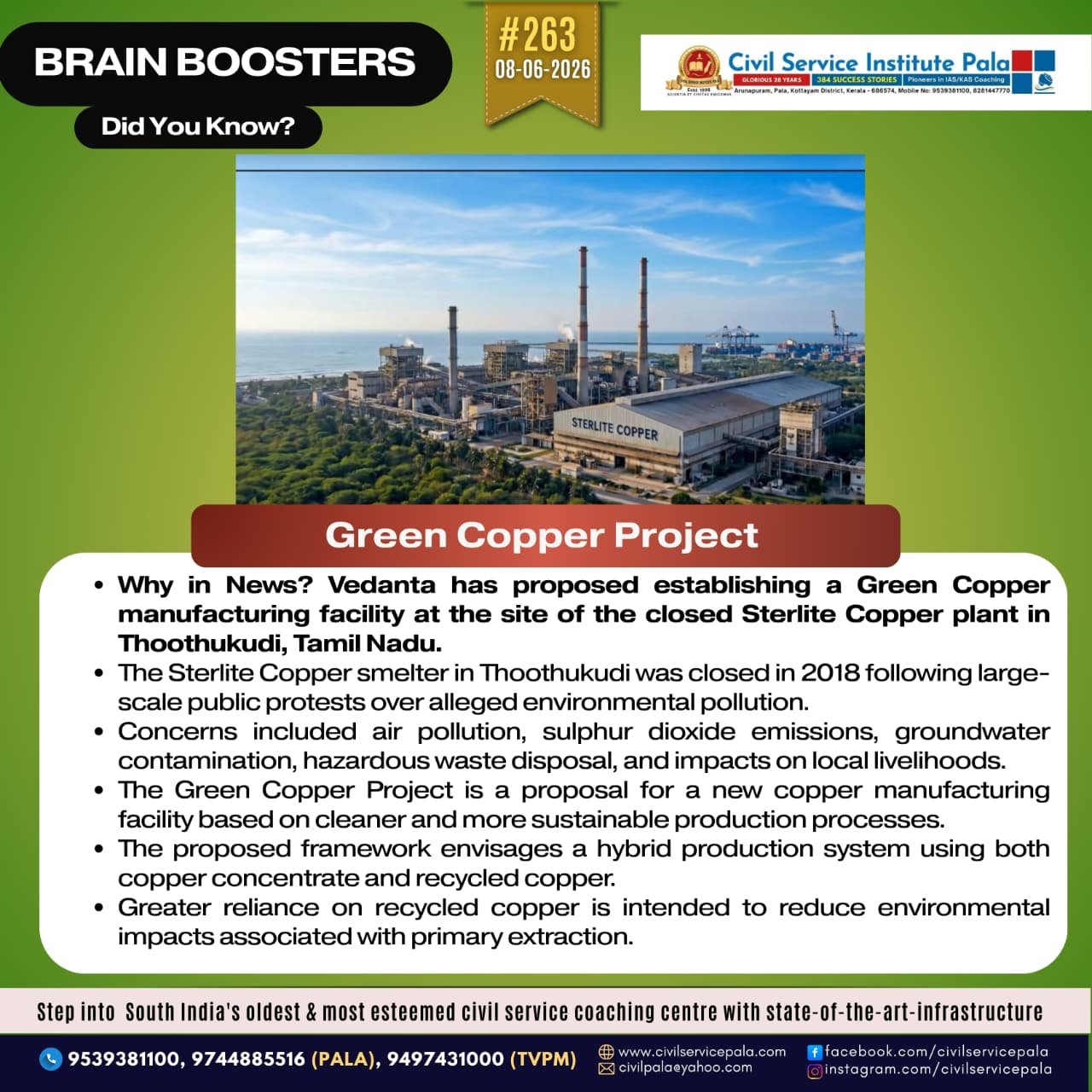
Green Copper Project (Thoothukudi, Tamil Nadu)
Green Copper Project (Thoothukudi, Tamil Nadu)
Why in News?
Vedanta has proposed establishing a Green Copper manufacturing facility at the site of the closed Sterlite Copper plant in Thoothukudi, Tamil Nadu.
The proposal has triggered a renewed debate on balancing industrial development, strategic mineral security, employment generation, and environmental protection.
Background: Sterlite Copper Controversy
The Sterlite Copper smelter in Thoothukudi was closed in 2018 following large-scale public protests over alleged environmental pollution.
The closure followed action by the Tamil Nadu Pollution Control Board (TNPCB) and was subsequently upheld by the courts.
Environmental concerns included air pollution, sulphur dioxide emissions, groundwater contamination, hazardous waste disposal, and impacts on local livelihoods.
The protests culminated in police firing in 2018, making the issue one of India's most significant environmental justice movements.
What is the Green Copper Project?
The Green Copper Project is a proposal for a new copper manufacturing facility based on cleaner and more sustainable production processes.
The proposal claims to be distinct from the earlier smelter and is presented as an environmentally improved model.
The project seeks to combine industrial growth with stronger environmental safeguards and community oversight.
Key Features of the Proposed Green Copper Framework
Cleaner Production Model
The proposed framework envisages a hybrid production system using both copper concentrate and recycled copper.
Greater reliance on recycled copper is intended to reduce environmental impacts associated with primary extraction.
Environmental Safeguards
The project proposes a zero-liquid-discharge system to minimise water pollution.
It plans to improve sulphur dioxide emission controls compared to earlier operations.
Greater water recycling and use of desalinated seawater have been proposed.
The proposal includes shutting down the phosphoric acid unit associated with gypsum waste generation.
Community Participation : A Local Management Committee (LMC) has been proposed to institutionalise community participation in project oversight.
Social Responsibility : The proposal includes a dedicated Corporate Social Responsibility (CSR) commitment for regional development.
Economic Significance of Copper
Copper is a strategic metal critical for energy transition and industrial development.
It is an essential input for electric vehicles, renewable energy systems, transmission infrastructure, electronics, and manufacturing.
Secure domestic copper production is important for India's clean energy and manufacturing ambitions.
Impact of Sterlite Closure
The Sterlite plant earlier accounted for a significant share of India's refined copper production.
Following the closure, India shifted from being a net exporter to a net importer of refined copper.
The closure affected downstream industries, MSMEs, logistics networks, and port-related economic activity.
Thousands of direct and indirect livelihoods were affected in the Thoothukudi region.
Analytical Insight
The Green Copper debate reflects the broader challenge of pursuing green industrialization in India.
Sustainable industrial projects increasingly require not only technological improvements but also social legitimacy, environmental accountability, and community participation.
The long-term success of such projects depends on building trust through transparent governance and rigorous environmental safeguards.
