



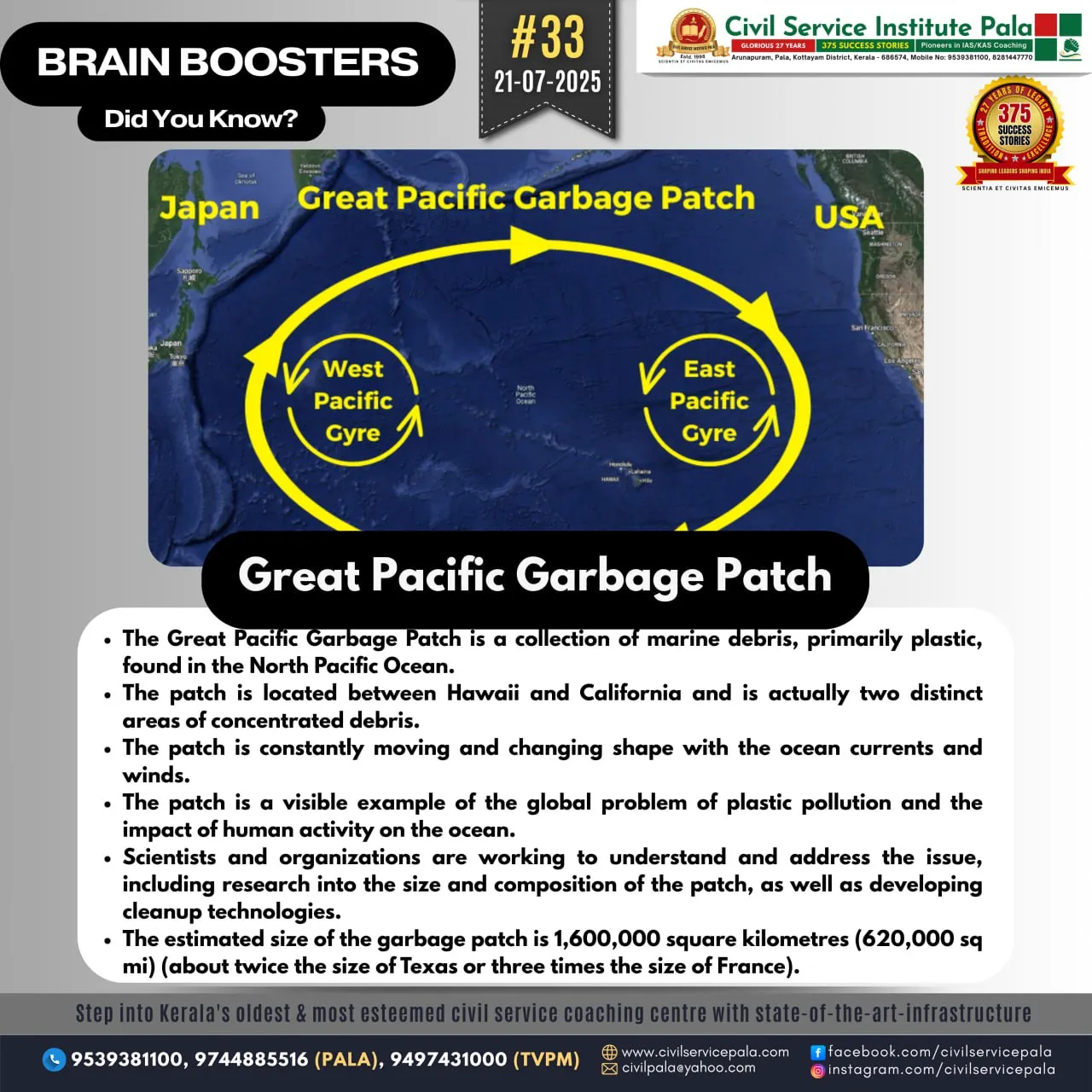
Great Pacific Garbage Patch (GPGP)
The Great Pacific Garbage Patch (GPGP) is a massive area in the North Pacific Ocean where marine debris, primarily plastic, accumulates due to ocean currents. It is one of the most significant symbols of marine pollution.
Location:
Situated between Hawaii and California, within the North Pacific Subtropical Gyre.
Not a solid island of trash but a diffuse, soup-like region with millions of microplastics and some larger floating debris.
Formation:
Ocean currents, called gyres, trap floating plastic and debris from rivers, ships, fishing industries, and coastal litter.
The North Pacific Gyre circulates clockwise, drawing debris into the center over time.
Size:
Estimated to cover 1.6 million square kilometers—twice the size of Texas.
Contains over 1.8 trillion pieces of plastic, weighing around 80,000 metric tons.
Composition:
Around 94% of the debris is microplastic (tiny plastic fragments).
The remaining includes larger items like fishing nets (ghost nets), containers, bottles, and household items.
Environmental Impact:
Marine animals ingest or get entangled in plastics, causing injury or death.
Microplastics enter the food chain, affecting marine life and potentially humans.
Coral reefs and ecosystems are disrupted by the debris.
Cleanup Efforts:
Organizations like The Ocean Cleanup are developing technologies to remove debris.
Solutions include barrier systems, recycling initiatives, and reducing plastic use globally.
Key Takeaway:
The Great Pacific Garbage Patch is a result of human plastic pollution combined with ocean currents. Addressing it requires global cooperation, innovation, and reducing plastic dependency to protect marine ecosystems.Source: https://www.nature.com/articles/s41598-025-00619-w
