



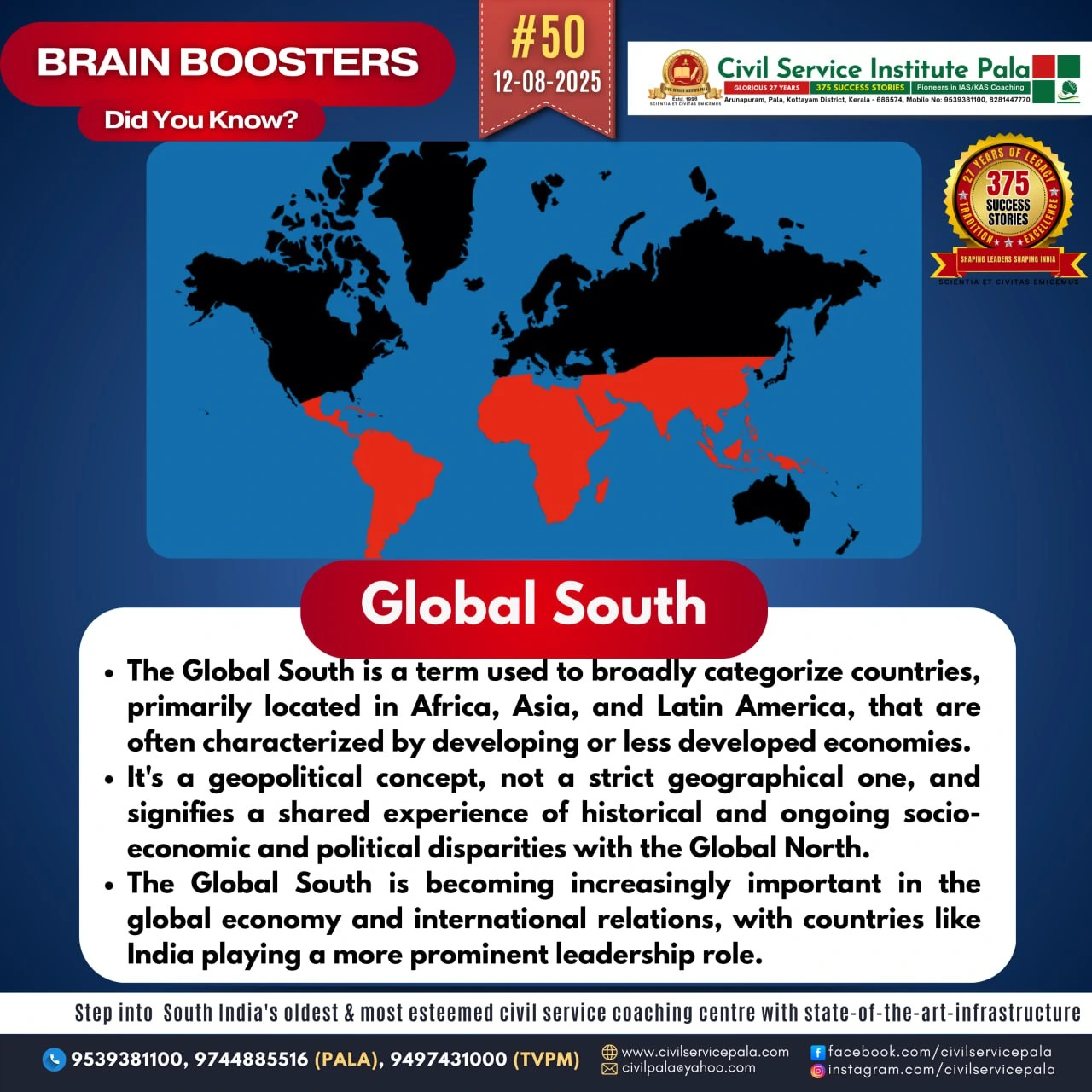
Global South
The “Global South” is a political and economic term used to broadly describe countries that are generally less economically developed, located primarily in Africa, Latin America, the Caribbean, Asia, and Oceania.
It’s not purely a geographic term—in fact, some “Global South” countries are in the northern hemisphere (like India or China), while some in the southern hemisphere (like Australia) are not part of it. Origins and Evolution
Cold War roots: It evolved from earlier classifications like the “Third World” (non-aligned or developing countries) and “developing world”.
It became popular as a way to avoid the colonial connotations of terms like “Third World.”
Symbolically, “south” refers to countries historically subjected to colonialism, economic exploitation, and marginalization in the global order. Key Characteristics
Economic status: Often lower income, emerging economies, or developing countries.
Historical context: Many were formerly colonized and continue to face structural inequalities in trade, technology access, and global governance.
Political stance: Often advocate for reforms in international institutions (e.g., UN, World Bank, IMF) to reflect more equitable global power-sharing.
Solidarity: Shared platforms like the G77, BRICS, and the Non-Aligned Movement champion their interests. Current Relevance
The Global South is increasingly assertive in climate negotiations, trade talks, and geopolitical discussions.
Rising economies like India, Brazil, Indonesia, and South Africa are key voices.
The term emphasizes shared challenges like poverty reduction, climate adaptation, and equitable access to resources.
Source:https://www.thehindu.com/news/international/global-south-from-the-margins-to-the-centre/article69805276.ece
