



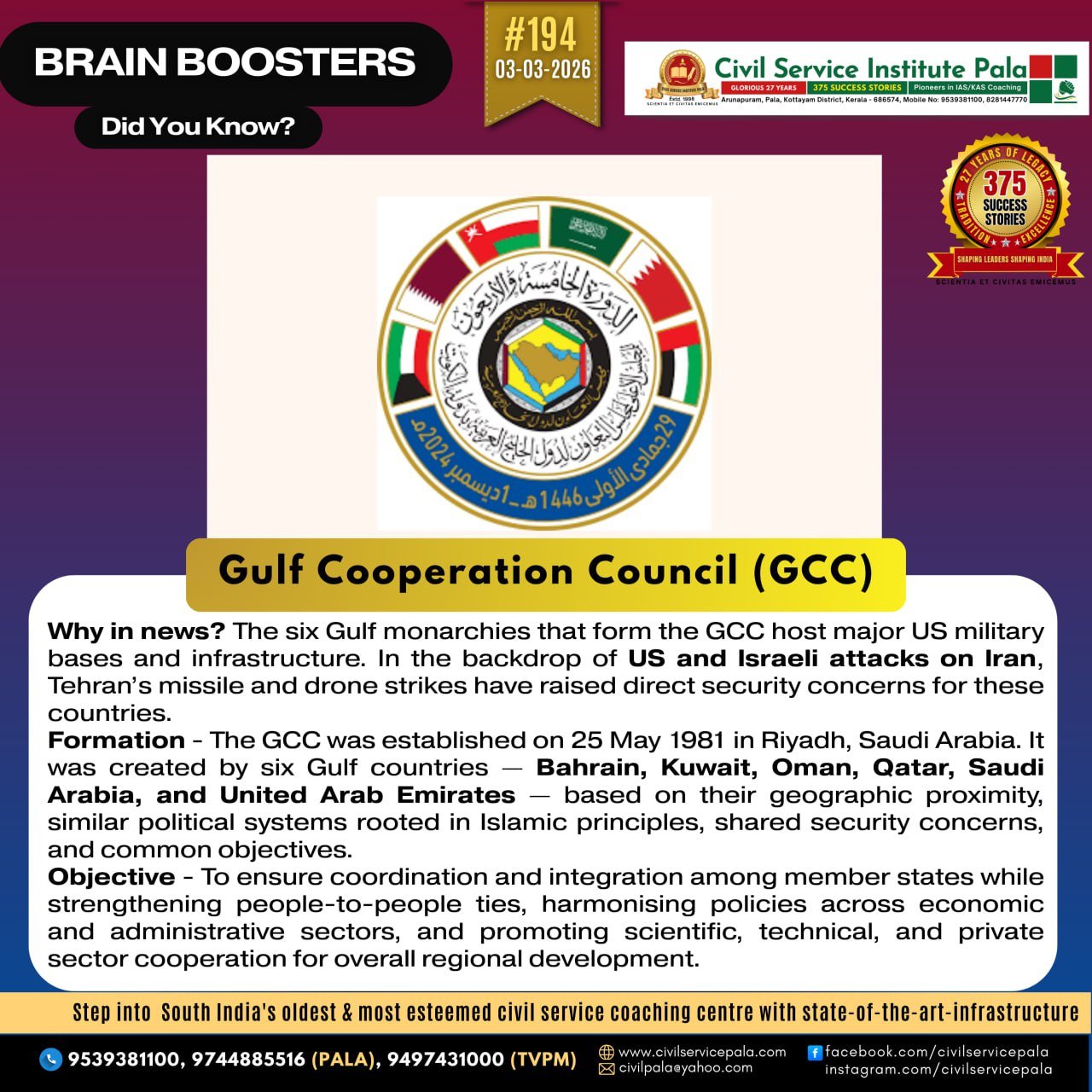
GCC
Why in news? The six Gulf monarchies that form the GCC host major US military bases and infrastructure. In the backdrop of US and Israeli attacks on Iran, Tehran’s missile and drone strikes have raised direct security concerns for these countries.
The GCC was established on 25 May 1981 in Riyadh, Saudi Arabia. It was created by six Gulf countries — Bahrain, Kuwait, Oman, Qatar, Saudi Arabia, and United Arab Emirates — based on their geographic proximity, similar political systems rooted in Islamic principles, shared security concerns, and common objectives.
Objectives
• To maintain coordination, integration, and interconnection among member states in all fields.
• To strengthen ties between their peoples and formulate similar regulations in areas such as economy, finance, trade, customs, tourism, legislation, and administration.
• To promote scientific and technical progress in industry, mining, agriculture, water resources, and animal resources.
• To establish scientific research centres, promote joint ventures, and encourage private sector cooperation.
Organizational Structure
The GCC functions through the following main organs:
a) Supreme Council
The highest authority of the GCC, comprising the Heads of State of the six member countries. It meets once a year in ordinary session, and emergency sessions can be convened at the request of any two member states. The chairmanship rotates annually among member states. Decisions are taken by majority vote. The Council determines overall policies and ratifies recommendations from the Ministerial Council and Secretariat General.
b) Ministerial Council
Composed of the Foreign Ministers of the six member states. It meets every three months in ordinary session and may hold emergency meetings if required. The Council formulates policies and recommends measures to enhance cooperation and coordination in economic, social, and cultural spheres.
c) Secretariat General
Headquartered in Riyadh, it prepares reports, studies, budgets, and drafts rules and regulations. It assists member states in implementing decisions taken by the Supreme and Ministerial Councils. The Secretary General is appointed for a renewable three-year term by the Supreme Council upon recommendation of the Ministerial Council.
d) Dispute Settlement Commission
The Dispute Settlement Commission is attached to the Supreme Council. It is constituted by the Supreme Council on a case-by-case basis, depending on the nature of the dispute submitted to it. Its role is to examine disputes between member states and provide appropriate recommendations or rulings in accordance with GCC principles and agreements.
Significance to India
The GCC holds immense strategic and economic importance for India.
• The Gulf region forms India’s immediate maritime neighbourhood across the Arabian Sea. Stability and security in the region directly impact India’s interests.
• The GCC is a major trading partner and plays a growing role in shaping the economic and security policies of its member states.
• The region holds substantial oil and gas reserves, which are crucial for India’s energy security.
• There is strong potential for cooperation in trade, investment, energy, and manpower. India–GCC Free Trade Agreement (FTA)
On 24 February 2026, India and the GCC formally launched negotiations for a comprehensive FTA. The joint statement was signed by Piyush Goyal and the GCC Secretary General in New Delhi.
• The GCC is India’s largest trading partner bloc.
• Bilateral trade reached USD 178.56 billion in FY 2024–25 (Exports: USD 56.87 billion; Imports: USD 121.68 billion), accounting for over 15% of India’s global trade.
• Trade has grown steadily over the past five years with an average annual growth rate of 15.3%.
Key Exports from India: Engineering goods, rice, textiles, machinery, gems and jewellery.
Key Imports from GCC: Crude oil, LNG, petrochemicals, and precious metals such as gold.
The GCC region represents a market of over 61 million people with a GDP of approximately USD 2.3 trillion (2024). It is also a significant source of FDI for India, with cumulative investments exceeding USD 31 billion as of September 2025.
