



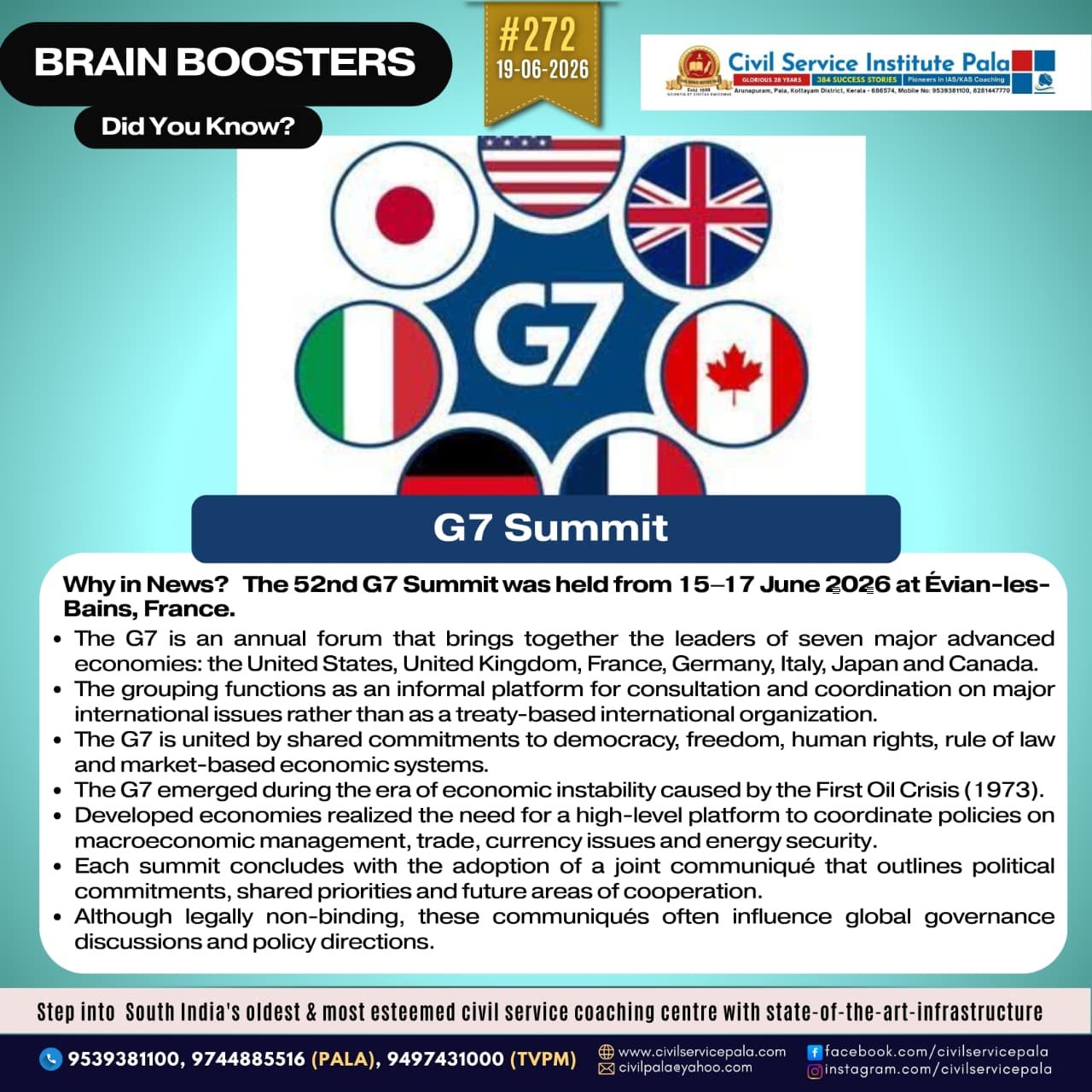
G7 (GROUP OF SEVEN)
G7 (GROUP OF SEVEN)
Why in News?
• The 52nd G7 Summit was held from 15–17 June 2026 at Évian-les-Bains, France.
• One of the notable outcomes of the summit was the announcement of a non-binding G7 Critical Minerals Resilience and Production Alliance, reflecting growing concerns regarding supply chain security and strategic minerals.
What is the G7?
• The G7 is an annual forum that brings together the leaders of seven major advanced economies: the United States, United Kingdom, France, Germany, Italy, Japan and Canada.
• The European Union (EU) participates in G7 discussions and summits but is not included in the rotating presidency system.
• The grouping functions as an informal platform for consultation and coordination on major international issues rather than as a treaty-based international organization.
• The G7 is united by shared commitments to democracy, freedom, human rights, rule of law and market-based economic systems.
Historical Evolution of the G7
Origins in the Economic Crises of the 1970s
• The G7 emerged during a period of significant economic instability caused by events such as the Nixon Shock (1971) and the First Oil Crisis (1973).
• Developed economies realized the need for a high-level platform where leaders could coordinate policies on macroeconomic management, trade, currency issues and energy security.
• Acting on the initiative of French President Valéry Giscard d’Estaing, the first summit was convened in 1975 at Château de Rambouillet, France.
• The original participants were France, the United States, the United Kingdom, West Germany, Italy and Japan, forming the Group of Six (G6).
• Canada joined shortly thereafter, transforming the grouping into the Group of Seven (G7).
Transition from G7 to G8 and Back
• Russia was gradually integrated into the grouping and formally joined in 1998, leading to the creation of the G8.
• Russia's participation was suspended in 2014 following the annexation of Crimea.
• Since 2014, the forum has again functioned as the G7.
Nature and Institutional Structure
Informal Forum
• The G7 is not a formal international organization and does not possess a treaty, charter or legally binding constitution.
• It has no permanent secretariat, headquarters or standing administrative bureaucracy.
• Decisions are generally reached through consensus rather than voting.
Rotating Presidency
• The presidency rotates annually among member countries.
• The country holding the presidency acts as a temporary coordinator and hosts the annual summit.
• The presidency plays a decisive role in setting priorities, determining thematic focus areas and organizing ministerial meetings.
Summit Communiqué
• Each summit concludes with the adoption of a joint communiqué that outlines political commitments, shared priorities and future areas of cooperation.
• Although legally non-binding, these communiqués often influence global governance discussions and policy directions.
How Does the G7 Function?
Role of Leaders' Summits
• Heads of State and Government meet annually to discuss major international challenges.
• Discussions cover economic, political, security, environmental and developmental issues.
• The summit serves as the highest decision-making platform within the G7 framework.
Sherpa Process
• Preparatory negotiations are conducted by officials known as Sherpas, who serve as personal representatives of national leaders.
• Sherpas coordinate discussions, negotiate draft texts and prepare the final summit communiqué.
• Their work ensures continuity between annual summits.
Ministerial Meetings
• As the agenda expanded, the G7 began holding specialized ministerial meetings from the late 1990s onward.
• Ministers responsible for finance, foreign affairs, climate, energy, development and other sectors meet throughout the year.
• These meetings provide technical inputs and policy recommendations for leaders' discussions.
Expansion of the G7 Agenda
Original Focus
• During its early years, the G7 primarily focused on:
o Macroeconomic coordination
o Exchange rate stability
o Trade issues
o Energy security
o Economic growth
Contemporary Focus
• Over time, the agenda expanded far beyond economic issues.
• Today, G7 discussions include:
o International security
o Climate change
o Clean energy transition
o Food security
o Artificial Intelligence
o Development cooperation
o Critical minerals
o Supply chain resilience
o Global health
o Emerging technologies
o Geopolitical conflicts
• This transformation reflects the growing interconnectedness of global challenges.
Role of Civil Society and Stakeholders
• The G7 increasingly engages with civil society through specialized Engagement Groups.
• These groups represent academia, business, science, research institutions, youth, culture and other sectors.
• Engagement Groups formulate recommendations and submit them to the G7 presidency for consideration.
• This mechanism broadens participation beyond governments and incorporates diverse perspectives into policy discussions.
Engagement with Developing Countries
• As global challenges became increasingly interconnected, the G7 expanded dialogue with developing countries and emerging economies.
• Issues such as climate change, food security and sustainable development require cooperation beyond the G7 membership.
• Consequently, summit hosts often invite additional countries and international organizations to participate in discussions.
• This outreach aims to improve coordination on global governance issues.
Why Does the G7 Matter?
Economic Influence
• Despite changes in the global economy, G7 countries continue to account for a significant share of global economic output.
• The group's policy positions frequently shape international economic governance and influence institutions such as the IMF and World Bank.
Political Influence
• The G7 remains one of the most influential forums for coordination among advanced democracies.
• It provides a platform for collective responses to geopolitical crises, security challenges and global emergencies.
Norm-Setting Role
• G7 declarations often influence international discussions on democracy, human rights, climate policy and technological governance.
• The forum acts as a major agenda-setting institution in global affairs.
Global Representativeness
• In 1980, G7 countries accounted for approximately 60.5% of global GDP and 13.8% of the world's population.
• Today, they account for roughly 44.1% of global GDP and 9.6% of global population.
• The G7's share of global population and economic output has steadily declined over time.
• Critics argue that the group's influence remains disproportionately large relative to its demographic representation.
Limited Inclusiveness
• Many major emerging economies are not permanent members despite their growing global importance.
• As a result, some analysts question whether the G7 alone can effectively address increasingly globalized challenges.
Informal Nature
• The absence of legally binding enforcement mechanisms means implementation depends entirely on political commitment.
• Summit declarations often rely on voluntary compliance rather than enforceable obligations.
