



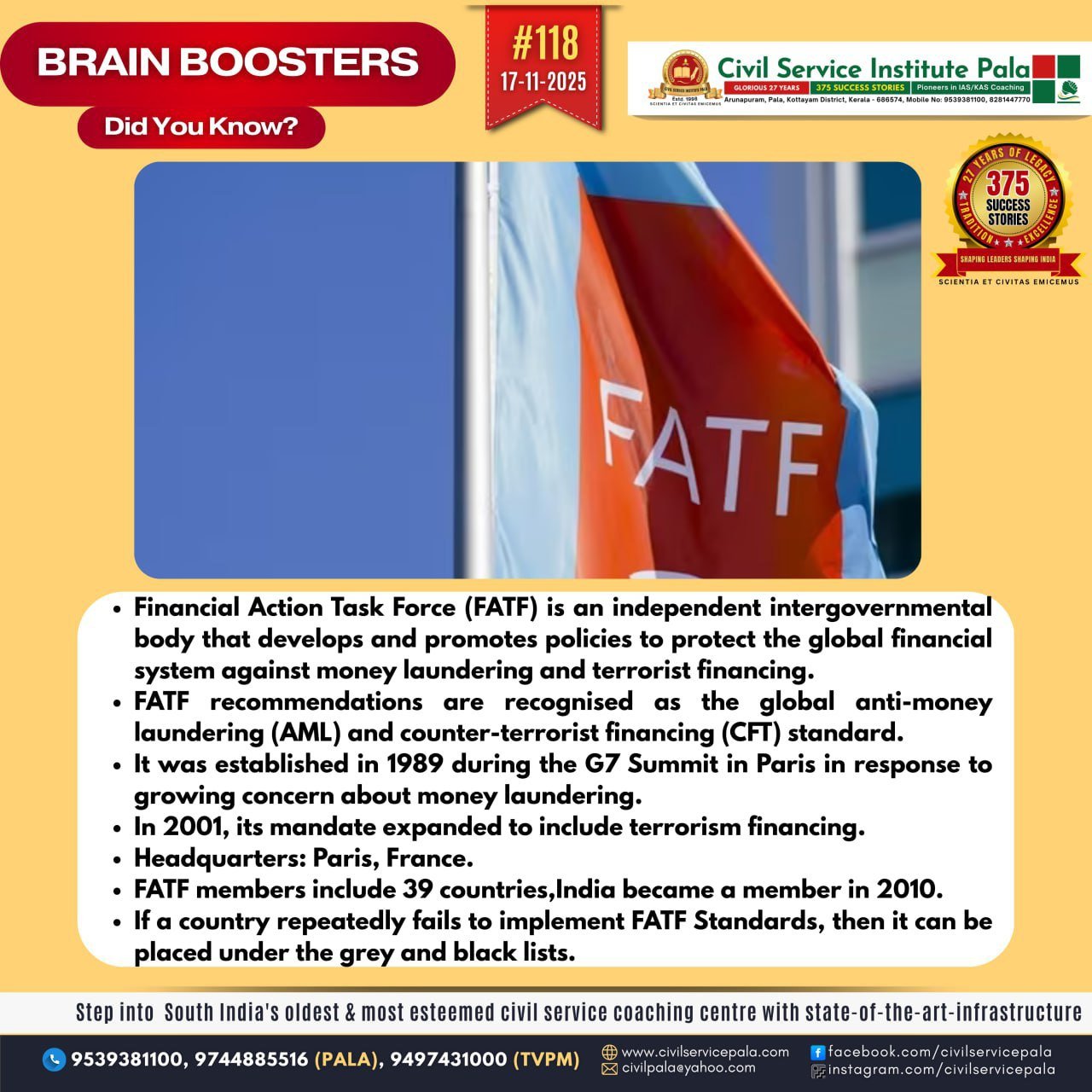
Financial Action Task Force (FATF)
The Financial Action Task Force (FATF) is an intergovernmental body that sets global standards to combat: Money laundering (ML) Terrorist financing (TF) Proliferation financing (such as funding for weapons of mass destruction) What is FATF? The Financial Action Task Force (FATF) was established in 1989 by the G7 countries.
Its main purpose is to protect the international financial system from misuse by criminals, terrorists, and rogue states. Key Functions of FATF \
1. Sets Global Standards FATF issues 40 Recommendations, which act as a global rulebook for financial transparency and anti-money laundering efforts.
2. Monitors Countries FATF assesses how well countries follow these rules through mutual evaluations.
3. Publishes Watchlists If a country has weaknesses in controlling money laundering and terror financing, FATF places them on: Grey List – Country is under increased monitoring and must fix deficiencies. Black List – Country has serious strategic deficiencies and faces severe financial restrictions (currently very few).
4. Promotes International Cooperation FATF helps countries share information and coordinate actions against global financial crimes. Why FATF Matters Being on the FATF lists affects a country’s: Foreign investment International loans Trade and capital flows Overall economic reputation Countries strive to comply because FATF influence is global and powerful. India and FATF India is a member country of FATF (since 2010). India has strengthened laws such as the PMLA (Prevention of Money Laundering Act) based on FATF recommendations.
