



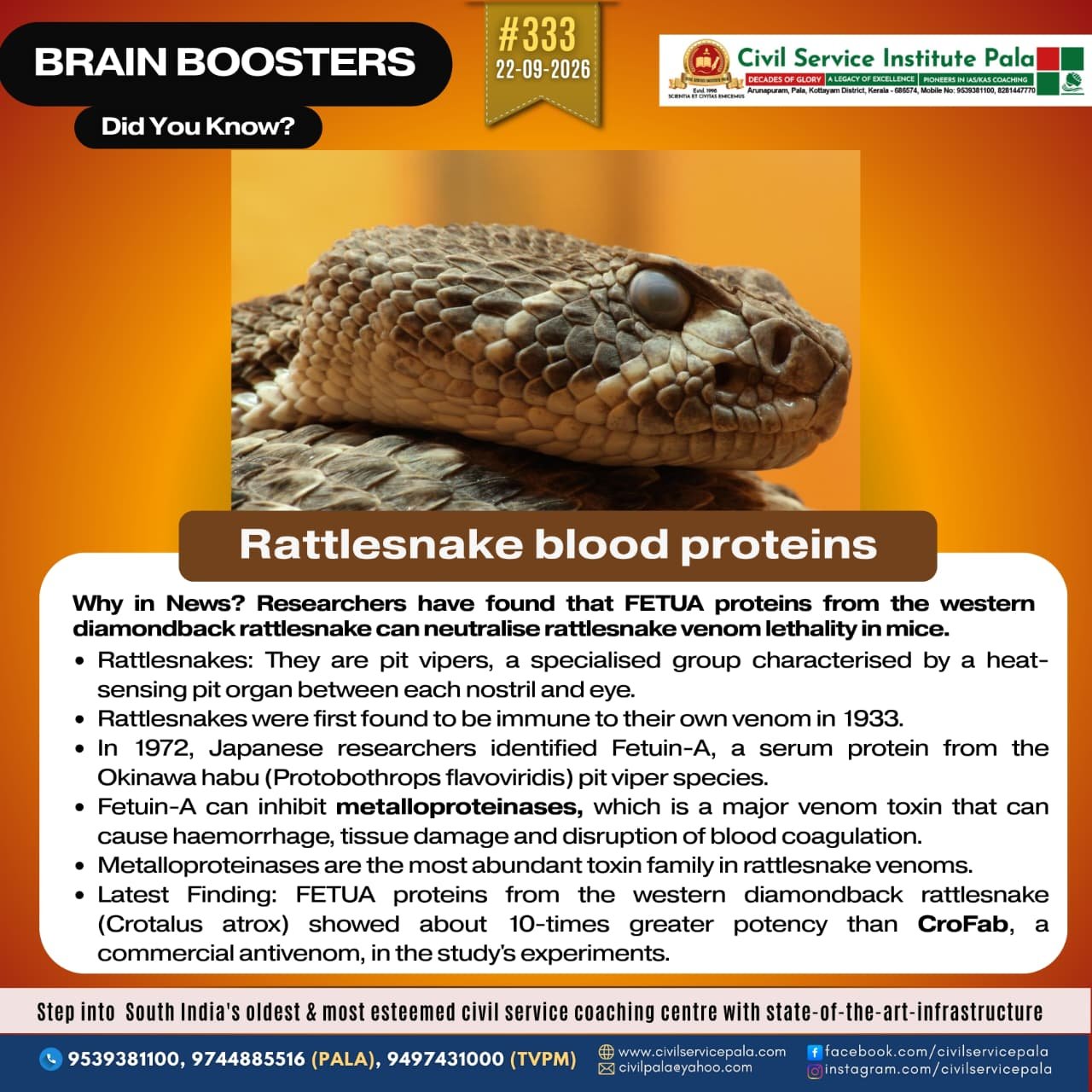
FETUA Proteins and Next-Generation Snake Antivenom
FETUA Proteins and Next-Generation Snake Antivenom
Why in News?
Researchers have found that FETUA proteins from the western diamondback rattlesnake can neutralise rattlesnake venom lethality in mice, showing roughly 10-times the potency of a commercial antivenom in the experiments.
How Do Snakes Resist Their Own Venom?
Rattlesnakes were first found to be immune to their own venom in 1933.
Venom resistance in snakes occurs mainly through two mechanisms:
• Target modification: The venom’s targets in the body evolve in a way that prevents the toxins from effectively attacking them. This mechanism is seen in snakes such as cobras.
• Toxin sponges: Some snakes possess specific molecules in their bloodstream that bind to and neutralise venom toxins before they can cause damage. This mechanism occurs in vipers.
Rattlesnakes are pit vipers, a group of vipers characterised by a heat-sensing pit organ between each nostril and eye.
Discovery of Fetuin-A and FETUA Proteins
In 1972, Japanese researchers identified Fetuin-A, a serum protein from the Okinawa habu (Protobothrops flavoviridis), a pit viper endemic to the Ryukyu Islands.
• Fetuin-A can inhibit metalloproteinases, a major class of venom toxins.
• Metalloproteinases can cause haemorrhage, tissue damage and disruption of the blood-coagulation system.
• Metalloproteinases are the most abundant toxin family in rattlesnake venoms.
• Later research established that Fetuin-A belongs to a larger family of proteins called FETUAs.
• In 2022, researchers identified four FETUA proteins — FETUA-2, FETUA-3, FETUA-4 and FETUA-5 — in the western diamondback rattlesnake (Crotalus atrox).
How FETUAs Worked as Antivenom Candidates
Researchers tested combinations of C. atrox FETUA proteins by pre-mixing them with venom before injecting the mixture into experimental mice.
• Results showed that certain combinations were able to block haemorrhaging and even prevent death from the venom.
• Ultimately showed that certain combinations could fully neutralise rattlesnake venom lethality.
The proteins also showed cross-species activity across eastern diamondback rattlesnake, the Malayan pit viper and Chinese moccasin.
• Among the true vipers tested, they provided significant protection against Sochurek’s saw-scaled viper.
• However, it is crucial to note that the experiments showed no protection against the puff adder.
This indicates that FETUAs can recognise and neutralise venom components across some distant snake species, although their activity is not universal.
Why This Could Lead to Next-Generation Antivenom
An effective antivenom requires both potency and broad reactivity.
The study found that the FETUA proteins were approximately 10 times more potent than CroFab, a commercial antivenom produced using animals immunised with four pit-viper venoms, including C. atrox.
FETUAs also offer potential manufacturing advantages:
• They can be produced as recombinant proteins in the laboratory in potentially unlimited quantities.
• They have a defined molecular composition.
• Unlike conventional animal-derived antivenoms, their production does not require animals to be immunised and antibodies subsequently purified from their blood.
• Their naturally evolved specificity and potency provide a biological basis for exploring them as antivenom components.
Major Limitation
The findings demonstrate venom-neutralising capacity, but they do not yet demonstrate clinical treatment of snakebite.
A key limitation is that the experiments pre-mixed venom and FETUA proteins before injecting them into mice. This is different from treating an animal after it has already been envenomed, which is the clinically relevant situation.
FETUAs primarily target metalloproteinases. They do not neutralise other important venom components, particularly neurotoxins that dominate many medically important snake venoms.
Therefore, FETUAs should currently be viewed as a potential metalloproteinase-neutralising component of a next-generation antivenom, rather than a standalone therapy.
Implications for India
India faces a more complex antivenom challenge because it has both vipers and elapids such as cobras.
The study found partial protection against saw-scaled vipers (Echis carinatus group), which includes one of India's Big Four snakes. However, partial cross-reactivity does not necessarily mean clinical protection.
The proposed strategy for India is therefore to:
• Identify and test FETUA proteins from Indian vipers rather than relying only on rattlesnake FETUAs.
• Use FETUAs to address metalloproteinase-rich venom components.
• Combine them with other agents capable of targeting neurotoxic elapid venoms, which FETUAs cannot neutralise.
