



Ferrocene
Ferrocene — definition and structure
• Ferrocene is a landmark organometallic compound in which an iron (Fe) atom is sandwiched between two cyclopentadienyl rings (C5H5−), forming a stable “sandwich” structure.
• The Fe–ring bonding and the aromatic character of the cyclopentadienyl ligands confer exceptional thermal and chemical stability and distinct electronic properties.
Importance and applications
• Significance in chemistry: Ferrocene established the field of sandwich compounds and organometallic stability; it is a model system for studying metal–ligand bonding and aromaticity in organometallics.
• Catalysis and materials: Ferrocene derivatives are employed as reagents, ligands and redox active building blocks in catalysis, molecular electronics, and advanced functional materials.
• Pharmaceuticals and bioinorganic research: Ferrocene has been incorporated into drug candidates to modify lipophilicity, redox behaviour and biological activity.
Medical applications
• Ferrocifens: Ferrocene analogues of tamoxifen designed for hormone dependent breast cancer.
• Ferroquine: A ferrocene containing analogue of chloroquine that shows activity against chloroquine sensitive and chloroquine resistant Plasmodium falciparum.
Latest breakthrough — boron based analogue
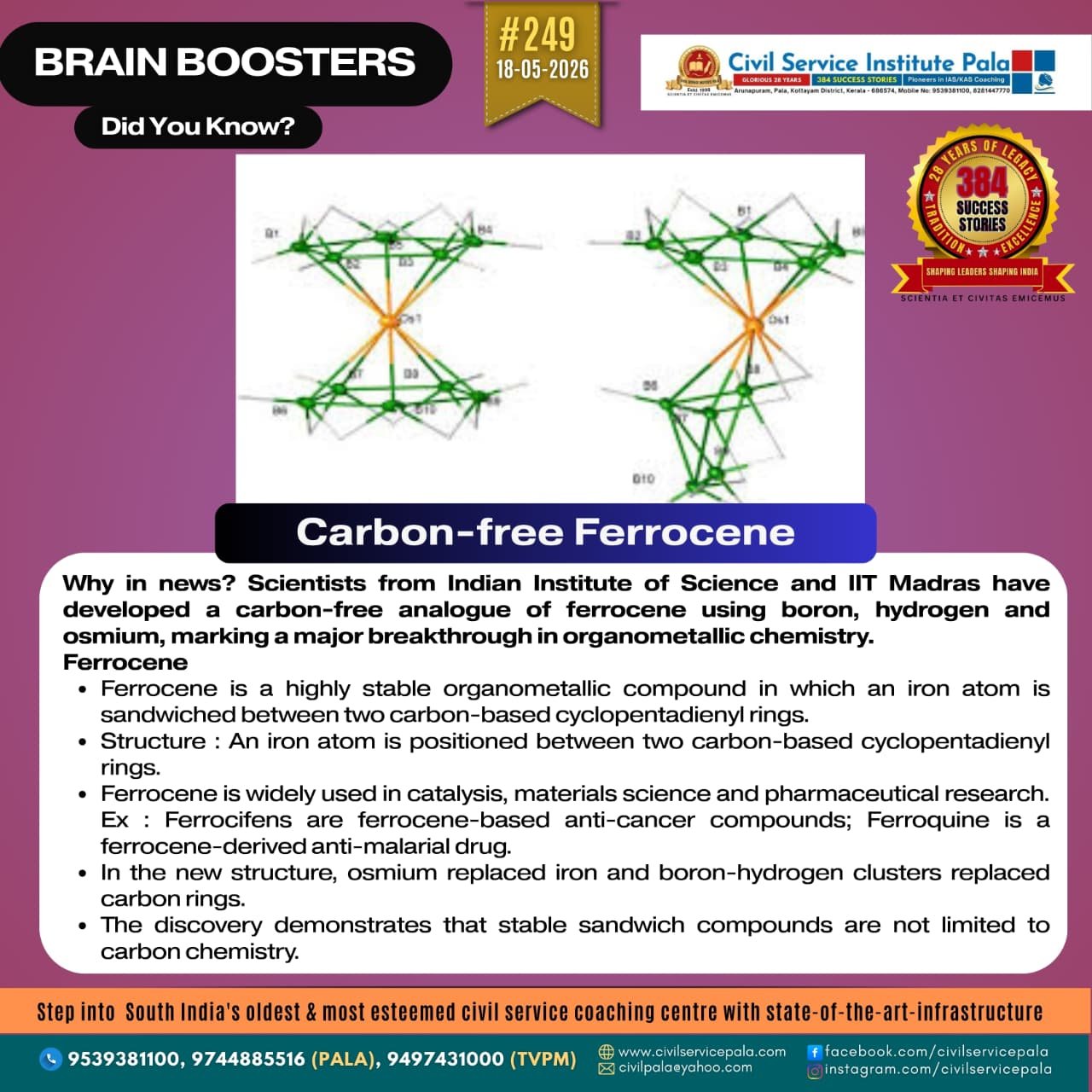
• Discovery: Researchers at the Indian Institute of Science and IIT Madras reported a carbon free analogue of ferrocene in which the cyclopentadienyl carbon rings are replaced by boron–hydrogen clusters, and iron is replaced by osmium (Os), producing a stable inorganic “sandwich” complex.
• Key insight: The work shows that boron clusters can mimic the structural and binding roles of carbon rings in forming stable, metal bound cyclic systems.
Significance
• Conceptual advance: Demonstrates that stable sandwich type organometallic architectures need not be restricted to carbon based ligands, expanding fundamental organometallic chemistry.
• Materials and catalysis: Boron based sandwich complexes may offer new routes to inorganic materials with distinctive electronic, catalytic and bonding properties.
• Potential applications: Possibilities include novel catalysts, electronic materials, and (long term) roles in targeted delivery or imaging if biocompatibility and functionalisation are demonstrated.
• The finding is an important laboratory scale advance; further work is needed to understand synthesis scalability, stability under application conditions, and practical utility.
