



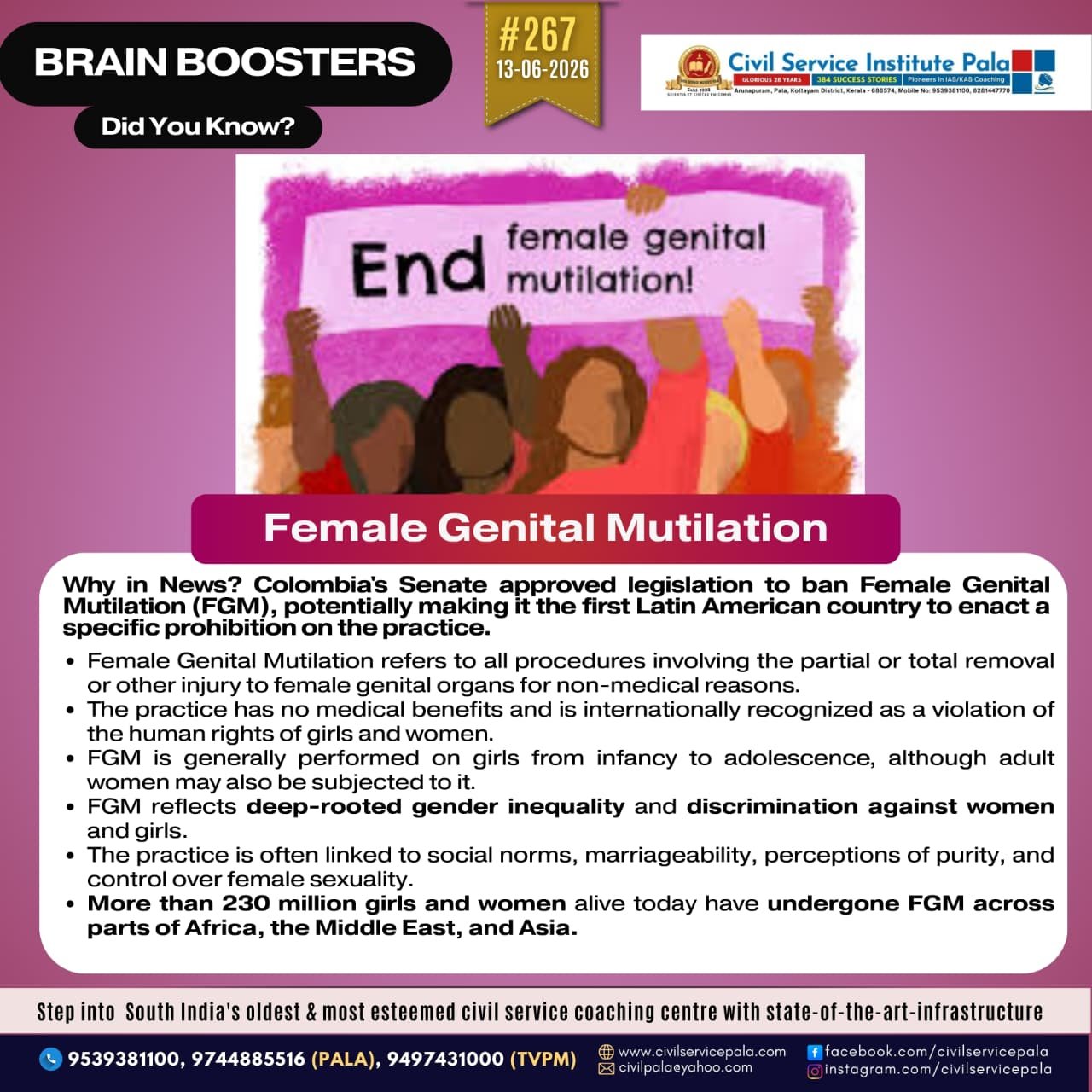
Female Genital Mutilation (FGM)
Why in News?
Colombia's Senate approved legislation to ban Female Genital Mutilation (FGM), potentially making it the first Latin American country to enact a specific prohibition on the practice.
The development has renewed global attention on FGM as a human rights and public health issue.
What is Female Genital Mutilation (FGM)?
Female Genital Mutilation refers to all procedures involving the partial or total removal of external female genitalia or other injury to female genital organs for non-medical reasons.
The practice has no medical benefits and is internationally recognized as a violation of the human rights of girls and women.
FGM is generally performed on girls from infancy to adolescence, although adult women may also be subjected to it.
Core Features
FGM reflects deep-rooted gender inequality and discrimination against women and girls.
The practice is often linked to social norms, marriageability, perceptions of purity, and control over female sexuality.
No major religion mandates FGM, although it is sometimes incorrectly justified on religious grounds.
More than 230 million girls and women alive today have undergone FGM across parts of Africa, the Middle East, and Asia.
Health Impacts
Immediate Effects
FGM can cause severe pain, excessive bleeding, infections, urinary complications, shock, and even death.
The procedure often occurs without proper medical safeguards, increasing health risks.
Long-Term Effects
FGM can lead to chronic urinary and reproductive tract problems.
It increases the risk of complications during pregnancy and childbirth.
Women may experience sexual dysfunction and reduced quality of life.
Survivors frequently suffer from anxiety, depression, post-traumatic stress disorder, and other psychological effects.
Medicalization of FGM
In some regions, health workers perform FGM under the belief that it is safer in medical settings.
Medicalization does not eliminate harm and may legitimize the practice.
The World Health Organization strongly opposes the medicalization of FGM.
Global Dimensions
More than four million girls are estimated to be at risk of FGM annually.
Treatment of FGM-related health complications imposes significant economic burdens on healthcare systems.
The issue is increasingly viewed as a global human rights concern rather than merely a cultural practice.
International Response
WHO Initiatives
WHO advocates a holistic approach involving health, education, legal, and social sectors.
WHO has developed guidelines for prevention, survivor care, and ending medicalized FGM.
World Health Assembly
The World Health Assembly adopted Resolution WHA61.16 calling for coordinated global action to eliminate FGM.
Challenges
Strong social pressure within communities often perpetuates the practice.
Lack of awareness and weak enforcement of laws hinder eradication efforts.
Cultural acceptance and intergenerational transmission continue to sustain the practice.
Medicalization may create a false perception of safety.
Way Forward
Combining legal prohibition with community-based awareness campaigns is the best approach to tackle this issue.
Greater emphasis should be placed on girls' education and women's empowerment.
Religious and community leaders should be engaged in behavioural change initiatives.
Survivor-centered healthcare and psychological support systems need strengthening.
