



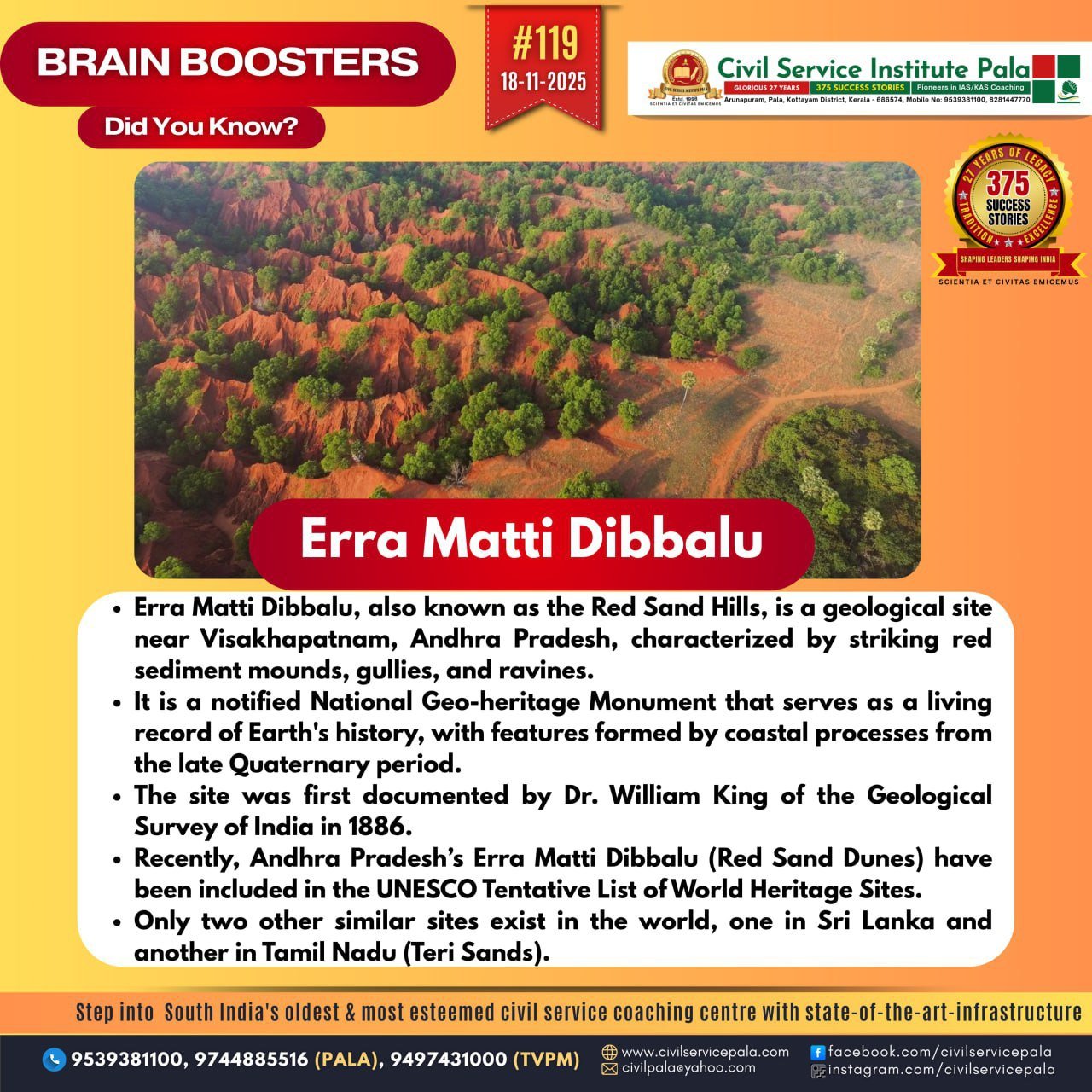
Erra Matti Dibbalu (Red Sand Dunes)
Erra Matti Dibbalu (Red Sand Dunes)
• Location: Erra Matti Dibbalu, meaning “Red Sand Hills” in Telugu, are located near Bheemunipatnam (Bhimili) close to Visakhapatnam, Andhra Pradesh. They lie along the coastal stretch between Visakhapatnam and Bhimunipatnam.
• Geological nature: These are unique coastal red sand dunes formed by the combined actions of: Sea winds Climatic variations Periodic sea-level changes Deposition of red sediments brought from the Eastern Ghats
• Age and formation: Studies suggest that these dunes were formed between 12,000–18,000 years ago during the Late Pleistocene to Holocene period. Their red colour is due to the presence of iron oxide in the sand.
• Structure: The dunes show layered structures indicating: Ancient river deposits Marine influence Wind-blown sand They form cliff-like formations rising up to 30–40 metres. Significance of Erra Matti Dibbalu
1. Geological Heritage Site They are recognized as a National Geo-heritage Site by the Geological Survey of India. These dunes are rare, with similar formations found only in Tamil Nadu and South Africa.
2. Evidence of past climate change The dunes act as a natural archive of Quaternary climate, revealing: Past monsoon patterns Sea-level fluctuations Paleoclimatic changes Thus, they are crucial for studies on climate history.
3. Coastal ecosystem buffer They act as a natural barrier against: Coastal erosion Storm surges High winds This makes them important for disaster mitigation along the Visakhapatnam coast.
4. Biodiversity value The dune ecosystem supports: Specialized scrub vegetation Nesting sites for birds Though not extremely biodiverse, it is ecologically fragile and unique.
5. Tourism and education A popular geo-tourism and educational site, helping students and researchers understand coastal geomorphology and climate science.
6. Threatened landscape They face threats from: Urban expansion near Vizag Unregulated tourism Sand mining Conservation is crucial to prevent further degradation.
