



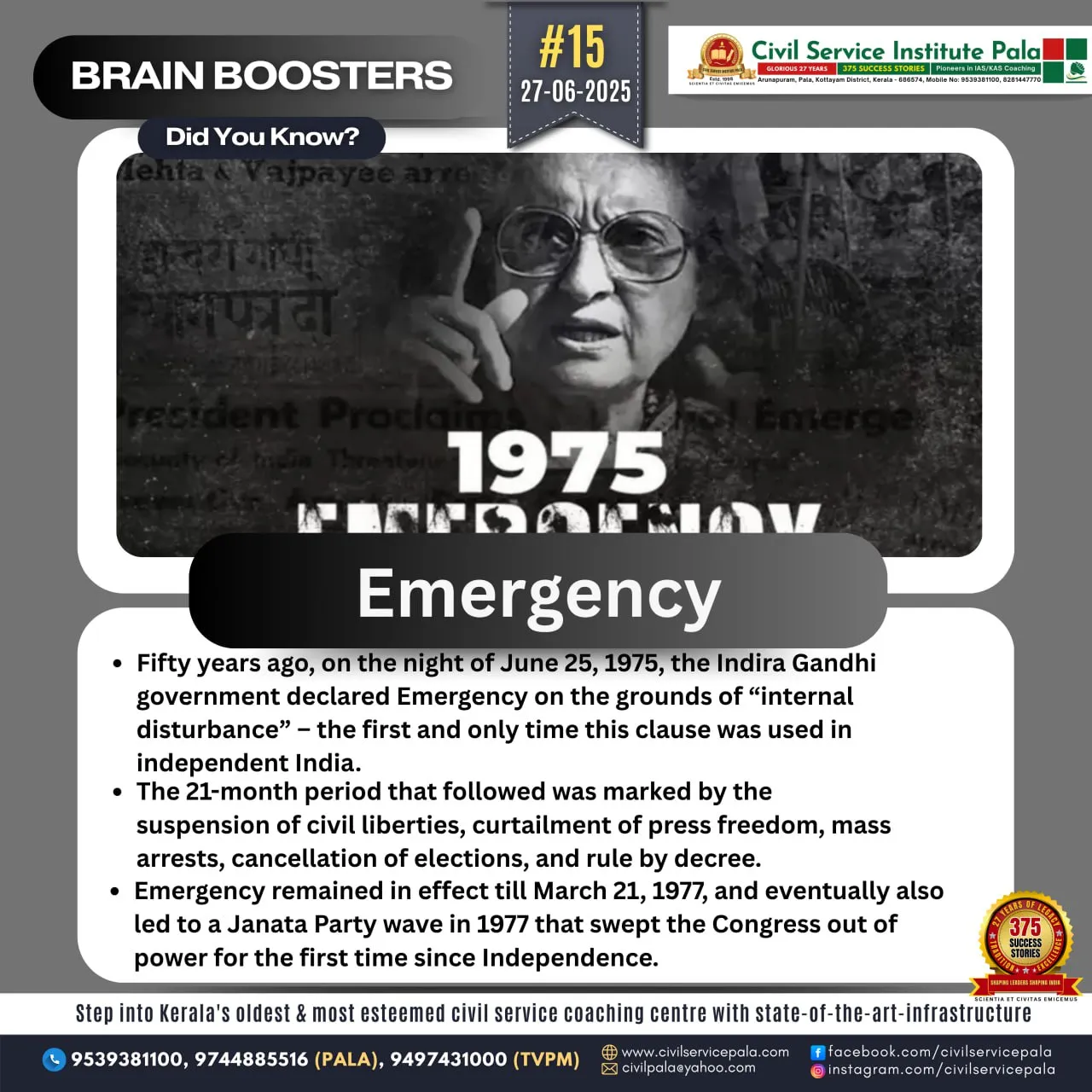
Emergency
The Indian Emergency was a 21-month period from June 25, 1975, to March 21, 1977, when Prime Minister Indira Gandhi unilaterally declared a state of emergency across the country. It is one of the most controversial and defining episodes in India’s post-independence history, marked by authoritarian rule, suspension of civil liberties, mass arrests, censorship, and forced sterilizations.
Background and Causes
Political Turmoil and Legal Pressure:
On June 12, 1975, the Allahabad High Court found Indira Gandhi guilty of electoral malpractices in the 1971 general elections. The court invalidated her election and barred her from holding elected office for six years.
This ruling came amid rising opposition demands for her resignation and mass protests led by figures like Jayaprakash Narayan (JP).
Social Unrest:
India was facing high inflation, food shortages, labor strikes, and widespread dissatisfaction.
Movements in Gujarat and Bihar (Nav Nirman Andolan and JP Movement) were mobilizing students and civil society against corruption and misgovernance.
Perceived Threat to National Stability:
Gandhi and her allies claimed that the situation was deteriorating into chaos and that the protests amounted to a conspiracy to destabilize the government.
Declaration and Implementation
Date Declared: June 25, 1975.
Legal Basis: Article 352 of the Indian Constitution (external and internal disturbance).
Presidential Assent: Fakhruddin Ali Ahmed signed the emergency proclamation.
Key measures taken:
Suspension of Civil Liberties:
Fundamental rights were suspended, especially the right to free speech, protest, and legal recourse (Article 21 was curtailed).
Press was heavily censored. Newspapers like The Indian Express and The Statesman left blank spaces to protest censorship.
Mass Arrests:
Over 100,000 political opponents, activists, journalists, and dissenters were jailed under the Maintenance of Internal Security Act (MISA).
Leaders from opposition parties (Janata Party, RSS, socialists) were arrested.
Crackdown on Dissent:
Student and labor unions were suppressed.
Government critics were silenced through intimidation or imprisonment.
Forced Sterilization Campaign:
Sanjay Gandhi, Indira’s son, led a coercive family planning program.
Millions of men, particularly from lower-income backgrounds, were sterilized under duress.
Centralization of Power:
Parliament became a rubber stamp. Judiciary faced pressure and intimidation.
The bureaucracy and police acted on direct orders from the PMO.
Aftermath and Consequences
Elections and Fall of Indira Gandhi:
Under pressure at home and abroad, Gandhi lifted the Emergency in March 1977 and called for general elections.
The Janata Party, a coalition of anti-Emergency forces, swept the polls, and Indira Gandhi was voted out.
It was the first time the Congress Party was removed from power since independence.
Legal and Constitutional Impact:
The Emergency exposed flaws in the Constitution’s safeguards against authoritarian misuse.
In response, the 44th Amendment (1978) was passed to make future declaration of Emergency more difficult and protect civil liberties.
Public Memory and Legacy:
The Emergency remains a dark chapter in Indian democracy.
It continues to be a cautionary tale about the fragility of democratic institutions and the dangers of concentrated power.
Key Figures
Indira Gandhi – Prime Minister who declared and oversaw the Emergency.
Sanjay Gandhi – Played a major role in implementing authoritarian measures, especially sterilization drives.
Jayaprakash Narayan (JP) – Iconic opposition leader who spearheaded resistance.
Morarji Desai – Became Prime Minister after the Emergency ended as part of the Janata government.
Conclusion
The Emergency was a turning point for Indian democracy. It showed how democratic systems can be undermined from within using legal mechanisms. Though India returned to democracy afterward, the period serves as a reminder that civil liberties and institutional checks need constant vigilance.
Source : https://indianexpress.com/article/explained/explained-emergency-its-lessons-10086542/
