



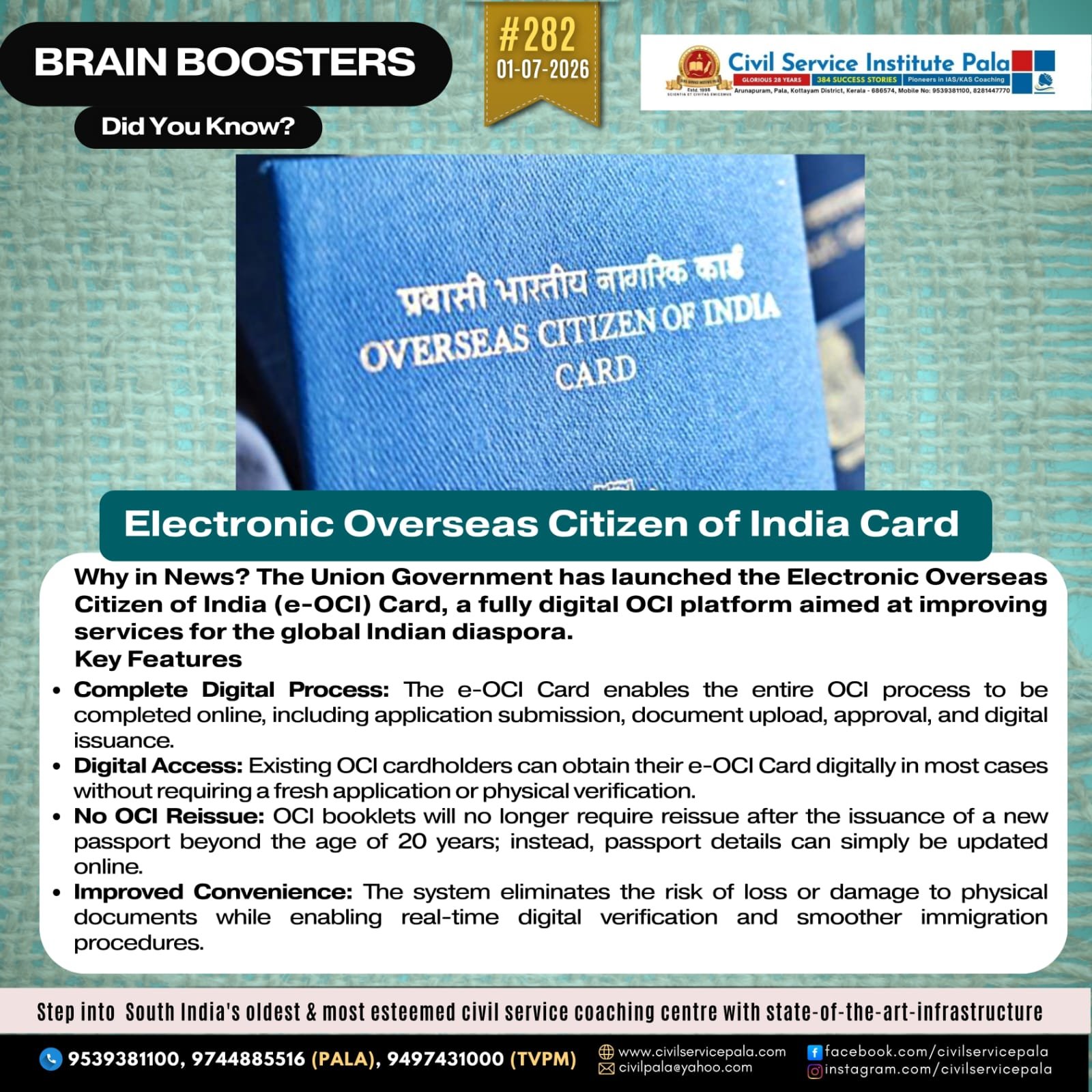
Electronic Overseas Citizen of India (e-OCI) Card
Brain Booster – e-OCI Card & Overseas Citizenship of India (OCI)
Why in News?
• The Union Government has launched the Electronic Overseas Citizen of India (e-OCI) Card, a fully digital OCI platform aimed at improving services for the global Indian diaspora.
• The initiative eliminates the need to reissue the OCI booklet whenever a new passport is issued after the age of 20 years and enables digital verification, online processing, and faster immigration clearance.
e-OCI Card: Key Features
• Complete Digital Process: The e-OCI Card enables the entire OCI process to be completed online, including application submission, document upload, approval, and digital issuance.
• Digital Access: Existing OCI cardholders can obtain their e-OCI Card digitally in most cases without requiring a fresh application or physical verification.
• No OCI Reissue: OCI booklets will no longer require reissue after the issuance of a new passport beyond the age of 20 years; instead, passport details can simply be updated online.
• Improved Convenience: The system eliminates the risk of loss or damage to physical documents while enabling real-time digital verification and smoother immigration procedures.
What is Overseas Citizenship of India (OCI)?
• Overseas Citizenship of India (OCI) is not dual citizenship. India does not permit dual citizenship because Article 9 of the Constitution provides that a person who voluntarily acquires the citizenship of another country shall not remain an Indian citizen.
• OCI is a special legal status granted through registration as an Overseas Citizen of India Cardholder under the Citizenship Act, 1955. While OCI cardholders enjoy rights specified by the Central Government, they are not granted the constitutional or political rights available to Indian citizens.
• An OCI can be defined as a person registered as Overseas Citizen of India (OCI) Cardholder under the Citizenship Act, 1955
Evolution of the OCI Scheme
• 2000: A High-Level Committee on the Indian Diaspora under L.M. Singhvi was constituted to strengthen India's engagement with overseas Indians.
• 2002: The committee recommended amending the Citizenship Act, 1955 to introduce Overseas Citizenship for eligible Persons of Indian Origin.
• Citizenship (Amendment) Act, 2003: Introduced OCI for PIOs of specified countries (excluding Pakistan and Bangladesh).
• Citizenship (Amendment) Act, 2005: Expanded OCI eligibility to PIOs from all countries except Pakistan and Bangladesh, subject to their home country's laws.
• Citizenship (Amendment) Act, 2015: Merged the PIO Card Scheme and the OCI Card Scheme into a single Overseas Citizen of India Cardholder scheme. All existing PIO cardholders were deemed OCI cardholders from 9 January 2015.
Who is Eligible for OCI Registration?
• A foreign citizen who:
o was an Indian citizen at or after the commencement of the Constitution;
o was eligible to become an Indian citizen at the commencement of the Constitution;
o belonged to a territory that became part of India after 15 August 1947;
o is a child, grandchild or great-grandchild of such a person;
o is a minor child of an eligible person or of Indian citizens;
o is the foreign spouse of an Indian citizen or OCI cardholder, provided the marriage has been registered and has subsisted continuously for at least two years.
• Persons who themselves, or whose parents, grandparents or great-grandparents, were citizens of Pakistan, Bangladesh or any country notified by the Central Government are not eligible.
Rights and Limitations of OCI Cardholders
• OCI cardholders enjoy long-term travel and residency facilities in India and receive such rights as may be specified by the Central Government.
• However, OCI cardholders do not enjoy constitutional or political rights available only to Indian citizens. They cannot vote, contest elections, hold constitutional offices such as President or Vice-President, become Judges of the Supreme Court or High Courts, or claim equality of opportunity in public employment except where specifically permitted by the Central Government.
