



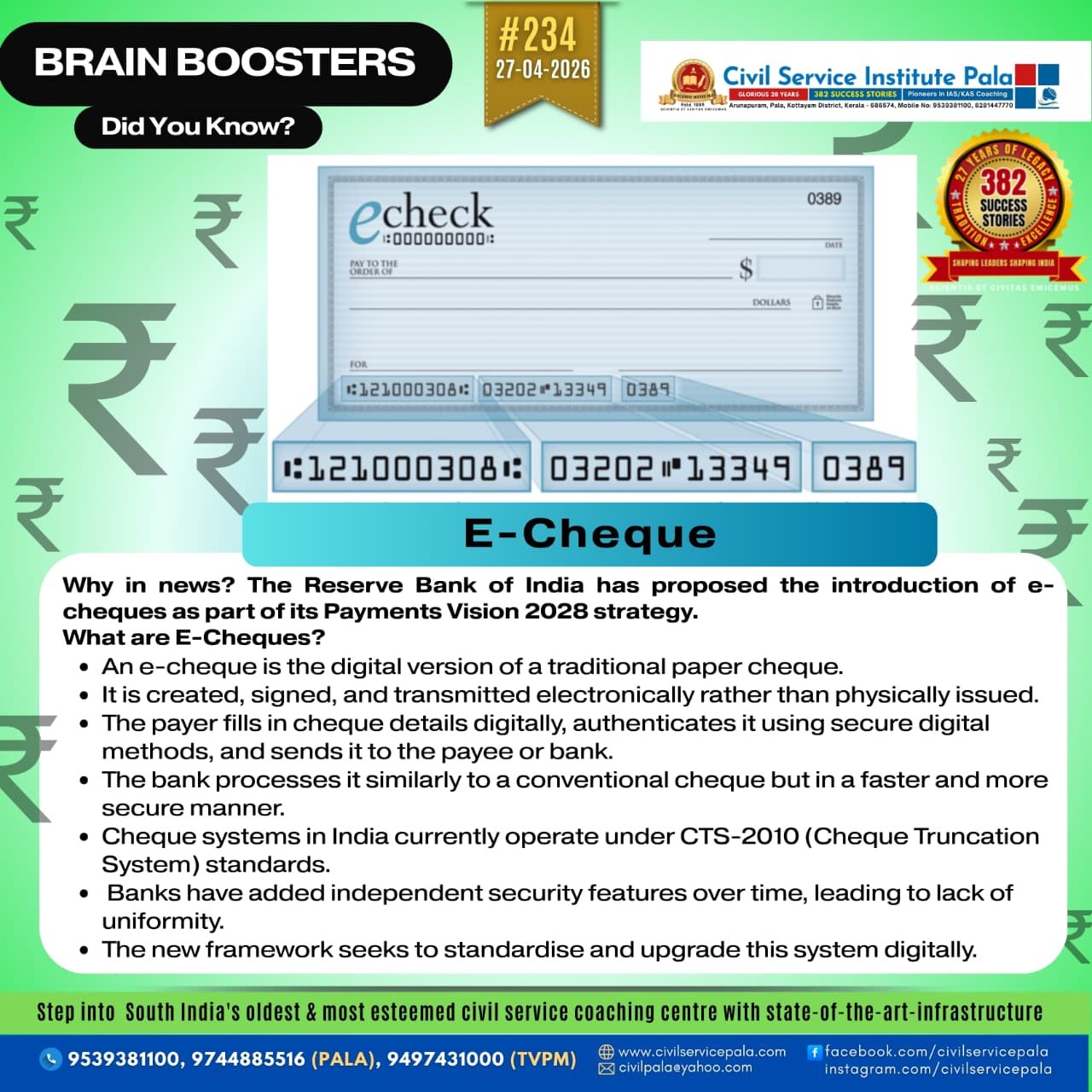
E-cheques
The Reserve Bank of India has proposed the introduction of e-cheques as part of its Payments Vision 2028 strategy.
* The move aims to modernise India’s payment ecosystem by combining traditional cheque reliability with digital efficiency.
What are E-Cheques?
* An e-cheque is the digital version of a traditional paper cheque.
* It is created, signed, and transmitted electronically instead of being physically issued.
* The payer fills in cheque details digitally, authenticates it using secure digital methods, and sends it to the payee or bank.
* The bank processes it similarly to a conventional cheque but in a faster and more secure manner.
Existing Framework
* Cheque systems in India currently operate under CTS-2010 (Cheque Truncation System) standards.
* Banks have added independent security features over time, leading to lack of uniformity.
* The new framework seeks to standardise and upgrade this system digitally.
RBI Payments Vision 2028 – Key Provisions
* Introduction of e-cheques to merge paper-based trust with digital speed and efficiency.
* Comprehensive review of cheque design and security features used across different banks to enhance uniformity across banking ecosystem.
* Strengthening fraud prevention mechanisms and aligning cheque systems with emerging digital processes.
* Adoption of best practices across all cheque instruments, building on existing CTS standards.
* Continued recognition of cheques as a relevant payment instrument for certain use cases.
Key Features of E-Cheques
* Digital issuance – No physical paper required.
* Secure authentication – Uses digital signatures or equivalent verification methods.
* Electronic transmission – Sent instantly to payee/bank.
* Faster processing – Reduces clearing time compared to physical cheques.
* Traceability – Easy tracking and audit trail.
* Integration-ready – Compatible with modern banking and payment systems.
