



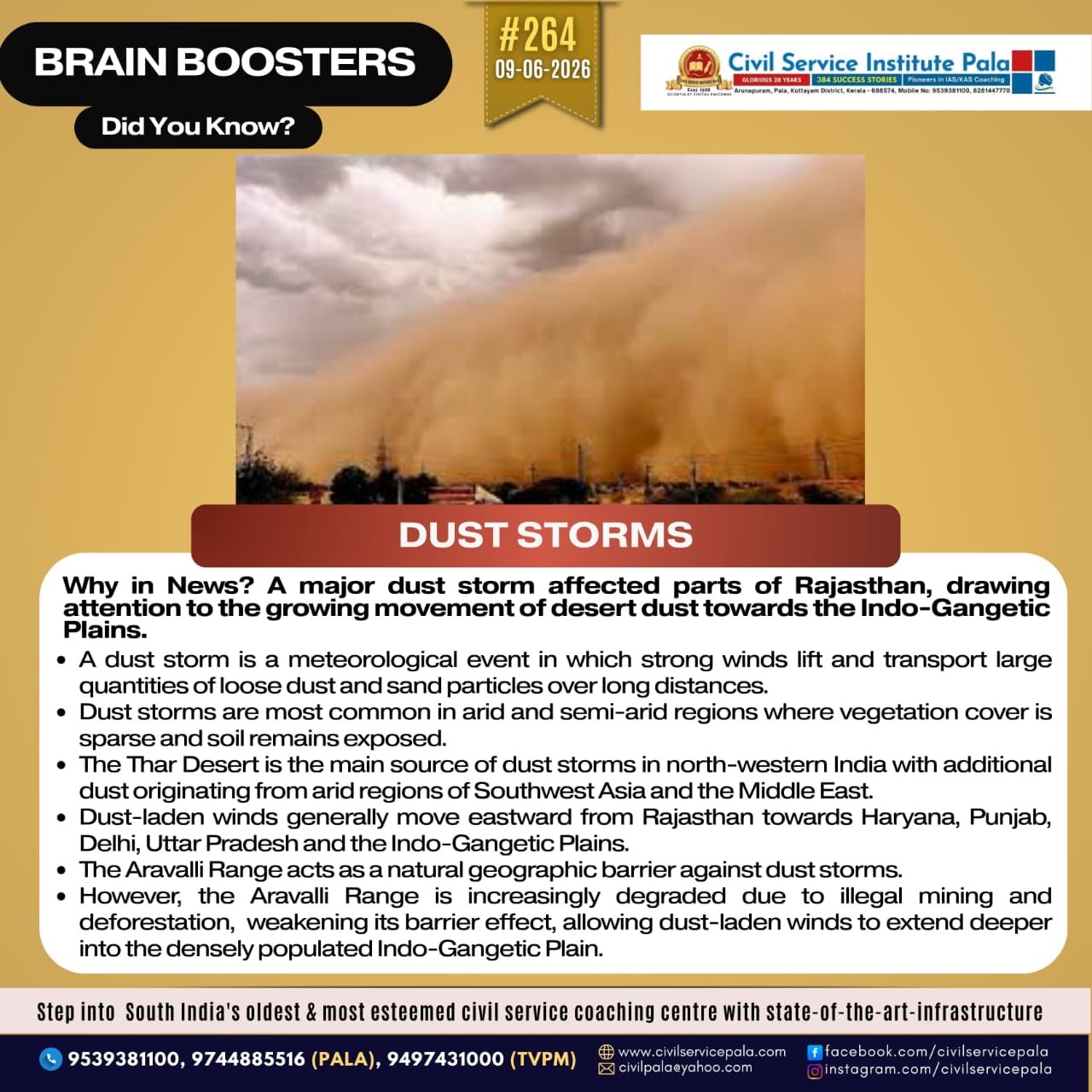
Dust Storms
Dust Storms, Aravalli Range and Desertification in Northern India
Why in News?
A major dust storm affected parts of Rajasthan, drawing attention to the growing movement of desert dust towards the Indo-Gangetic Plains.
Degradation of the Aravalli Range is weakening its natural role as a barrier against dust transport and desertification.
What is a Dust Storm?
A dust storm is a meteorological event in which strong winds lift and transport large quantities of loose dust and sand particles over long distances.
Dust storms are most common in arid and semi-arid regions where vegetation cover is sparse and soil remains exposed.
In India, dust storms occur primarily during the pre-monsoon season from April to June.
Formation of Dust Storms
Source Regions
The Thar Desert is the principal source of dust storms affecting northwestern India.
Additional dust may originate from arid regions of Southwest Asia and the Middle East.
Conditions Required
Intense surface heating during summer creates dry and unstable atmospheric conditions.
Strong westerly and southwesterly winds lift loose soil and sand particles into the atmosphere.
Sparse vegetation and degraded land surfaces increase the availability of dust for transport.
Movement of Dust
Dust-laden winds generally move eastward from Rajasthan towards Haryana, Punjab, Delhi, Uttar Pradesh and the Indo-Gangetic Plains.
The intensity and reach of dust transport depend on wind speed, land cover and topography.
Aravalli Range: Natural Barrier Against Dust
Protective Role of the Aravallis
The Aravalli Range acts as a natural geographic barrier between the Thar Desert and the densely populated Indo-Gangetic Plains.
Dust-bearing winds lose speed when they encounter the Aravalli hills, causing sand and dust particles to settle.
The presence of obstacle dunes on the western slopes of the Aravallis provides physical evidence of this interception process.
Forests and vegetation on the hills create a natural "scrubbing effect" that traps dust particles and reduces their movement further east.
The Aravallis therefore help limit desertification, air pollution and excessive dust transport into northern India.
The Aravallis are often called the "Green Wall of Northwestern India" because they check the eastward expansion of the Thar Desert.
Impacts of Dust Storms
Environmental Impacts
Dust storms reduce air quality by increasing concentrations of particulate matter.
Dust particles affect atmospheric radiation by scattering and absorbing sunlight.
Large dust loads can temporarily alter surface temperatures.
Dust deposition can affect soil properties, vegetation and local ecosystems.
Human and Economic Impacts
Dust storms reduce visibility and disrupt transportation.
Fine dust particles aggravate respiratory and cardiovascular diseases.
Agricultural productivity can be affected through soil erosion and crop damage.
Impact on Indo-Gangetic Plains
Delhi and surrounding regions already lie within a high dust-exposure zone.
Increased dust transport contributes significantly to seasonal air pollution in northern India.
Weakening of the Aravalli barrier could further intensify dust-related pollution episodes.
State of the Aravalli Range
Major Causes of Degradation
Mining of granite, silica, marble and other minerals has fragmented many hill systems.
Deforestation has reduced the natural vegetation cover required to trap dust.
Urbanisation and infrastructure development have altered natural landscapes.
Encroachments, land-use changes and unsustainable pastoral activities have weakened ecological resilience.
Ecological Consequences
Several hills and hillocks have been lost or significantly degraded due to anthropogenic pressures.
Forest degradation has created gaps in the mountain chain, reducing its effectiveness as a dust barrier.
These gaps facilitate greater movement of dust and sand towards northern India.
Degradation of the range also affects biodiversity conservation, groundwater recharge and regional climate regulation.
Aravalli Mining and Legal Issues
Mining has been one of the most significant drivers of ecological degradation in the Aravallis.
Concerns have emerged regarding the balance between mineral extraction and ecological protection.
The Supreme Court has recently examined issues relating to the scientific definition and protection of the Aravalli ecosystem.
Accurate ecological definition of the Aravallis is crucial for ensuring effective conservation and regulating mining activities.
The Court has initiated the process of constituting a multidisciplinary expert committee to reassess the definition and protection framework of the Aravalli Range.
Importance of Aravalli Conservation
Conservation of the Aravallis is critical for preventing desertification in northern India.
The range supports biodiversity, groundwater recharge and ecosystem stability.
Protecting the Aravallis can help reduce dust transport, improve air quality and enhance climate resilience.
Ecological restoration, afforestation and scientific regulation of mining are essential for long-term sustainability.
