



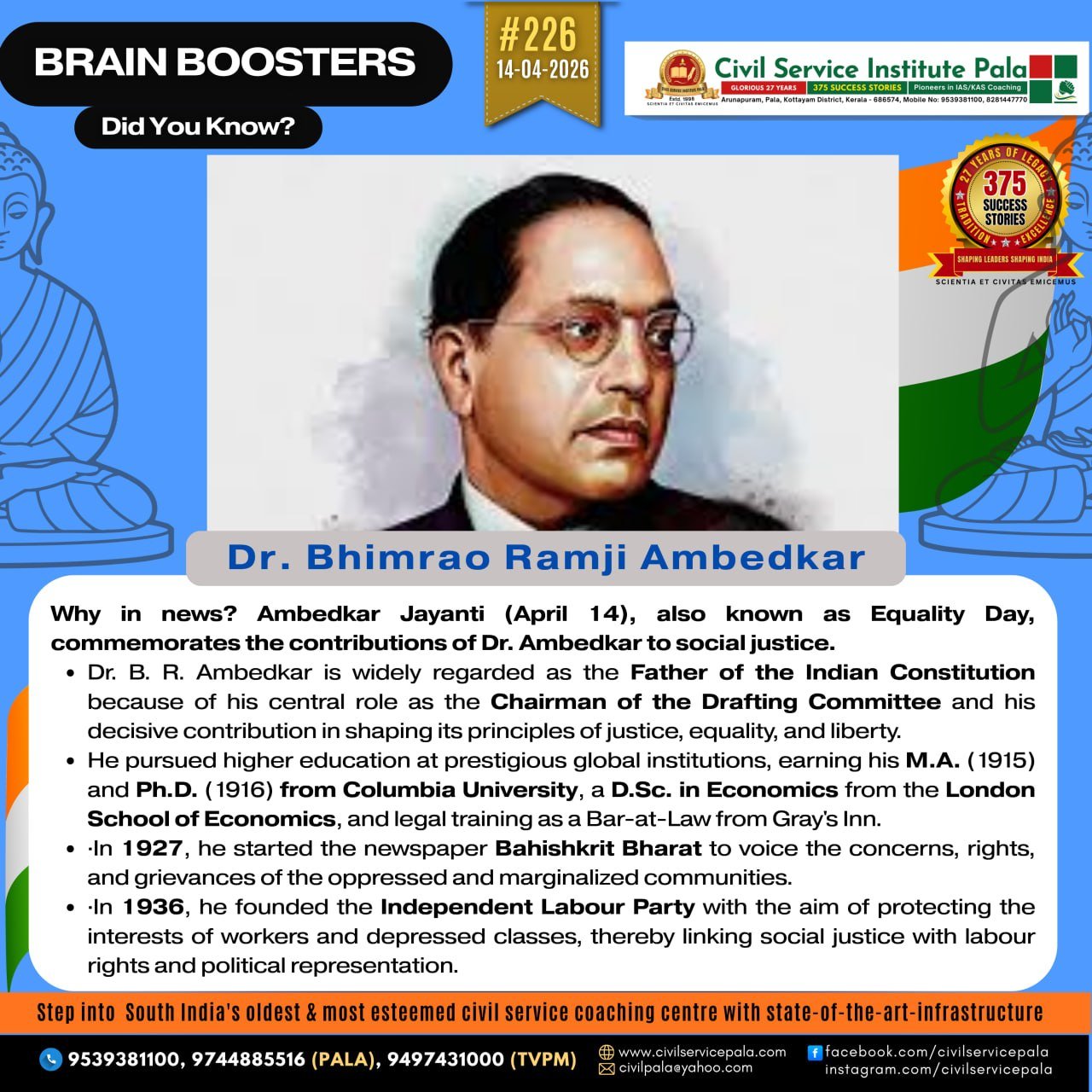
Dr. Bhimrao Ramji Ambedkar
Life, Education & Intellectual Formation
• Dr. B. R. Ambedkar is widely regarded as the Father of the Indian Constitution because of his central role as the Chairman of the Drafting Committee and his decisive contribution in shaping its principles of justice, equality, and liberty.
• He pursued higher education at prestigious global institutions, earning his M.A. (1915) and Ph.D. (1916) from Columbia University, a D.Sc. in Economics from the London School of Economics, and legal training as a Bar-at-Law from Gray's Inn.
Social & Political Initiatives
• In 1927, he started the newspaper Bahishkrit Bharat to voice the concerns, rights, and grievances of the oppressed and marginalized communities, and to promote social awareness and reform.
• In 1936, he founded the Independent Labour Party with the aim of protecting the interests of workers and depressed classes, thereby linking social justice with labour rights and political representation.
• In 1942, he was appointed as the Labour Member in the Viceroy’s Executive Council, where he contributed to policies related to labour welfare, working conditions, and economic reforms under colonial administration.
Role in Constitution Making & Governance
• In 1946, he became a Member of the Constituent Assembly, where he played a crucial role in shaping the legal and institutional framework of independent India.
• As the Chairman of the Drafting Committee, he was primarily responsible for drafting and refining the Indian Constitution, ensuring it embodied democratic values, fundamental rights, and safeguards for marginalized groups.
• After independence, he served as the first Law Minister of India (1947–1951), during which he worked on legal reforms but later resigned due to differences over key policy issues such as the Hindu Code Bill.
Economic Thought & Institutional Contributions
• His scholarly work on finance and currency significantly influenced the Hilton Young Commission, which later contributed to the establishment of modern financial institutions in India.
• He played an important conceptual role in the formation of the Reserve Bank of India, as his ideas on monetary policy and financial governance were considered in shaping the central banking system.
Ideology & Approach to Social Reform
• He was a strong and consistent critic of the caste system, viewing it as a deeply entrenched social injustice that needed complete eradication rather than superficial reform.
• He rejected symbolic measures such as merely changing the name of “untouchables,” arguing that such actions do not address the root causes of social inequality or bring real empowerment.
• Instead, he advocated for structural changes in society, including legal safeguards, education, economic upliftment, and political representation, to achieve genuine social transformation.
Core Contributions
🔹 1. Social Justice
• He dedicated his life to the eradication of caste discrimination, consistently challenging the social structures that perpetuated inequality and oppression.
• Through his movements, writings, and institutions, he worked towards the empowerment of marginalized communities, ensuring their access to education, rights, and dignity.
🔹 2. Constitutionalism
• He laid the legal and institutional foundation for democracy and equality in India, ensuring that the Constitution enshrined values such as liberty, equality, and fraternity.
• He also ensured the creation of institutional safeguards for fundamental rights, particularly to protect vulnerable sections from discrimination and injustice.
🔹 3. Economic Vision
• His academic and policy work reflected a deep understanding of public finance, monetary policy, and labour rights, linking economic structures with social justice.
• His early ideas and research influenced institutions like the Reserve Bank of India and contributed to broader discussions on economic planning and financial stability.
Conversion to Buddhism
• In line with his rejection of caste-based inequality, he formally converted to Buddhism on 14 October 1956 in Nagpur, marking a significant ideological and social shift.
• Through this conversion, he embraced and promoted the principles of equality, rationality, and social justice, which he found aligned with his vision for society.
• In recognition of his contribution to Buddhist thought and social reform, he was conferred the title of “Bodhisattva” at the World Buddhist Conference held in Kathmandu in 1954.
Key Writings & Academic Contributions
• In his seminal work Castes in India: Their Mechanism, Genesis and Development (1916), he provided a systematic analysis of the origin and functioning of the caste system in India.
• In Evolution of Provincial Finance in British India, he examined the historical development and structure of financial administration under colonial rule.
• In The Problem of the Rupee: Its Origin and Solution, he critically analyzed India’s monetary system and proposed reforms for currency stability.
• In Who Were the Shudras?, he explored the historical roots and social positioning of the Shudra community within the caste hierarchy.
• In Thoughts on Linguistic States, he discussed the reorganization of states in India on linguistic lines, emphasizing administrative efficiency and national unity.
Relevance Today
• The ideas of Dr. B. R. Ambedkar remain highly relevant in contemporary India, as issues such as caste inequality, social exclusion, and economic disparity continue to persist in various forms.
• His vision continues to guide the pursuit of inclusive development, where growth is not limited to a few but benefits all sections of society, especially the marginalized.
• His emphasis on social justice policies is reflected in modern welfare measures and affirmative action aimed at reducing historical inequalities.
• His commitment to democratic governance remains significant, as his constitutional framework ensures accountability, rule of law, and protection of fundamental rights.
