



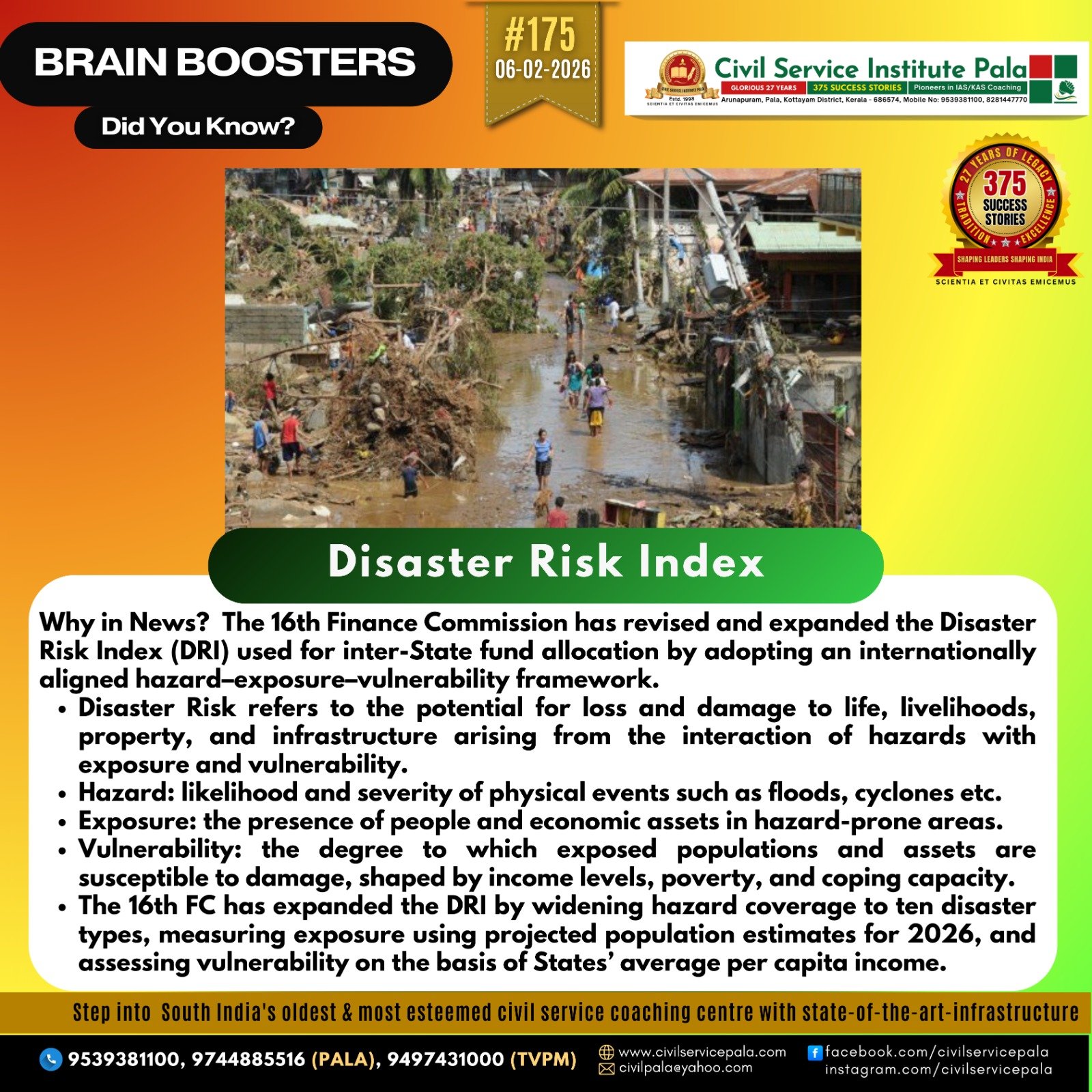
Disaster Risk Index
Why in News? The 16th Finance Commission has revised and expanded the Disaster Risk Index (DRI) used for inter-State fund allocation by adopting an internationally aligned hazard–exposure–vulnerability framework.
Disaster Risk refers to the potential for loss and damage to life, livelihoods, property, and infrastructure arising from the interaction of hazards with exposure and vulnerability.
As per the United Nations Office for Disaster Risk Reduction (UNDRR) and Intergovernmental Panel on Climate Change (IPCC), disaster risk exists only when hazard, exposure, and vulnerability intersect, and is therefore a multiplicative function of these three components.
Core components of Disaster Risk :
(a) Hazard - The probability and intensity of potentially damaging physical events such as floods, droughts, cyclones, earthquakes, heatwaves, etc.
(b) Exposure - The presence of people, infrastructure, crops, and economic assets in areas that may be affected by hazards.
(c) Vulnerability - The susceptibility of exposed elements to damage, shaped by factors such as income levels, poverty, capacity to cope, and access to resources for prevention and mitigation.
The 16th Finance Commission adopted the UNDRR–IPCC framework and defined disaster risk as a multiplicative function of hazard, exposure, and vulnerability.
Expanded hazard coverage:
The Commission expanded the hazard list to ten disasters, including floods, droughts, cyclones, earthquakes, landslides, heatwaves, lightning, and cloudbursts, with hazard scores assigned using quintile-based rankings weighted by actual disaster expenditure.
Improved exposure measurement:
Exposure is measured using projected population for 2026.
Refined vulnerability indicator:
Vulnerability is assessed using States’ average per capita income (average from 2018 19 to 2023 24) instead of BPL population, reflecting both susceptibility and economic capacity to manage disaster risks.
Revised allocation formula:
30% of disaster-related allocations are based on the Disaster Risk Index, while 70% are linked to States’ historical expenditure (2011 12 to 2023 24), with a base allocation indexed at 5% annual growth.