



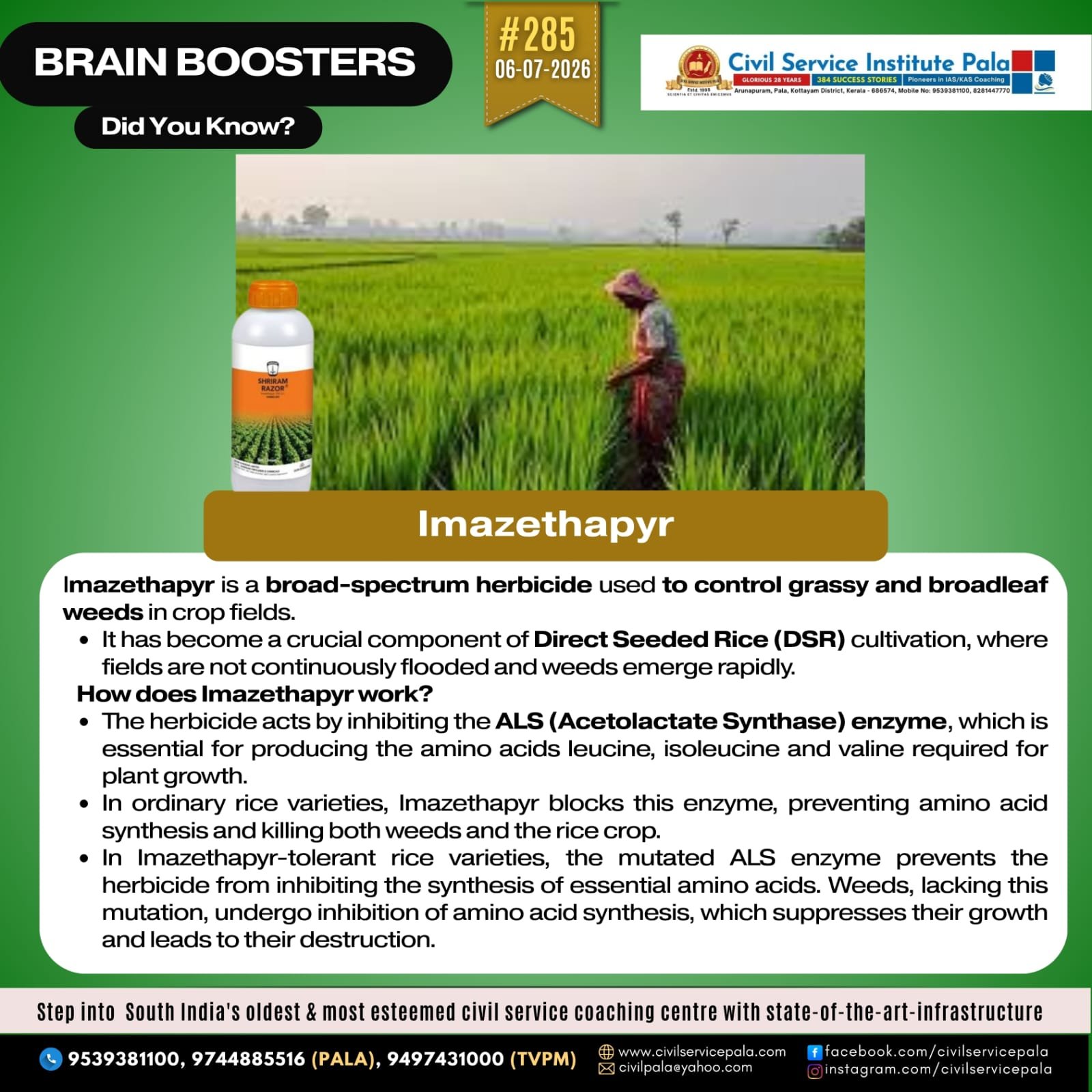
Direct Seeded Rice (DSR) & Imazethapyr Herbicide
Direct Seeded Rice (DSR) & Imazethapyr Herbicide
Why in News?
The possibility of below-normal monsoon conditions has increased interest in Direct Seeded Rice (DSR) cultivation, as it significantly reduces water and labour requirements compared to conventional paddy cultivation. The adoption of DSR is being facilitated by new Imazethapyr herbicide-tolerant (HT) basmati varieties developed by the Indian Agricultural Research Institute (IARI).
Imazethapyr: The Key Enabler of DSR
What is Imazethapyr?
• Imazethapyr is a broad-spectrum herbicide used to control grassy and broadleaf weeds in crop fields.
• It has become a crucial component of Direct Seeded Rice (DSR) cultivation, where fields are not continuously flooded and weeds emerge rapidly.
How does Imazethapyr work?
• The herbicide acts by inhibiting the ALS (Acetolactate Synthase) enzyme, which is essential for producing the amino acids leucine, isoleucine and valine required for plant growth.
• In ordinary rice varieties, Imazethapyr blocks this enzyme, preventing amino acid synthesis and killing both weeds and the rice crop.
Why do HT rice varieties survive?
• The Imazethapyr-tolerant (HT) basmati varieties possess a mutated ALS gene developed through non-genetically modified mutation breeding.
• The mutation alters the enzyme's binding site, preventing Imazethapyr from attaching to it.
• As a result, the rice plant continues normal growth while the herbicide selectively kills only the weeds.
• Pusa Basmati-1985 and Pusa Basmati-1979 are the HT basmati varieties developed by IARI.
• These are not genetically modified (GM) crops. Rather, they were developed through mutation breeding by modifying a naturally occurring gene.
Direct Seeded Rice (DSR)
What is DSR?
• Direct Seeded Rice (DSR) is a method in which paddy seeds are directly sown into the main field, similar to wheat cultivation.
• It eliminates the need for raising nurseries, uprooting seedlings and transplanting them into puddled fields.
Why is DSR gaining importance?
• It substantially reduces water consumption, making it suitable during years of rainfall deficit.
• It addresses the growing shortage of agricultural labour required for transplanting.
• It shortens the cultivation process by eliminating nursery preparation and transplantation operations.
Traditional Paddy Transplantation
• Paddy seeds are first sown in nurseries and grown into seedlings for about 25–30 days before being shifted to the main field.
• The main field is prepared through puddling, which involves repeated tilling under flooded conditions to create a soft seedbed.
• The seedlings are manually uprooted from the nursery and transplanted into the puddled field.
• Standing water is maintained during the early stages of crop growth, naturally suppressing weed germination and growth.
• The method is highly labour-intensive because it requires nursery preparation, uprooting and transplantation of seedlings.
• It is also highly water-intensive, requiring repeated irrigation and continuous flooding throughout much of the crop period.
Direct Seeded Rice (DSR)
• Paddy seeds are directly sown into the main field without first raising seedlings in a nursery.
• DSR eliminates the need for puddling, continuous flooding and manual transplantation of seedlings.
• Since standing water is absent, weeds are controlled using herbicides such as Imazethapyr instead of natural water suppression.
• The technology significantly reduces labour requirements by eliminating nursery preparation and transplantation operations.
• DSR saves approximately 30–35% of irrigation water, as fields only need to be kept moist rather than continuously flooded.
• The technology has gained importance in regions facing water scarcity and increasing agricultural labour shortages.
How DSR Reduces Water Use
• Conventional transplanted paddy cultivation requires continuous flooding, particularly during the initial weeks after transplantation, along with multiple irrigations throughout the crop season.
• Direct Seeded Rice (DSR) eliminates the need for continuous flooding, as the fields are maintained only under moist conditions rather than standing water.
• The reduced irrigation requirement enables DSR to save approximately 30–35% of water compared to conventional transplanted paddy cultivation.
How DSR Reduces Labour Requirement
• DSR eliminates the need for nursery preparation (paneeri), uprooting seedlings and manually transplanting them into the main field.
• The technology significantly reduces the labour requirement associated with paddy cultivation by removing these labour-intensive operations.
• As a result, DSR has emerged as an effective alternative in regions experiencing agricultural labour shortages.
