



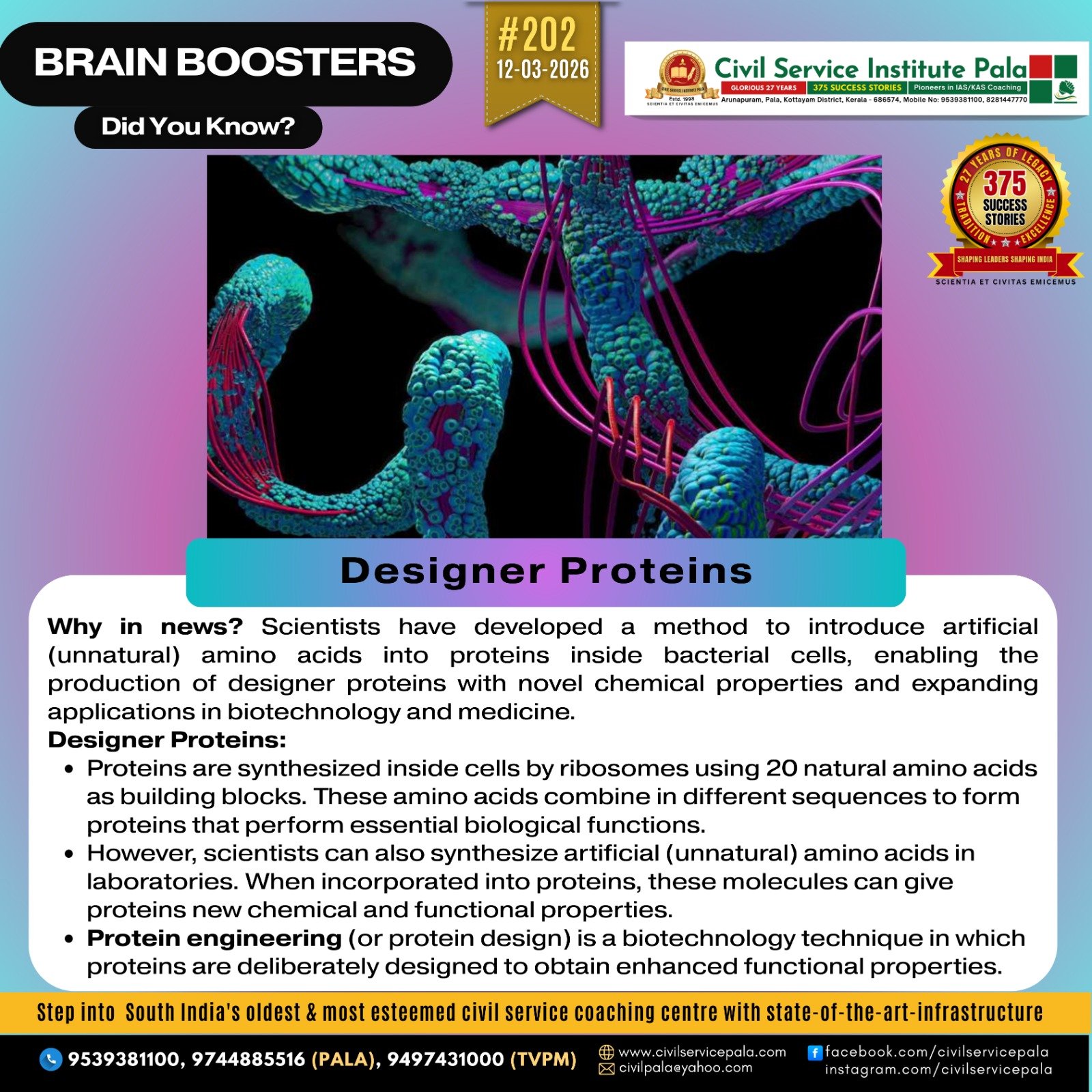
Designer Proteins
Why in News:
Scientists have developed a method to introduce artificial (unnatural) amino acids into proteins inside bacterial cells, enabling the production of designer proteins with novel chemical properties and expanding applications in biotechnology and medicine.
Designer Proteins:
Proteins are synthesized inside cells by ribosomes using 20 natural amino acids as building blocks. These amino acids combine in different sequences to form proteins that perform essential biological functions.
However, scientists can also synthesize artificial (unnatural) amino acids in laboratories. When incorporated into proteins, these molecules can give proteins new chemical and functional properties.
Protein Engineering:
Protein engineering (or protein design) is a biotechnology technique in which proteins are deliberately modified or designed to obtain enhanced or entirely new functional properties.
Main Technological Innovation
Researchers engineered a bacterial peptide transporter (ABC transporter) to act as a “Trojan horse” that carries artificial amino acids into the cell.
Process in simple terms:
1. Artificial amino acid is hidden inside a short peptide (3–4 amino acids long).
2. The bacterial ABC transporter imports the peptide as a nutrient.
3. Cellular enzymes break the peptide into individual amino acids.
4. The artificial amino acid becomes available for protein synthesis by ribosomes.
Importance of the Discovery
• The engineered transporter can import up to 10× more artificial amino acids than earlier systems.
• It works efficiently even in complex growth media with competing natural peptides.
• The method allows routine production of proteins containing artificial amino acids.
Potential Applications
• Targeted drug delivery using engineered antibodies.
• Creation of multifunctional therapeutic proteins.
• Development of advanced biomaterials and enzymes.
• Future possibility of engineering human cells to produce artificial therapeutic proteins.
