



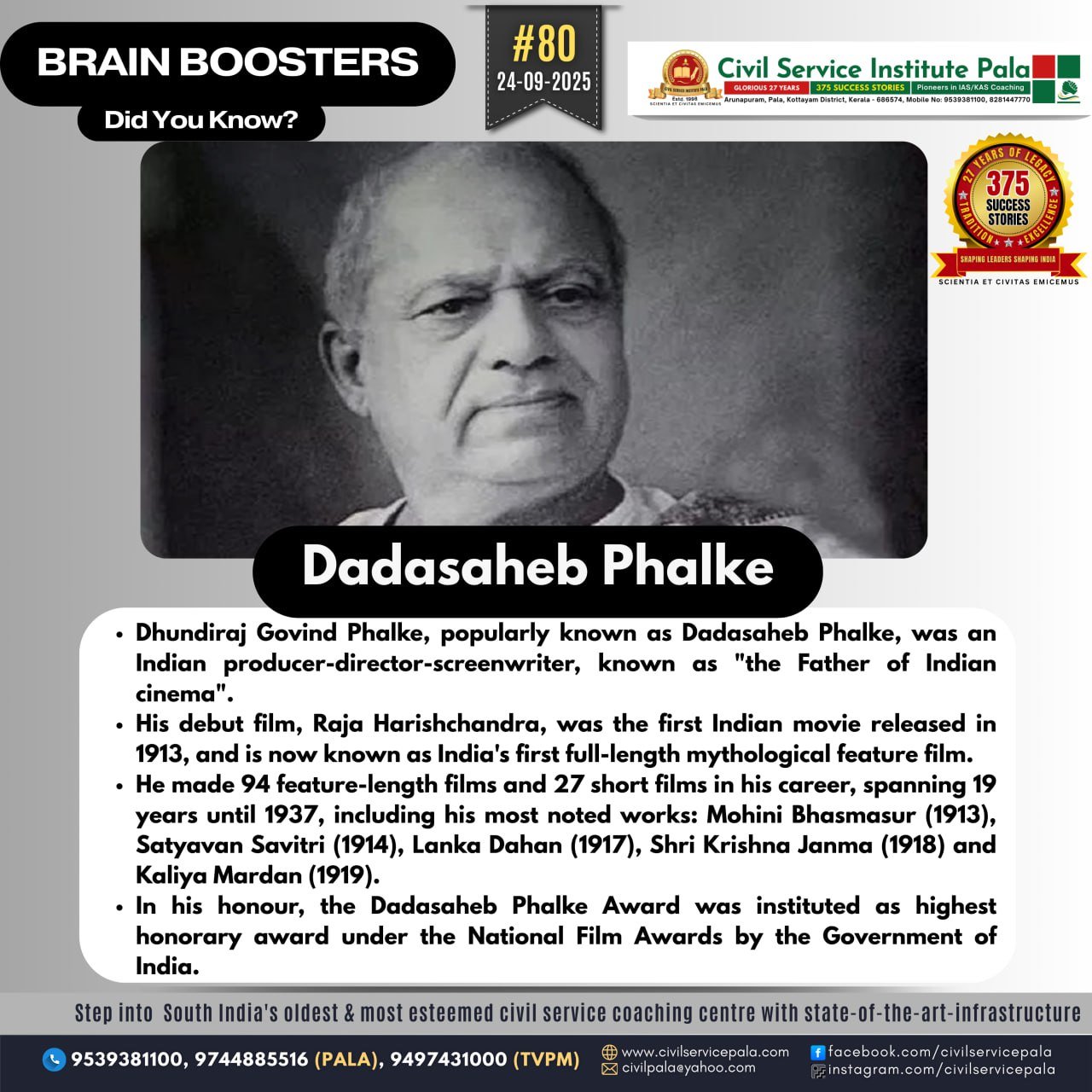
Dadasaheb Phalke
Dadasaheb Phalke, born Dhundiraj Govind Phalke on April 30, 1870, in Trimbak, Maharashtra, is widely regarded as the Father of Indian Cinema. He was a pioneering Indian film producer, director, and screenwriter who made India's first full-length feature film, Raja Harishchandra, released in 1913. This silent mythological film laid the foundation for the Indian film industry and marked the beginning of Indian cinema.
Phalke was a talented technician and innovator who experimented with special effects and trick photography. Over 19 years until 1937, he produced and directed 94 feature-length films and 27 shorts, with notable works including Mohini Bhasmasur (1913), Satyavan Savitri (1914), Lanka Dahan (1917), Shri Krishna Janma (1918), and Kaliya Mardan (1919). His films often drew from Indian mythology and folklore.
He overcame several challenges such as lack of resources, societal taboos (like casting a woman in Mohini Bhasmasur), and technical difficulties to establish a distinct Indian cinematic style. His first film premiered on May 3, 1913, in Bombay and was a commercial success, proving the viability of an Indian film industry. In recognition of his monumental contributions, the Government of India instituted the Dadasaheb Phalke Award in 1969, the highest honor in Indian cinema, awarded annually for lifetime achievement in film.
Despite his early successes, Phalke faced difficulties later in his career with the advent of sound films and other changes, eventually withdrawing from filmmaking. He passed away on February 16, 1944, in Nashik. His legacy remains a cornerstone of Indian cinema history.
