



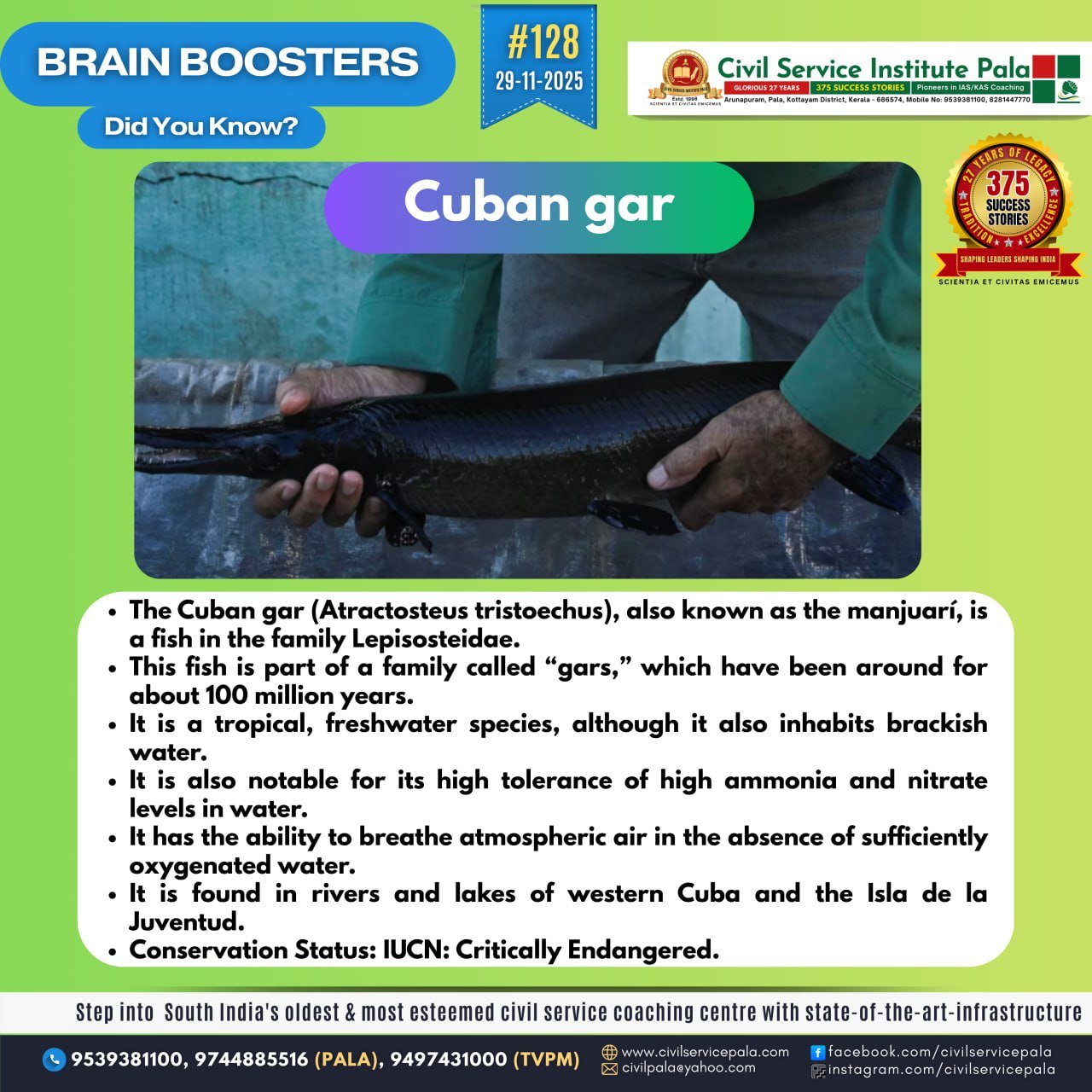
Cuban Gar
The Cuban gar (Atractosteus tristoechus) is a fascinating, ancient fish species found only in Cuba, making it endemic to the island nation. It belongs to the gar family (Lepisosteidae), a lineage of fish that has existed for over 100 million years, often called “living fossils.”
Key Features
1. Appearance
Has an elongated, torpedo-shaped body like other gars.
Covered with ganoid scales—diamond-shaped, thick, bony plates that act like natural armor.
Features a broad snout (wider than the alligator gar) and sharp teeth adapted for predation. Usually olive to brownish on top with lighter undersides for camouflage.
2. Habitat and Distribution
Found only in Cuba, especially in:
Slow-moving rivers,
Lagoons,
Freshwater swamps,
Brackish coastal areas. Historically had a wider distribution but is now restricted due to habitat degradation.
3. Diet and Ecology
A top predator in Cuban freshwater ecosystems.
Feeds on: Fish, Crustaceans, Occasionally small birds or amphibians.
Plays an important role in maintaining ecological balance by controlling prey populations.
4. Reproduction
Spawns in shallow, vegetated waters during warm seasons.
Females lay adhesive eggs that stick to plants.
The eggs are toxic to humans and animals, a defense mechanism against predators.
5. Conservation Status
Listed as Critically Endangered due to:
Habitat loss,
Pollution,
Overfishing,
Competition with introduced species.
Conservation efforts in Cuba include captive breeding programs and habitat protection.
6. Importance
Holds ecological, cultural, and scientific value.
As a “living fossil,” it helps scientists study evolutionary adaptations over millions of years.
