



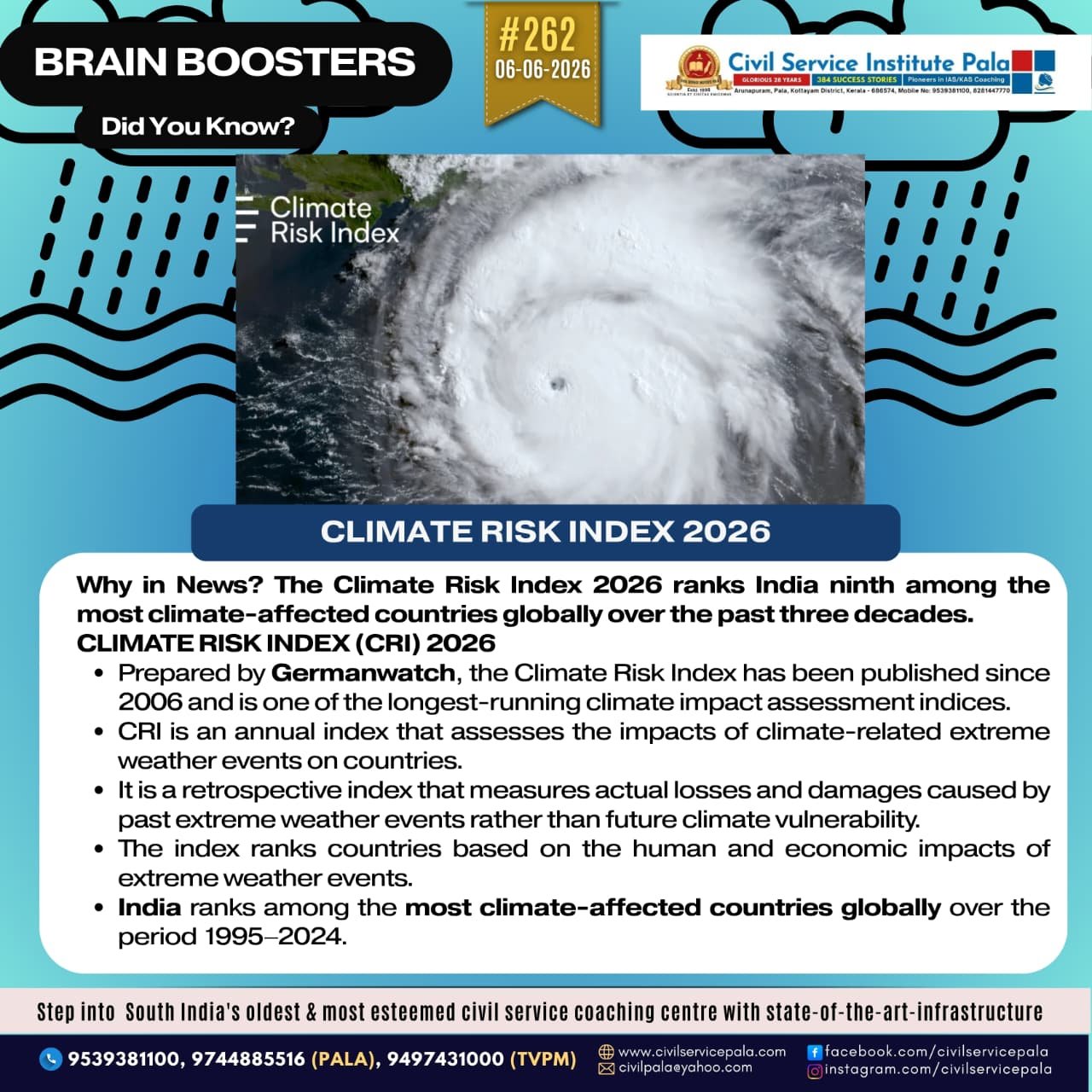
Climate Risk Index (CRI) 2026 – India, Asia and Climate Vulnerability
Climate Risk Index (CRI) 2026 – India, Asia and Climate Vulnerability
Why in News?
The Climate Risk Index (CRI) 2026 ranked India among the ten most climate-affected countries globally over the last three decades (1995–2024).
The report highlights the increasing human and economic costs of extreme weather events and underscores the need for stronger climate resilience and adaptation measures.
What is the Climate Risk Index (CRI)?
The Climate Risk Index (CRI) is an annual index that assesses the impacts of climate-related extreme weather events on countries.
It has been published since 2006 and is one of the longest-running climate impact assessment indices.
The index is prepared by the Germanwatch.
It is a retrospective index, meaning it measures actual losses and damages caused by past extreme weather events rather than future climate vulnerability.
The index ranks countries based on the human and economic impacts of extreme weather events.
How is the Index Calculated?
Hazard Categories Assessed
Hydrological hazards include floods, flash floods, and landslides.
Meteorological hazards include storms, cyclones, and extreme rainfall events.
Climatological hazards include heat waves, droughts, and wildfires.
Indicators Used
The CRI uses six indicators:
Economic losses (absolute terms). (16.67%)
Economic losses (relative to GDP). (33.33%)
Number of fatalities (absolute terms). (10%)
Number of fatalities (relative terms). (20%)
Number of people affected (absolute terms). (6.67%)
Number of people affected (relative terms). (13.33%)
Data Sources
The index uses data from the International Disaster Database (EM-DAT), World Bank, and International Monetary Fund
India in the Climate Risk Index
India ranks among the most climate-affected countries globally over the period 1995–2024.
India's position is largely driven by recurrent extreme weather events rather than isolated catastrophic disasters.
Frequent floods, cyclones, heat waves, heavy rainfall events, droughts, and landslides contribute significantly to India's ranking.
India's large population and extensive climate-sensitive sectors such as agriculture increase vulnerability to climate shocks.
The ranking demonstrates the growing importance of climate adaptation, disaster preparedness, and resilient infrastructure in India.
Global South
Global South remains one of the most climate-vulnerable regions in the world due to high population density, extensive coastlines, and dependence on climate-sensitive livelihoods.
Several Asian countries feature prominently among the most climate-affected nations because of recurring floods, cyclones, heat waves, and droughts.
Small Island Developing States (SIDS) and densely populated coastal regions in global south face heightened risks from sea-level rise and extreme weather events.
Climate change is transforming previously rare extreme events into recurring threats across the region.
Key Findings of CRI 2026
More than 832,000 deaths were linked to extreme weather events globally between 1995 and 2024.
Direct economic losses exceeded USD 4.5 trillion during the same period.
Over 9,700 extreme weather events were recorded worldwide.
Climate-related disasters are becoming more frequent and intense.
Human-induced climate change is increasing both the frequency and severity of extreme weather events.
Global South and Climate Justice
The CRI indicates that developing countries are disproportionately affected by climate-related disasters.
Countries in the Global South often experience greater losses due to limited adaptive capacity and weaker resilience infrastructure.
Climate vulnerability is closely linked to development challenges, poverty, and institutional capacity.
The findings strengthen calls for enhanced climate finance, technology transfer, and support for loss and damage mechanisms.
Way Forward
Strengthen climate-resilient infrastructure and urban planning.
Expand early warning systems and disaster preparedness mechanisms.
Increase investment in adaptation measures, especially in vulnerable regions.
