



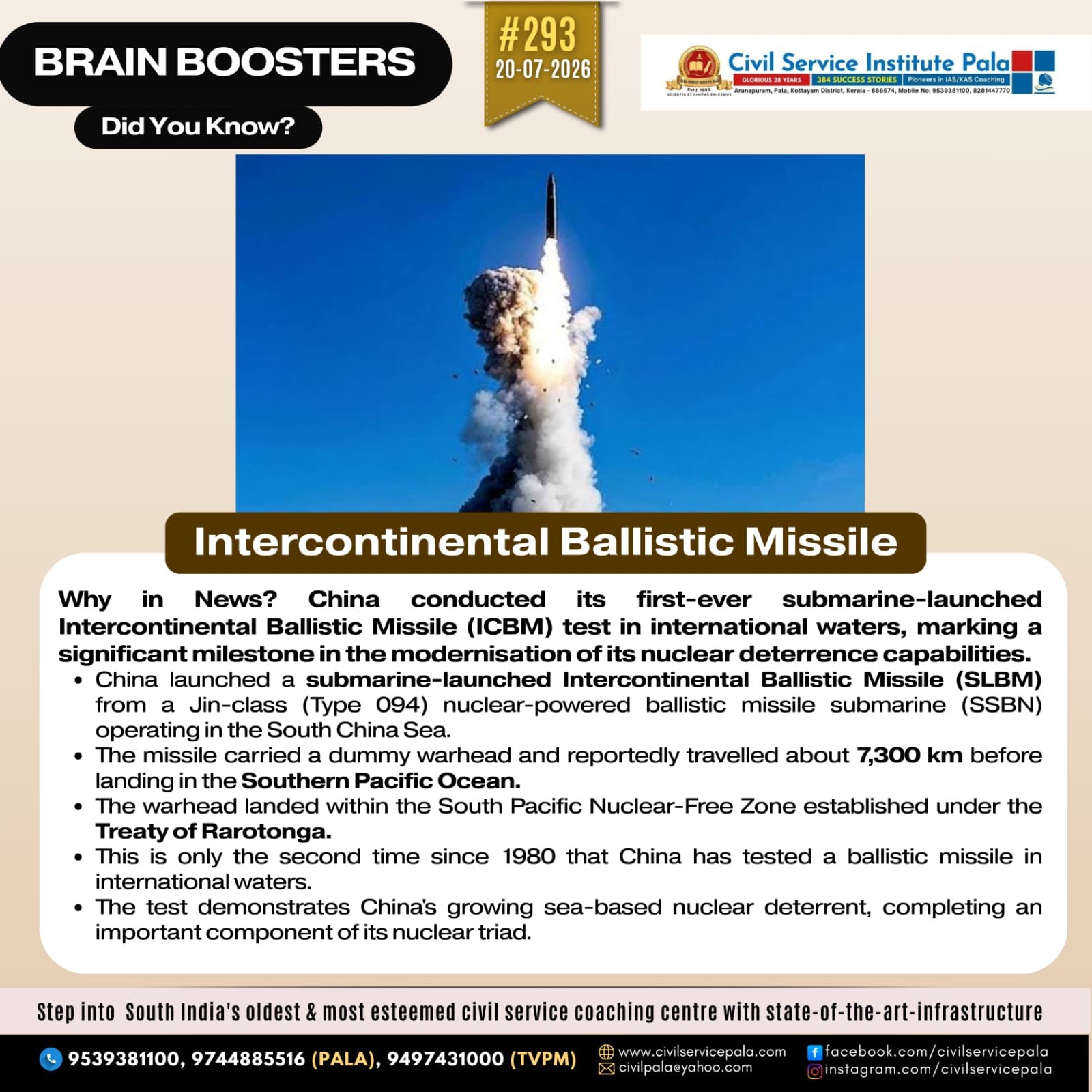
China's Sea-based ICBM Test
China's Sea-based ICBM Test
Why in News?
China conducted its first-ever submarine-launched Intercontinental Ballistic Missile (ICBM) test in international waters, marking a significant milestone in the modernisation of its nuclear deterrence capabilities.
China's Sea-based ICBM Test
What happened?
• China launched a submarine-launched Intercontinental Ballistic Missile (SLBM) from a Jin-class (Type 094) nuclear-powered ballistic missile submarine (SSBN) operating in the South China Sea.
• The missile carried a dummy warhead and reportedly travelled about 7,300 km before landing in the Southern Pacific Ocean.
• The warhead landed within the South Pacific Nuclear-Free Zone established under the Treaty of Rarotonga.
• This is only the second time since 1980 that China has tested a ballistic missile in international waters.
Which Missile Was Tested?
• The missile is believed to be either the Ju Lang-2 (JL-2) or the more advanced Ju Lang-3 (JL-3) submarine-launched ballistic missile.
• Both are Intercontinental Ballistic Missiles (ICBMs) capable of carrying nuclear warheads.
• The JL-2 has an estimated range of 8,000–9,000 km.
• The JL-3 is estimated to have a range exceeding 9,000 km.
• Both missiles are designed to be launched from Type 094 (Jin-class) SSBNs.
Why is the Test Significant?
Strengthening the Nuclear Triad
• The test demonstrates China's growing sea-based nuclear deterrent, completing an important component of its nuclear triad.
Nuclear Triad refers to the ability to deliver nuclear weapons through:
• Land-based ballistic missiles
• Submarine-launched ballistic missiles (SLBMs)
• Strategic bombers
A credible nuclear triad improves the survivability of a country's nuclear forces.
Enhancing Second-Strike Capability
• Ballistic missile submarines remain hidden underwater, making them difficult to detect and destroy.
• This greatly strengthens China's second-strike capability, ensuring it can retaliate even after suffering a nuclear attack.
• A survivable second-strike capability forms the foundation of nuclear deterrence.
Demonstration of Nuclear Modernisation
• The test forms part of China's broader programme of:
o expanding missile silos,
o modernising nuclear delivery systems,
o improving command and control,
o strengthening its strategic deterrence.
China's Nuclear Doctrine
Key Features
• No-First-Use (NFU) Policy
• Assured Retaliation
• Commitment not to use or threaten nuclear weapons against non-nuclear weapon states or nuclear weapon-free zones.
Emerging Changes
Although China's official doctrine remains unchanged, its operational posture is evolving.
Recent developments include:
• Rapid expansion of nuclear warheads.
• Development of more diverse delivery systems.
• Movement towards a Launch-on-Warning posture, where retaliatory missiles may be launched immediately after detecting an incoming nuclear attack rather than waiting for an actual strike.
• Strengthening of nuclear command, control and communication systems.
These developments suggest a gradual shift away from China's traditional policy of minimum nuclear deterrence.
Implications for India
• The test highlights the widening gap between India and China's sea-based nuclear capabilities.
• While India has operationalised its Arihant-class SSBNs, its current submarine-launched ballistic missiles have comparatively shorter ranges.
• The development increases the importance of deploying India's longer-range K-5 and K-6 submarine-launched ballistic missiles.
• It also strengthens the case for expanding:
o anti-submarine warfare (ASW) capabilities,
o underwater surveillance,
o seabed domain awareness in the Indian Ocean Region.
Implications for the Indo-Pacific
• Demonstrates the growing maturity of China's nuclear deterrence.
• Increases the survivability of Chinese nuclear forces.
• Complicates missile defence planning for the United States and its allies.
• Raises the strategic costs of military intervention near China's sphere of influence, particularly in the Indo-Pacific.
