



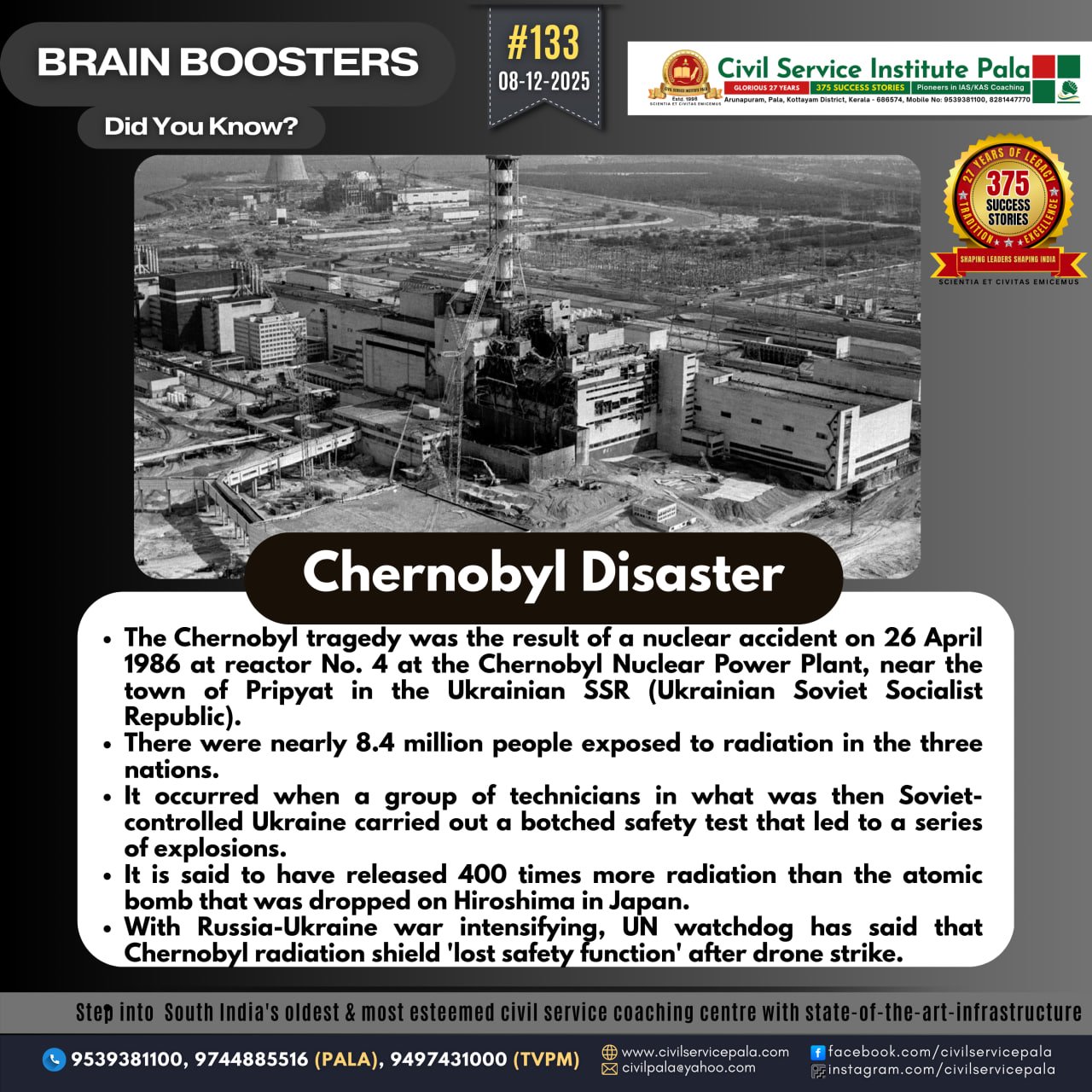
Chernobyl Disaster
What was the Chernobyl disaster
On 26 April 1986, at the nuclear power plant at Chernobyl Nuclear Power Plant (in what was then the USSR, now Ukraine), a test went catastrophically wrong: the reactor’s power output went out of control, causing explosions and a fire that blew off the heavy steel-and-concrete lid of the reactor.
Because the reactor design lacked a robust containment dome — common in many Western nuclear reactors — massive amounts of radioactive material (radionuclides) were released into the atmosphere, including iodine, caesium, plutonium, and others.
The released radiation spread over large parts of Ukraine, Belarus, Russia — and even reached many other European countries, carried by wind, contaminating soil, water, forests and farmland.
As a result: around 335,000 people were evacuated and displaced, large areas became uninhabitable, agriculture and forests were devastated, and the long-term environmental contamination proved severe.
On immediate fatalities: dozens died within months (from acute radiation sickness), but longer-term effects — increased cancer risk, other health problems — affected many more.
Beyond health and environment, the disaster triggered massive social, economic and political fallout: loss of livelihoods, collapse of agriculture in contaminated zones, widespread displacement, long-term stigma for affected regions.
It also shook global confidence in nuclear power: plans for further reactors (especially of similar design) were canceled, reactor-safety standards rethought worldwide, and more scrutiny placed on nuclear operations.
Recent developments & controversies (2025)
Though the disaster happened nearly 40 years ago, the site and its management remain embroiled in new controversies — especially due to the ongoing war in Ukraine.
In February 2025, a drone strike hit the protective structure covering the ruined reactor — known as the New Safe Confinement (NSC). According to the International Atomic Energy Agency (IAEA), the strike severely damaged the outer cladding and insulation of the shelter, causing fire and a breach in its safety functions.
The IAEA recently declared that the structure “has lost its primary safety functions, including the confinement capability.”
While, as of now, there is no detected radiation leak or rise in external radiation levels, the damage raises serious concerns about long-term containment and nuclear safety — especially given the fragile nature of the site.
The timing and nature of the attack — during a military conflict — underline a broader danger: nuclear sites in war zones become potential targets. This has sparked renewed global alarm about the risks of militarized nuclear infrastructure.
Meanwhile, there are moves to repurpose and “revive” the area: the operator of the plant and local authorities have signed a memorandum (2025) aiming to develop tourism — museum exhibits, historical-memory tours, educational projects — as part of efforts to rebuild the region and preserve memory of 1986.
This attempt to promote tourism raises debate: some see it as a path toward normalisation and remembrance, others fear it risks trivializing a catastrophe whose effects — contamination, health risks, displacement — persist.
Thus, the “Chernobyl story” is far from over. The site remains physically dangerous, politically sensitive, and symbolic — now also entangled in questions about nuclear safety in wartime, historical memory, and ethical boundaries of “dark tourism.”
Why Chernobyl still matters — and what’s at stake now
The damaged shelter at Chernobyl shows how even decades-old nuclear disasters remain unstable — containment isn’t guaranteed forever. What was considered “safe” can, under new conditions (war, neglect, damage), become dangerous again.
As global focus on nuclear energy resurges (for climate reasons), Chernobyl remains a stark reminder of worst-case scenarios — safety standards, reactor design, emergency preparedness, and the need for transparency.
There’s a moral and humanitarian dimension: the displaced communities, the “liquidators” (workers exposed to radiation), and even ecological consequences — soil, water, animals — are still affected in visible and invisible ways.
The current controversies around tourism, media narratives, and public memory highlight a struggle to balance remembrance and renewal, between exploiting historical interest and respecting tragedy.
