



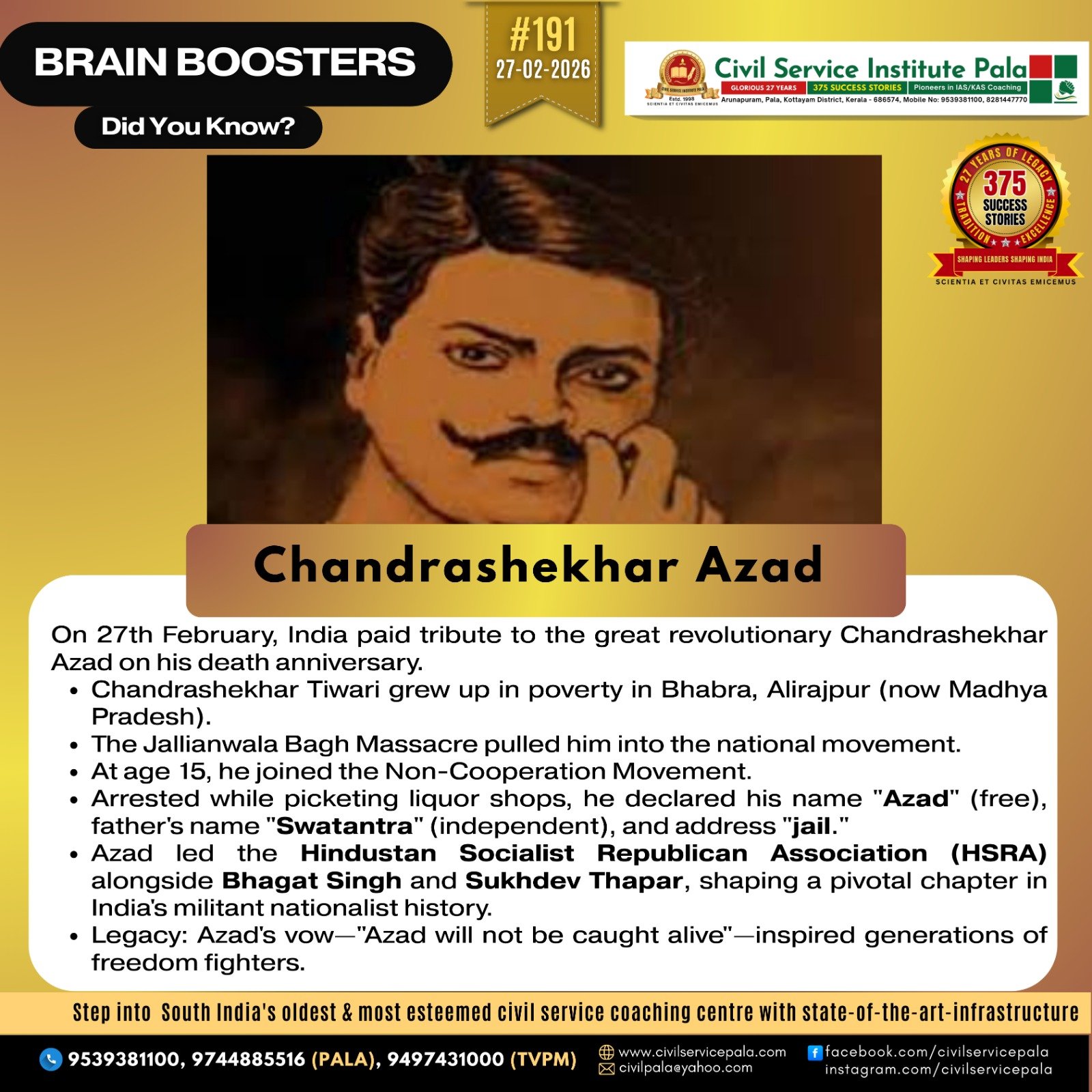
Chandrashekhar Azad
On 27th February, India paid tribute to the great revolutionary Chandrashekhar Azad on his death anniversary.
• Chandrashekhar Tiwari grew up in poverty in Bhabra, Alirajpur (now Madhya Pradesh).
• Turning point : The Jallianwala Bagh Massacre pulled him into the national movement. At age 15, he joined the Non-Cooperation Movement.
• Arrested while picketing liquor shops, he declared his name "Azad" (free), father's name "Swatantra" (independent), and address "jail."
• The Chauri Chaura incident forced Gandhi to stop the Non-Cooperation Movement. This sudden halt made Azad lose faith in the leadership's non-violence approach. It pushed him towards militant nationalism.
• Hindustan Republican Association (HRA) Formation (1924): Founded in Kanpur by Ramprasad Bismil, Jogesh Chandra Chatterjee, Sachin Sanyal to overthrow colonial rule via armed revolution.
• Kakori Robbery (1925): In 1925, HRA revolutionaries carried out the Kakori Robbery. They looted official cash from a train near Kakori, Lucknow. The British crackdown led to arrests and trials. Four leaders—Ramprasad Bismil, Ashfaqullah Khan, Roshan Singh, and Rajendra Lahiri—were hanged.
• HSRA Reorganisation (1928): In September 1928, revolutionaries held a key meeting at the Feroz Shah Kotla ruins in Delhi. Azad led the group and renamed the HRA to the Hindustan Socialist Republican Association (HSRA). Important members included Bhagat Singh, Sukhdev Thapar, Bhagwati Charan Vohra, Bejoy Kumar Sinha, Shiv Verma, and Jaidev Kapur.
• Assassination of Saunders : In 1928, revolutionaries sought to avenge Lala Lajpat Rai's death from a lathi charge. Bhagat Singh and Rajguru shot dead British officer John Saunders. Azad also shot an Indian constable who tried to pursue them as they fled.
• Martyrdom (27 Feb 1931): On 27 February 1931, Azad met fellow revolutionaries at Alfred Park in Allahabad. A traitor tipped off the British police, who surrounded them. Azad fought bravely but got injured. To avoid capture, he shot himself dead. His Colt pistol is now displayed at the Allahabad Museum.
Legacy: Azad's vow—"Azad will not be caught alive"—inspired generations of freedom fighters.
