



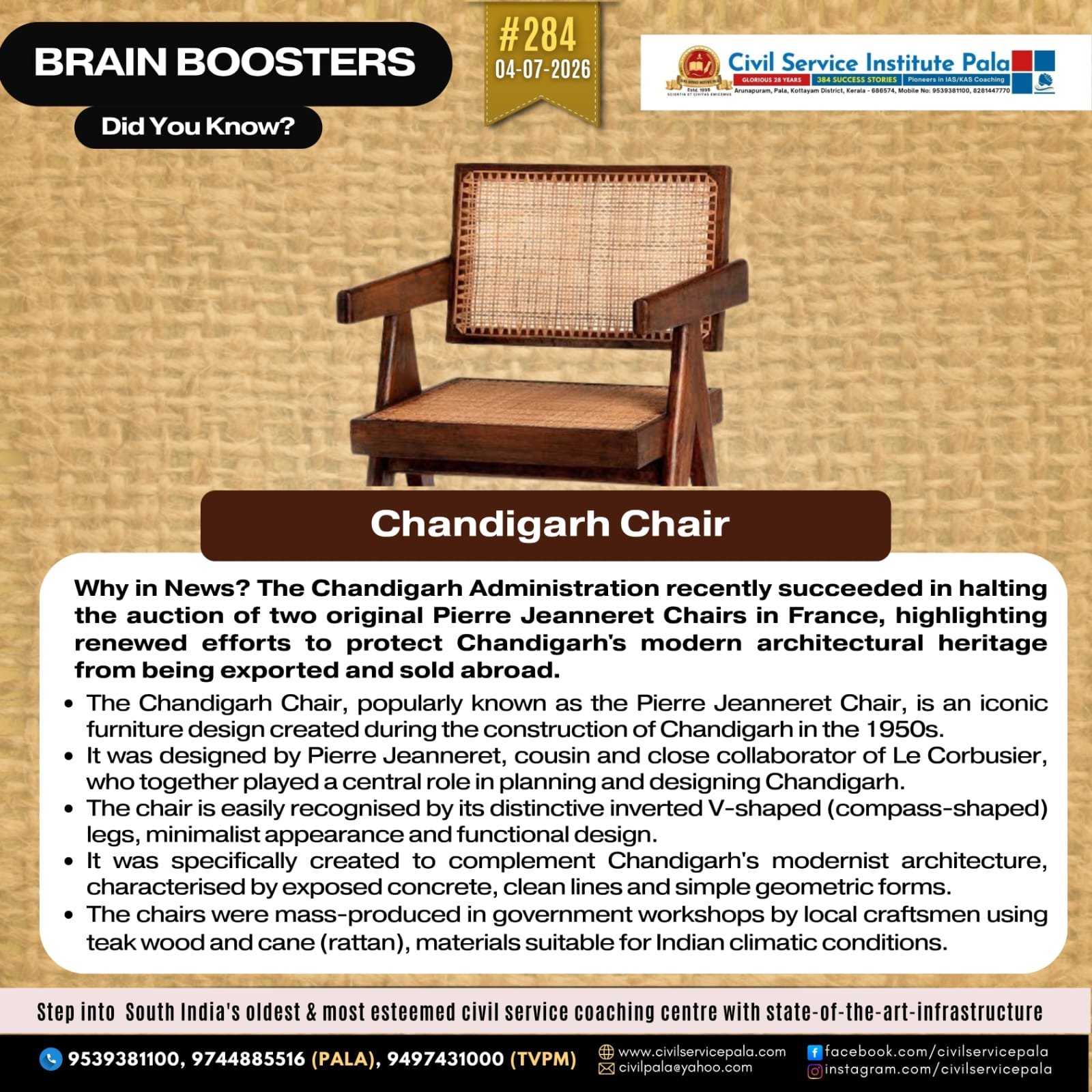
Chandigarh Chair (Pierre Jeanneret Chair)
Chandigarh Chair (Pierre Jeanneret Chair)
Why in News?
The Chandigarh Administration recently succeeded in halting the auction of two original Pierre Jeanneret Chairs in France, highlighting renewed efforts to protect Chandigarh's modern architectural heritage from being exported and sold abroad.
What is the Chandigarh Chair?
• The Chandigarh Chair, popularly known as the Pierre Jeanneret Chair, is an iconic furniture design created during the construction of Chandigarh in the 1950s.
• It was designed by Pierre Jeanneret, cousin and close collaborator of Le Corbusier, who together played a central role in planning and designing Chandigarh.
• The chair is easily recognised by its distinctive inverted V-shaped (compass-shaped) legs, minimalist appearance and functional design.
• It was specifically created to complement Chandigarh's modernist architecture, characterised by exposed concrete, clean lines and simple geometric forms.
Design and Construction
• The chairs were mass-produced in government workshops by local craftsmen using teak wood and cane (rattan), materials suitable for Indian climatic conditions.
• The design emphasised durability, comfort and ergonomics, providing good back support for long hours of use.
• Different versions were produced for different institutions:
o Capitol Complex chairs featured coloured leather upholstery and rounded armrests.
o Panjab University chairs had modified armrests to facilitate writing during lectures.
Role of the Chandigarh Collective
• Pierre Jeanneret worked with a group of architects known as the Chandigarh Collective.
• One of its prominent members was Urmila Eulie Chowdhury, who helped adapt the furniture designs to Indian requirements and everyday use.
From Government Furniture to Global Collectible
• For several decades, these chairs were used extensively in government offices, hospitals, educational institutions and other public buildings across Chandigarh.
• As newer steel furniture replaced them, many original chairs were discarded into government stores or sold as scrap.
• Beginning in the late 1990s and early 2000s, international antique dealers started acquiring these chairs from scrap dealers and government auctions at very low prices.
• Their exceptional design later gained worldwide recognition, transforming them into highly sought-after collectible pieces of modern furniture.
International Recognition
• Today, original Chandigarh Chairs form part of the permanent collections of internationally renowned museums, including - Victoria and Albert Museum, London and Museum of Modern Art (MoMA), New York.
• Auction prices have risen dramatically, with individual chairs fetching several tens of lakhs of rupees in international markets.
Government Protection Measures
• The Chandigarh Administration has recognised Pierre Jeanneret furniture as part of the city's listed heritage.
• Government departments were directed to prepare inventories of heritage furniture to prevent its disappearance.
• A 2011 Ministry of Home Affairs order prohibits export of Chandigarh heritage furniture outside India and transfer of such heritage articles between government institutions without prior authorisation.
• The administration has also approached foreign governments and embassies to stop overseas auctions of heritage furniture.
