



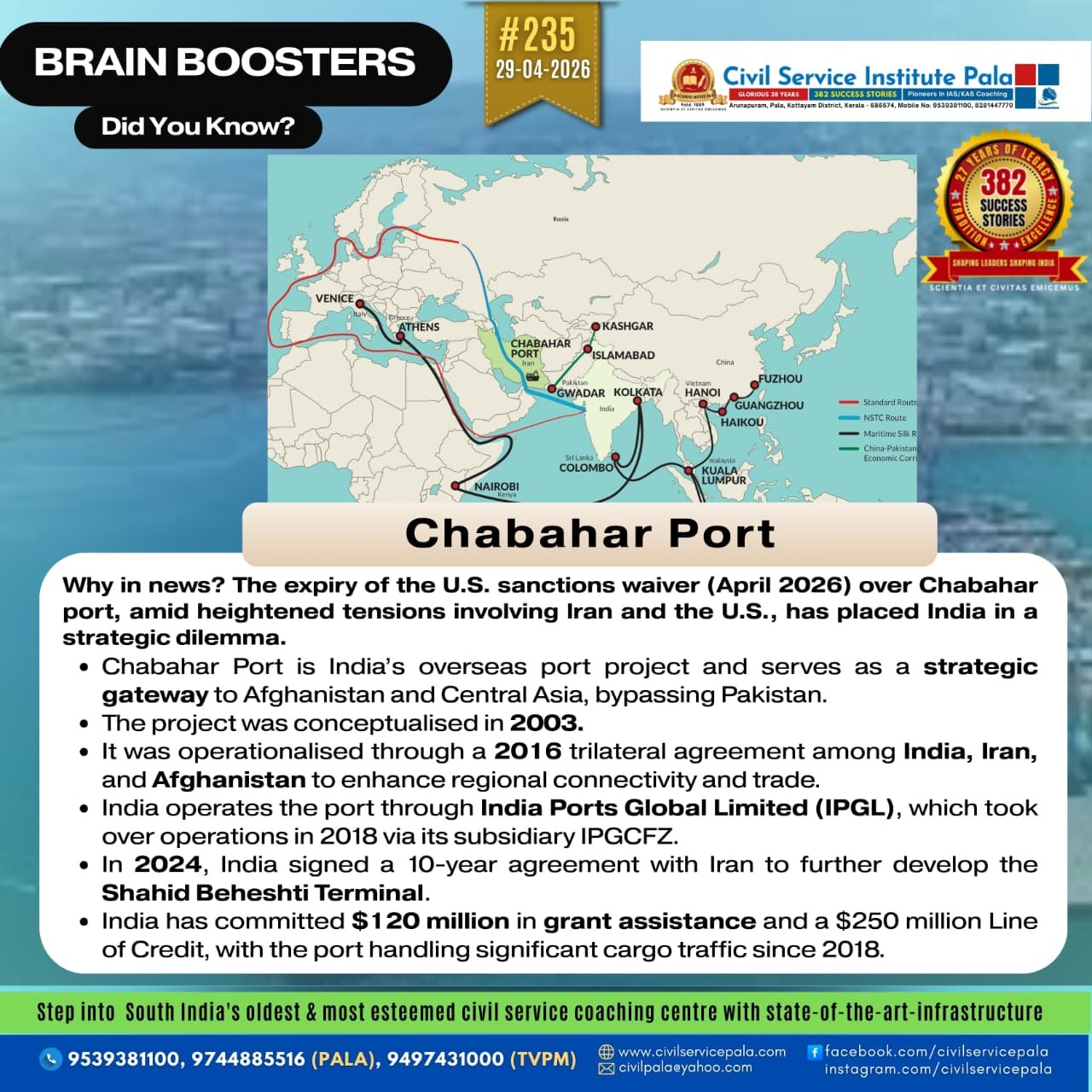
Chabahar Port
Chabahar Port
Chabahar Port, located in southeastern Iran, is India’s only overseas port project and serves as a strategic gateway to Afghanistan and Central Asia, bypassing Pakistan. The project was conceptualised in 2003 and operationalised through a 2016 trilateral agreement among India, Iran, and Afghanistan to enhance regional connectivity and trade.
India operates the port through India Ports Global Limited (IPGL), which took over operations in 2018 via its subsidiary IPGCFZ. In 2024, India signed a 10-year agreement with Iran to further develop the Shahid Beheshti Terminal. India has committed $120 million in grant assistance and a $250 million Line of Credit, with the port handling significant cargo traffic since 2018.
Recent Developments
The expiry of the U.S. sanctions waiver (April 2026), amid heightened tensions involving Iran and the U.S., has placed India in a strategic dilemma. With Washington signalling no extension under its sanctions regime, India faces a choice between continuing the project or avoiding sanctions exposure. In response, India has withdrawn personnel, prepaid investments, and is considering transferring its stake to an Iranian entity as a “tactical workaround” to retain long-term interests.
Challenges
• Persistent U.S. sanctions : curbs on oil trade and infrastructure cooperation has delayed progress.
• The revocation of the 2018 sanctions exemption in 2025 further constrained operations.
• Geopolitical instability in West Asia and policy shifts in the U.S. continue to undermine project viability.
Strategic Significance
1. Strategic Connectivity Advantage : Chabahar provides India with a direct maritime route to Afghanistan and Central Asia, bypassing Pakistan, whose land routes remain inaccessible for Indian trade. This makes it India’s only viable western corridor for regional connectivity.
2. Gateway to Eurasia : The port is a key node in the International North-South Transport Corridor (INSTC), which connects India to Iran, Russia, and Europe through integrated sea, road, and rail networks. This corridor is expected to reduce transit time and logistics costs compared to traditional routes such as the Suez Canal.
3. Counterbalance to Regional Geopolitics : Chabahar serves as a strategic counterweight to Gwadar Port, which is being developed by China under the China-Pakistan Economic Corridor. It enables India to maintain a strategic foothold in the region and avoid being excluded from emerging maritime and trade networks.
4. Energy and Economic Security : The port can function as a conduit for energy imports from Iran and Central Asia, helping India diversify supply sources and reduce dependence on politically sensitive or longer maritime routes.
5. Trade Expansion and Market Access : By opening access to landlocked regions, Chabahar enhances India’s export potential and strengthens trade linkages with Central Asia. It also supports integration into Eurasian markets.
6. Humanitarian and Development Role : The port has already been used as a logistics hub for humanitarian assistance, including wheat shipments to Afghanistan, demonstrating its practical utility beyond strategic considerations.
7. Regional Cooperation and Integration : Chabahar promotes broader regional economic integration by facilitating trade and connectivity among India, Iran, Afghanistan, and Central Asia, contributing to cooperative development in the region.
8. Strategic Autonomy and Long-Term Presence : India’s involvement reflects an effort to secure long-term geopolitical and economic interests in a competitive region, ensuring it retains influence amid growing external powers’ presence.
Despite challenges, Chabahar remains crucial for India’s connectivity strategy, especially as alternatives like IMEC face uncertainties. It strengthens India’s outreach to Central Asia, supports Afghanistan’s development, and enhances India’s role in regional trade networks. The Chabahar issue reflects a broader test of India’s strategic autonomy, balancing geopolitical pressures with long-term connectivity and regional influence. The evolving situation underscores the need for flexible diplomacy and diversified regional strategies.
