



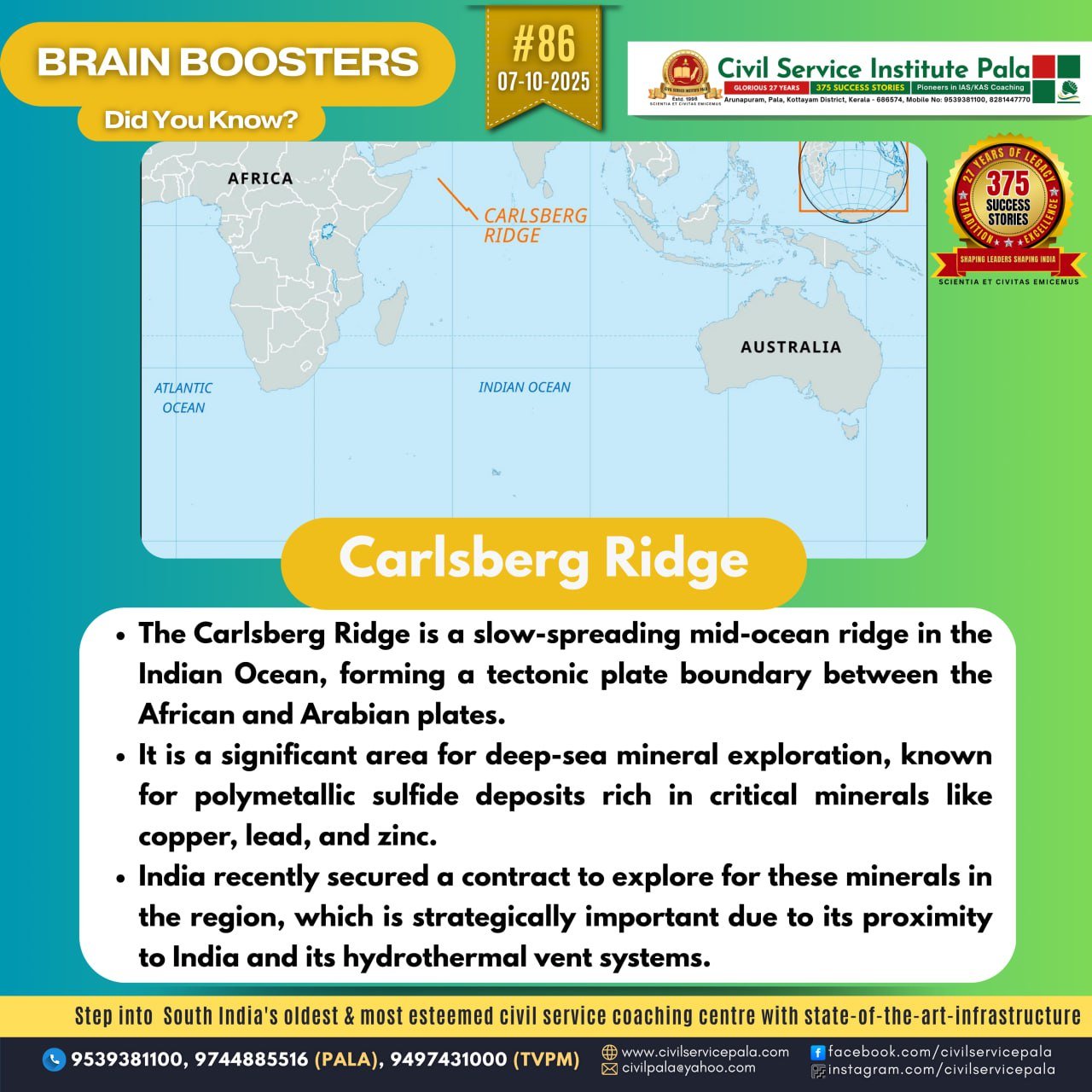
Carlsberg Ridge
The Carlsberg Ridge is a submarine (underwater) mountain range located in the Indian Ocean, and it forms an important part of the mid-ocean ridge system — the world’s longest mountain chain beneath the sea.
Location The Carlsberg Ridge lies in the northwestern Indian Ocean, between the Arabian Sea and the Central Indian Ridge. It extends roughly north-south, connecting with the Mid-Indian Ridge in the south and with the Owen Fracture Zone near the Arabian Sea in the north. It is located southwest of the Arabian Peninsula, between the Somali coast (Africa) and India.
Geological Nature The ridge is a divergent plate boundary, meaning it is a region where two tectonic plates move apart. Specifically, it separates the Somali Plate (to the west) and the Indian Plate (to the east). As the plates move away from each other, magma rises from the mantle, solidifies, and forms new oceanic crust — a process known as seafloor spreading. This continuous process causes the Indian Ocean basin to slowly widen over geological time.
Seismic and Volcanic Activity The ridge is seismically active because of plate movements. Earthquakes and underwater volcanic eruptions are common along the ridge. These activities contribute to the creation of new crust and hydrothermal vents that support unique marine ecosystems.
Scientific Importance The Carlsberg Ridge provides valuable evidence for the theory of plate tectonics and continental drift. Studies of its magnetic patterns helped confirm the process of seafloor spreading — one of the key proofs that the Earth’s crust moves over time. It plays a crucial role in understanding the evolution of the Indian Ocean basin and the tectonic interaction between the Indian, African, and Eurasian plates.
