



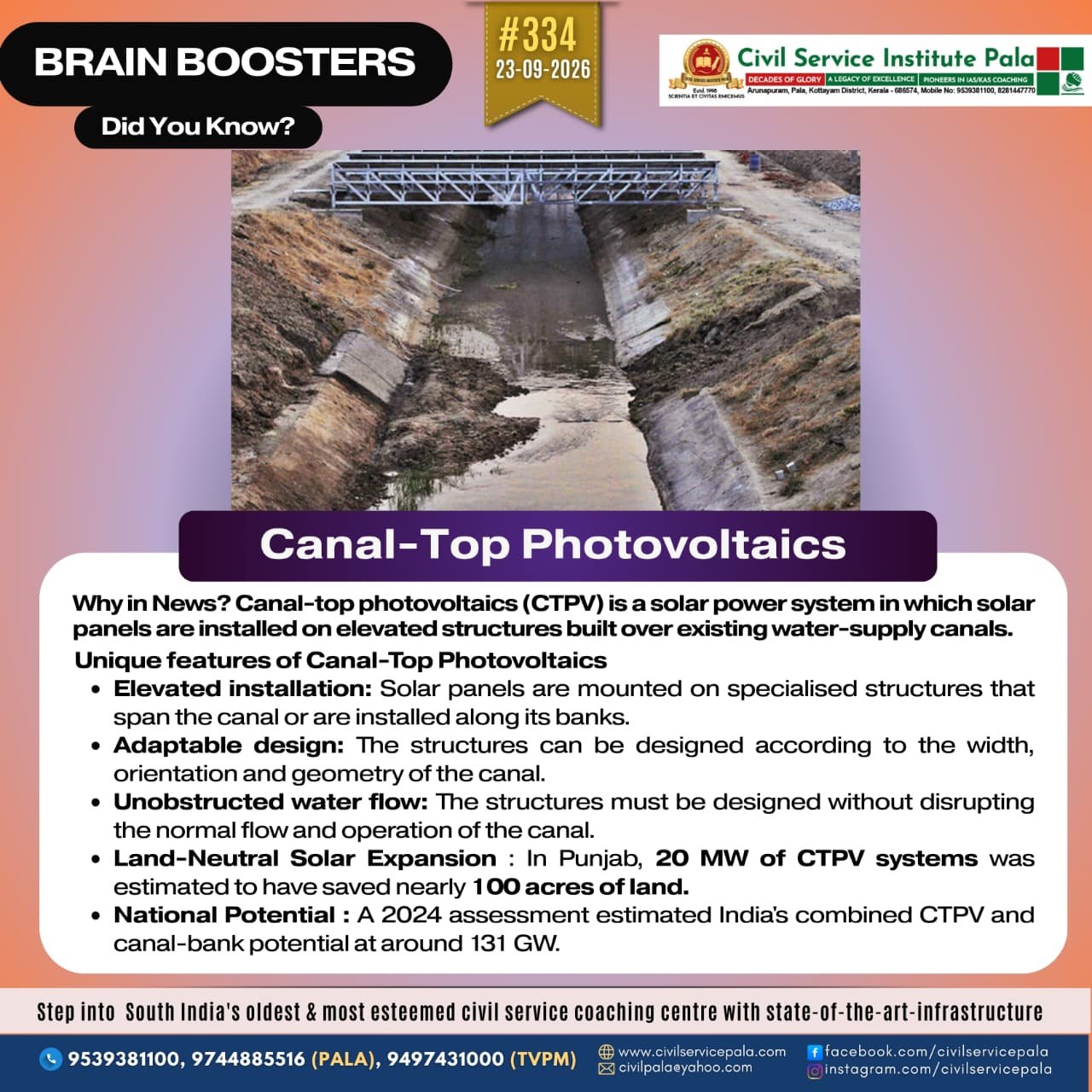
Canal-Top Photovoltaics (CTPV)
Canal-Top Photovoltaics (CTPV)
What is Canal-Top Photovoltaics?
Canal-top photovoltaics (CTPV) is a solar power system in which solar panels are installed on elevated structures built over existing irrigation and water-supply canals.
• Elevated installation: Solar panels are mounted on specialised structures that span the canal or are installed along its banks.
• Adaptable design: The structures can be designed according to the width, orientation and geometry of the canal.
• Unobstructed water flow: The structures must be designed without disrupting the normal flow and operation of the canal.
• Difference from floating solar: Unlike floating solar, where panels are placed on floating platforms over water bodies, CTPV uses fixed elevated structures above canals.
Potential of CTPV
1. Land-Neutral Solar Expansion: CTPV can generate solar power without requiring significant additional land by using existing canal infrastructure, making it relevant as land acquisition for large-scale solar projects becomes increasingly challenging and expensive. In Punjab, 20 MW of CTPV systems was estimated to have saved nearly 100 acres of land.
2. Large Untapped Canal Potential: India's extensive canal network provides considerable scope for CTPV expansion. A 2024 assessment estimated India's combined CTPV and canal-bank potential at around 131 GW, considering solar irradiation, canal characteristics, distance from substations and protected areas. It considered canals up to 30 m wide for CTPV and vertical bifacial installations for canals over 30 m wide. The five States with the highest identified potential were Uttar Pradesh, Bihar, Karnataka, Andhra Pradesh and Punjab.
3. Water Conservation and Improved Panel Performance: Solar panels installed over canals can reduce water loss through evaporation, making CTPV particularly useful in water-stressed regions. A 1-MW CTPV system over the Narmada Canal in Mehsana, Gujarat, commissioned in 2012, reportedly saves nearly 9 million litres of water annually. The water beneath the panels can also provide a cooling effect, which could improve panel performance during hot weather.
4. Growing Indian Experience: India has been an early adopter of CTPV, with its first installation at Mehsana, Gujarat, in 2012. Between 2014 and 2017, two 10-MW CTPV systems were commissioned in Vadodara, Gujarat, followed by 20 MW of CTPV systems in Punjab between 2017 and 2018. In September 2025, Punjab Energy Development Agency invited expressions of interest for 40-MW CTPV projects across Punjab's canal network spanning over 10,000 km, while Haryana initiated efforts to explore CTPV over six irrigation canals.
Policy Support
1. MNRE Pilot-Cum-Demonstration Scheme: The Ministry of New and Renewable Energy (MNRE) provided policy support to CTPV in 2014 through a pilot-cum-demonstration scheme targeting 50 MW each for canal-top photovoltaic and canal-bank projects. Financial assistance was set at ₹3 crore/MW or 30% of project cost, whichever was lower, for CTPV, and ₹1.5 crore/MW or 30% of project cost, whichever was lower, for canal-bank systems.
2. Renewed Policy Interest: The recently approved PM Surya Sarovar Yojana (PM-SSY) aims to develop 5,000 MW of floating solar capacity on reservoirs and other inland water bodies. Its focus on land-neutral solar applications could create greater policy attention for solutions such as CTPV. However, the limited scale-up of CTPV despite earlier financial support indicates the need for a broader policy approach.
Challenges Associated with CTPV
1. High Capital Cost: CTPV is more expensive than ground-mounted solar because it requires elevated structures over canal stretches. The additional requirement of structural steel, foundations, access provisions and structures capable of withstanding winds, while ensuring that canal operations are not disrupted, increases overall project costs.
2. Difficult Operation and Maintenance: The elevated location of solar panels over working canals makes cleaning, repair and replacement more difficult. These maintenance requirements can increase operational costs compared with conventional ground-mounted systems.
3. Canal Geometry and Grid Connectivity: Since CTPV systems follow the linear course of canals, irregular canal paths and changes in direction can complicate system design and increase the cost of electricity generation. These challenges become greater where substations or transformers are not strategically located.
4. Site-Specific Suitability: CTPV cannot be deployed uniformly across the canal network. Site selection needs to consider solar irradiation, canal width and geometry, canal orientation, proximity to substations, grid connectivity, nearby electricity demand, protected areas and land scarcity to maximise economic viability.
5. Limited Scale-Up: Although India installed its first CTPV system in 2012, deployment has remained limited for more than a decade. The experience of the 2014 MNRE scheme indicates that financial assistance alone has not been sufficient to convert pilot projects into large-scale deployment.
Way Forward
1. Prioritise Economically Suitable Canal Stretches: CTPV deployment should focus on canal stretches where land scarcity, electricity demand, grid connectivity, solar conditions and canal characteristics support economic viability.
2. Provide Tailored Financing: Viability gap funding and low-cost debt can support early projects, enable developers to gain experience and help reduce costs through scale and standardisation.
3. Move Beyond Financial Support: A renewed policy approach should combine financial assistance with standardised specifications and guidelines, capacity building of State nodal agencies and irrigation departments, coordination among concerned agencies and streamlined processes.
4. Promote Standardisation and Scale: Experience from early projects can help develop standardised designs and practices, gradually reducing costs and enabling CTPV to move beyond its current niche application.
