



Brain Booster: Vikram-1 Launch Vehicle
Brain Booster: Vikram-1 Launch Vehicle
Why in News?
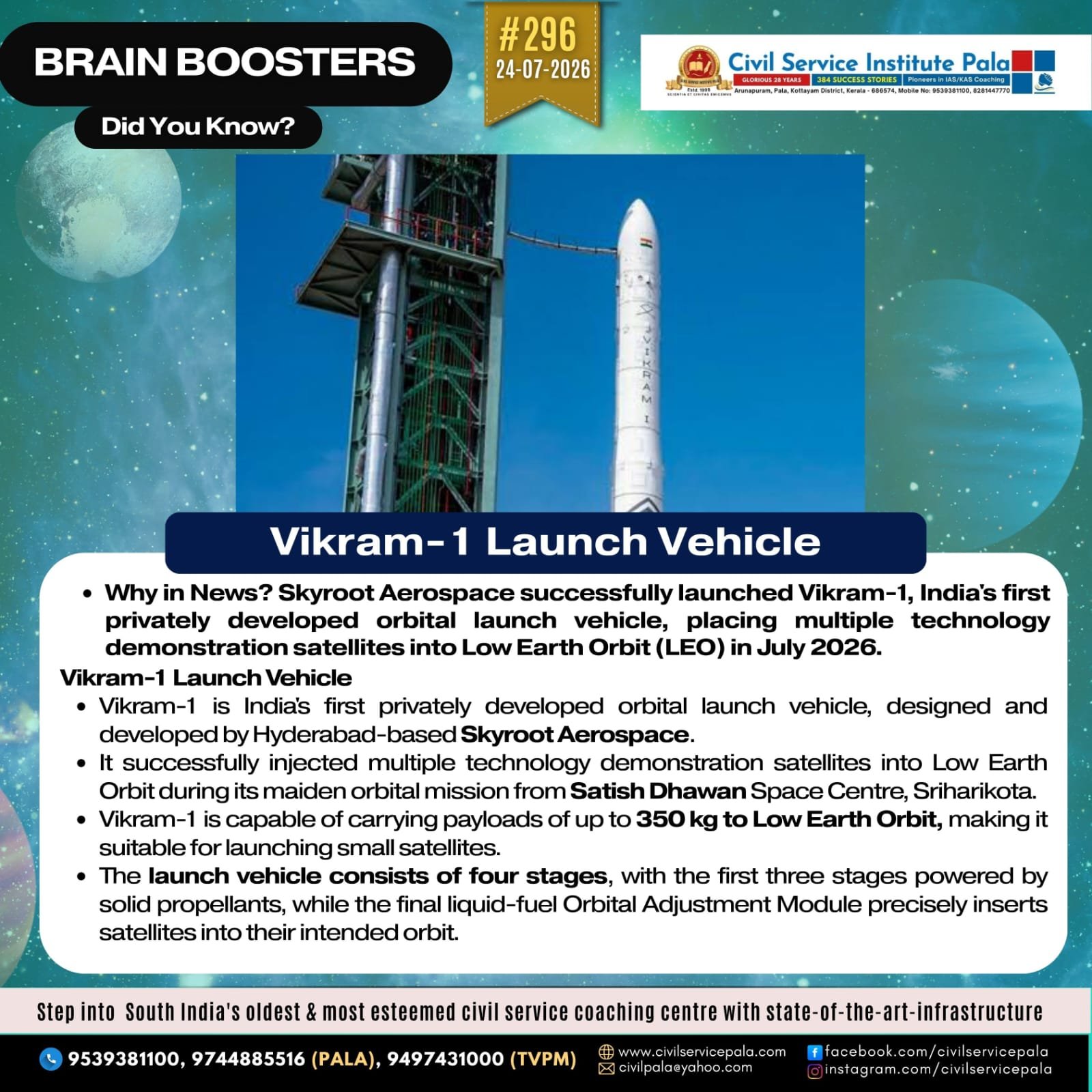
• Skyroot Aerospace successfully launched Vikram-1, India's first privately developed orbital launch vehicle, placing multiple technology demonstration satellites into Low Earth Orbit (LEO) in July 2026.
• With this achievement, India became the third country after the United States and China to develop private orbital launch capability.
• The launch marks a major milestone following the opening of India's space sector to private players in 2020 and the implementation of the Indian Space Policy, 2023.
Vikram-1 Launch Vehicle
• Vikram-1 is India's first privately developed orbital launch vehicle, designed and developed by Hyderabad-based Skyroot Aerospace.
• The launch vehicle successfully injected multiple technology demonstration satellites into Low Earth Orbit during its maiden orbital mission from Satish Dhawan Space Centre, Sriharikota.
• Vikram-1 is capable of carrying payloads of up to 350 kg to Low Earth Orbit, making it suitable for launching small satellites.
• The launch vehicle consists of four stages, with the first three stages powered by solid propellants, while the final liquid-fuel Orbital Adjustment Module precisely inserts satellites into their intended orbit.
• Unlike many maiden launches globally that carry dummy payloads, Vikram-1 carried actual technology demonstration payloads, reflecting confidence in the vehicle's reliability.
What is Low Earth Orbit (LEO)?
• Low Earth Orbit (LEO) is the region of space extending from approximately 160 km to 2,000 km above the Earth's surface.
• Satellites placed in LEO typically complete one orbit around the Earth in about 90–120 minutes.
• Because of its close proximity to Earth, LEO provides low communication latency and high-quality Earth observation capabilities.
• As a result, LEO is the preferred orbit for communication satellites, Earth observation satellites, imaging satellites and many small satellite constellations.
Why is LEO strategically important?
• LEO has become one of the most valuable regions of space because access to favourable orbital locations is largely based on a first-come, first-served principle.
• Although the 1967 Outer Space Treaty prohibits countries from claiming ownership of outer space, nations compete to occupy preferred orbital shells and obtain favourable radio-frequency allocations coordinated by the International Telecommunication Union (ITU).
• An orbital shell refers to a group of satellites operating at the same altitude and orbital inclination around the Earth.
• Once an orbital shell becomes densely occupied, later entrants must coordinate with existing operators or move to less favourable orbital regions.
• This has encouraged countries to deploy massive satellite megaconstellations, allowing them to establish a long-term operational presence in LEO.
LEO and the Global Space Race
• Several countries are rapidly expanding their presence in LEO by deploying large constellations of satellites.
• China is developing satellite megaconstellations such as Guowang and Qianfan, while SpaceX's Starlink has already deployed thousands of satellites with plans for many more.
• Besides commercial communication, these satellite networks strengthen strategic influence, surveillance capability and information dominance.
Why is Vikram-1 important for India?
• Vikram-1 gives India an indigenous private capability to launch small satellites, one of the fastest-growing segments of the global space industry.
• The mission strengthens India's independent access to Low Earth Orbit without relying solely on ISRO launches.
• A robust private launch ecosystem enhances India's ability to rapidly deploy or replace intelligence, surveillance and reconnaissance (ISR) satellites, an increasingly important capability in a contested Indo-Pacific security environment.
• The successful launch also demonstrates the growing maturity of India's private space sector following policy reforms that encouraged private participation.
Challenges Ahead
• Despite this milestone, India's overall launch frequency and operational capacity remain significantly lower than those of leading space powers.
• India currently lacks an operational reusable launch vehicle, which is essential for reducing launch costs and increasing launch frequency.
• ISRO's Next Generation Launch Vehicle (NGLV), which is expected to be partially reusable, is projected to become operational only in the mid-2030s.
• Greater government procurement, higher investment and continued private sector participation will be essential for India to secure a stronger presence in Low Earth Orbit.
