



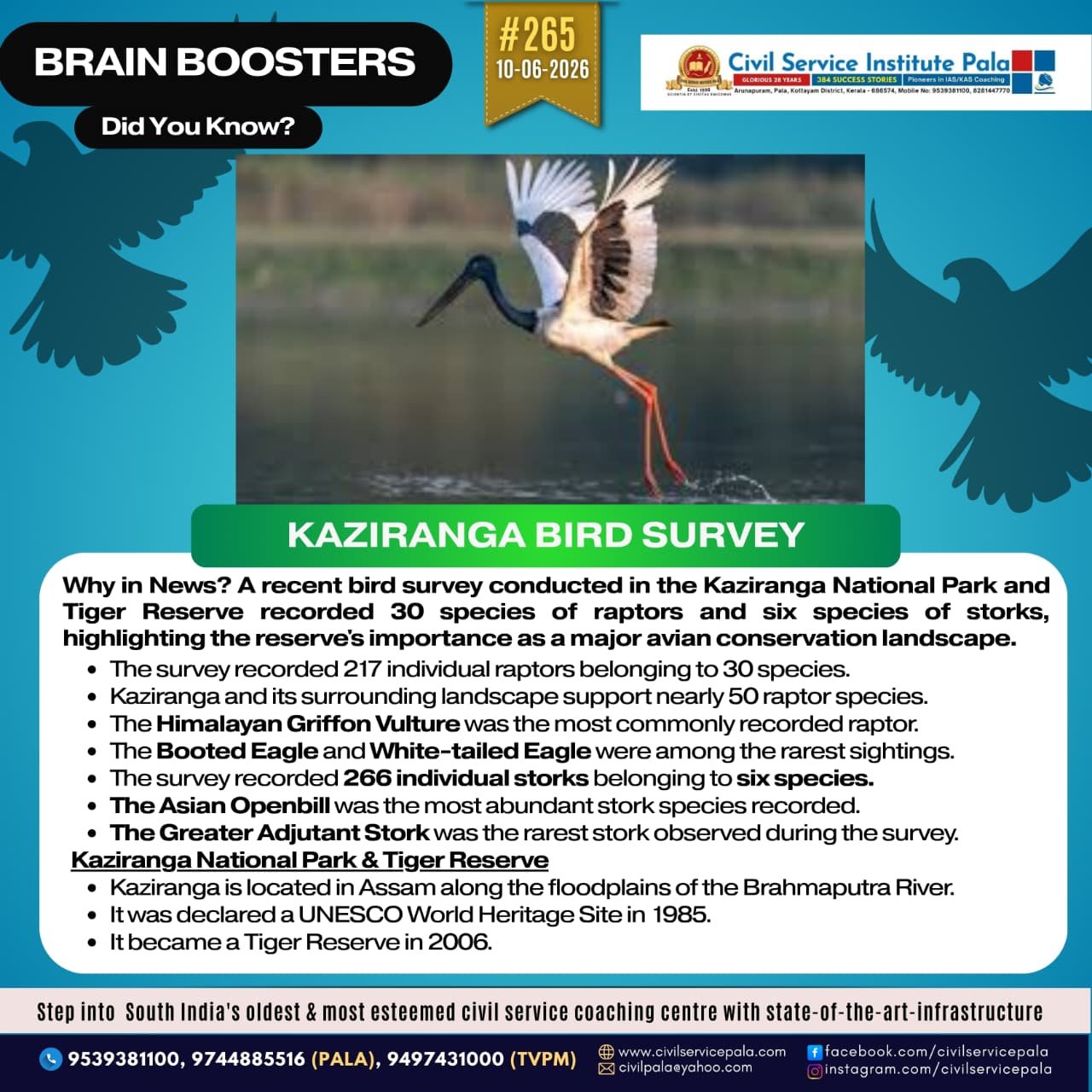
Brain Booster: Kaziranga Bird Survey 2026 – Raptors and Storks
Brain Booster: Kaziranga Bird Survey 2026 – Raptors and Storks
Why in News?
A recent bird survey conducted in the Kaziranga National Park and Tiger Reserve recorded 30 species of raptors and six species of storks, highlighting the reserve's importance as a major avian conservation landscape.
The survey was conducted jointly by the Kaziranga Tiger Reserve authority and researchers from Gauhati University.
What are Raptors?
Raptors are birds of prey that hunt and feed on other animals and occupy the top levels of the food chain.
They are characterized by hooked beaks, strong talons, and excellent vision adapted for hunting.
Raptors include eagles, hawks, falcons, vultures, buzzards, and owls.
Raptors are broadly classified into diurnal birds of prey (active during the day) and nocturnal birds of prey such as owls.
As apex predators, raptors serve as important indicators of ecosystem health and biodiversity.
What are Storks?
Storks are large, long-legged, long-necked wetland birds belonging to the family Ciconiidae.
They are commonly associated with wetlands, floodplains, marshes, rivers, and grassland ecosystems.
Storks play an important ecological role by controlling populations of fish, amphibians, reptiles, and insects.
Most species fly with their necks fully outstretched and legs trailing behind.
India hosts eight of the world's tropical and subtropical stork species.
Key Findings of the Survey
Raptors
The survey recorded 217 individual raptors belonging to 30 species.
Kaziranga and its surrounding landscape support nearly 50 raptor species, making it one of India's important raptor habitats.
The Himalayan Griffon Vulture was the most commonly recorded raptor.
The Booted Eagle and White-tailed Eagle were among the rarest sightings during the survey.
Storks
The survey recorded 266 individual storks belonging to six species.
The Asian Openbill was the most abundant stork species recorded.
The Greater Adjutant Stork was the rarest stork observed during the survey.
Why is Kaziranga Important for Birds?
Kaziranga lies at the confluence of the Brahmaputra floodplains and the Eastern Himalayan biodiversity region.
Its mosaic of wetlands, grasslands, river channels, forests, and marshes provides diverse habitats for birds.
Seasonal flooding by the Brahmaputra River maintains productive wetland ecosystems that support large bird populations.
The reserve serves as a crucial refuge for resident as well as migratory bird species.
It has been recognized as an Important Bird Area by BirdLife International.
About Kaziranga National Park & Tiger Reserve
Kaziranga is located in Assam along the floodplains of the Brahmaputra River.
It was declared a UNESCO World Heritage Site in 1985.
It became a Tiger Reserve in 2006.
The park supports the world's largest population of the Greater One-horned Rhinoceros.
It is also home to significant populations of tigers, elephants, wild water buffalo, and swamp deer.
Major vegetation types include alluvial grasslands, wetlands, tropical moist deciduous forests, and semi-evergreen forests.
