



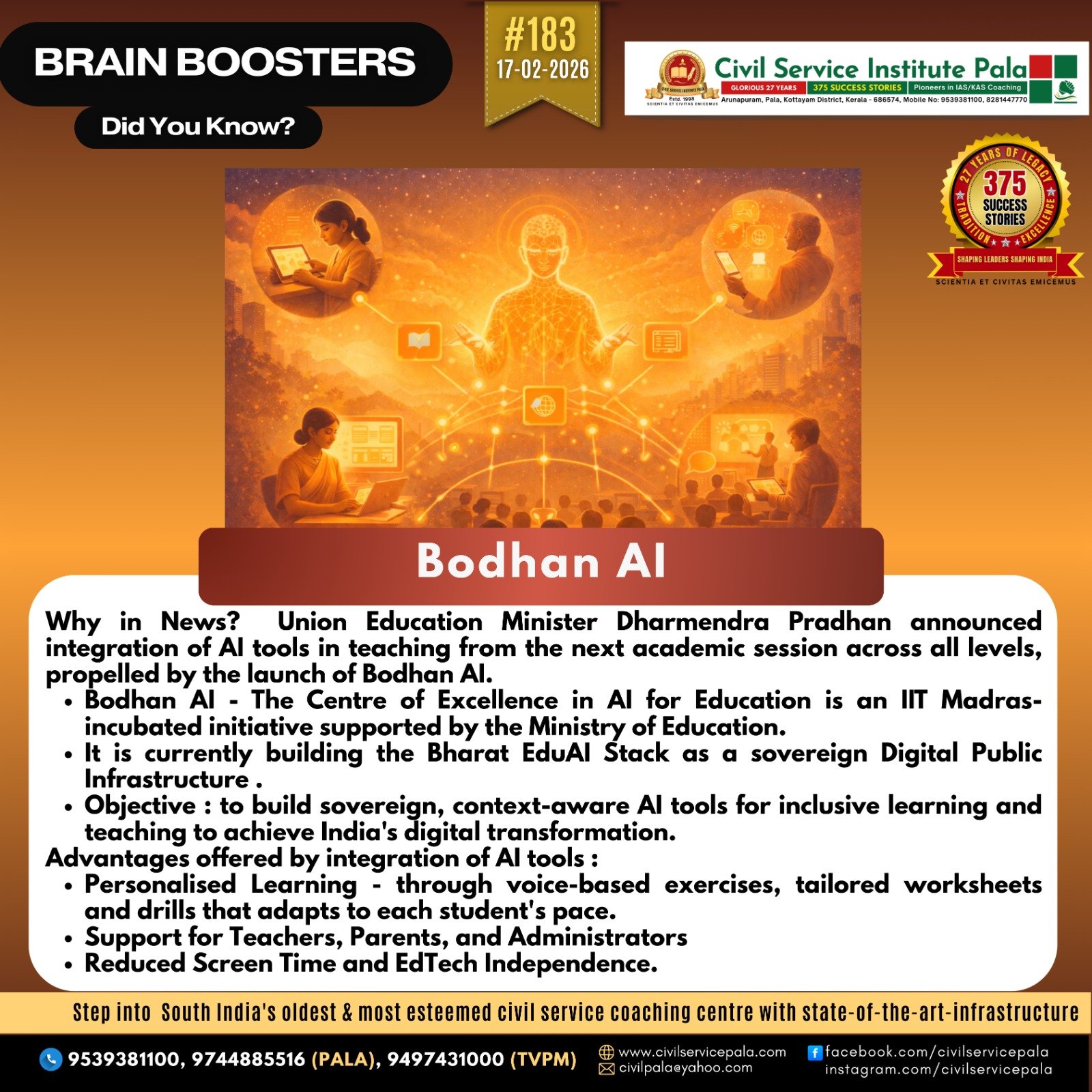
Bodhan AI
Why in News? Union Education Minister Dharmendra Pradhan announced integration of AI tools in teaching from the next academic session across all levels, propelled by the launch of Bodhan AI.
Bodhan AI - The Centre of Excellence in AI for Education is an IIT Madras-incubated initiative supported by the Ministry of Education.
It is currently building the Bharat EduAI Stack as a sovereign Digital Public Infrastructure .
Objective : to build sovereign, context-aware AI tools for inclusive learning and teaching to achieve India's digital transformation.
Features
• Bodhan AI builds AI tools that work smoothly with Indian languages, such as automatic speech recognition (to understand spoken words) and synthesis (to generate speech).
• It runs AI models on secure Indian servers so that EdTech apps can simply add these features—like upgrading an English reading checker to also test Hindi pronunciation.
• The platform supports real-world applications through partnerships with state governments. All AI tools developed shall follow the mandate of National Education Policy 2020 and frameworks from NCERT and SCERT.
Advantages
• Personalised Learning - Bodhan AI personalises learning through voice-based exercises where AI listens to a child speak in their mother tongue, spots errors (like pronunciation), and suggests tailored worksheets or drills. This adapts to each student's pace, unlike uniform teaching.
• Support for Teachers, Parents, and Administration - It provides progress reports to teachers/parents for targeted help (e.g., "focus on tenses") and aggregates data for admins to shape policies, like boosting regional language skills in underperforming areas.
• Reduced Screen Time and EdTech Independence - Voice tools cut screen exposure via audio interactions. EdTech firms can integrate Bodhan's Indian AI models easily—e.g., adding Hindi to English apps—avoiding foreign dependence like ChatGPT for secure, local control.
Scope - Bodhan AI will cover education from pre-primary level up to higher education across the entire country. It will receive funding through maintenance fees paid by state governments and equity shares from startups that use its services.
Key challenges - safeguarding students' personal data so that nothing they say or write gets stored publicly. Another challenge is ensuring all tools are deployed carefully in line with government policies.
