



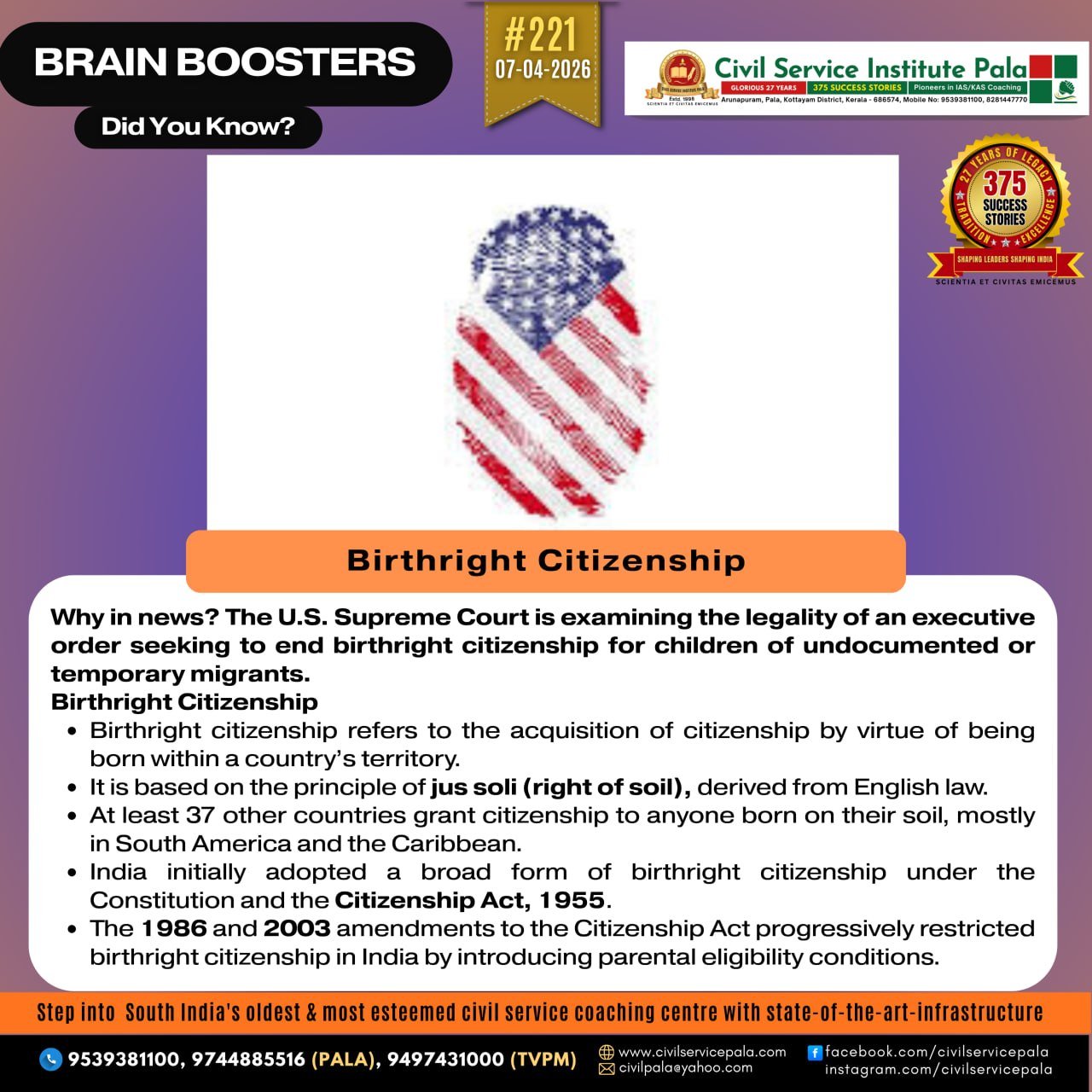
Birthright Citizenship
Birthright citizenship
• Birthright citizenship refers to the acquisition of citizenship by virtue of being born within a country’s territory and is based on the principle of jus soli (right of soil).
U.S. Context
• In the United States, birthright citizenship is guaranteed under the 14th Amendment (1868), which grants citizenship to all persons born or naturalised in the country and subject to its jurisdiction.
• It is generally applicable to all persons born on U.S. soil, except children of diplomats and enemies during hostile occupation.
India
• India initially adopted a broad form of birthright citizenship under the Constitution and the Citizenship Act, 1955, which provides five modes of acquiring citizenship: birth, descent, registration, naturalisation, and incorporation of territory.
• Under Article 5, persons born in India before the commencement of the Constitution were recognised as citizens.
• The 1955 Act granted citizenship by birth to all persons born in India after January 26, 1950, with limited exceptions such as children of foreign diplomats and enemy aliens.
• The 1986 amendment introduced a condition that at least one parent must be an Indian citizen.
• The 2003 amendment further restricted this by excluding children born to illegal migrants.
• Thus, for those born on or after December 3, 2004, citizenship is granted only if both parents are citizens, or one parent is a citizen and the other is not an illegal migrant.
