



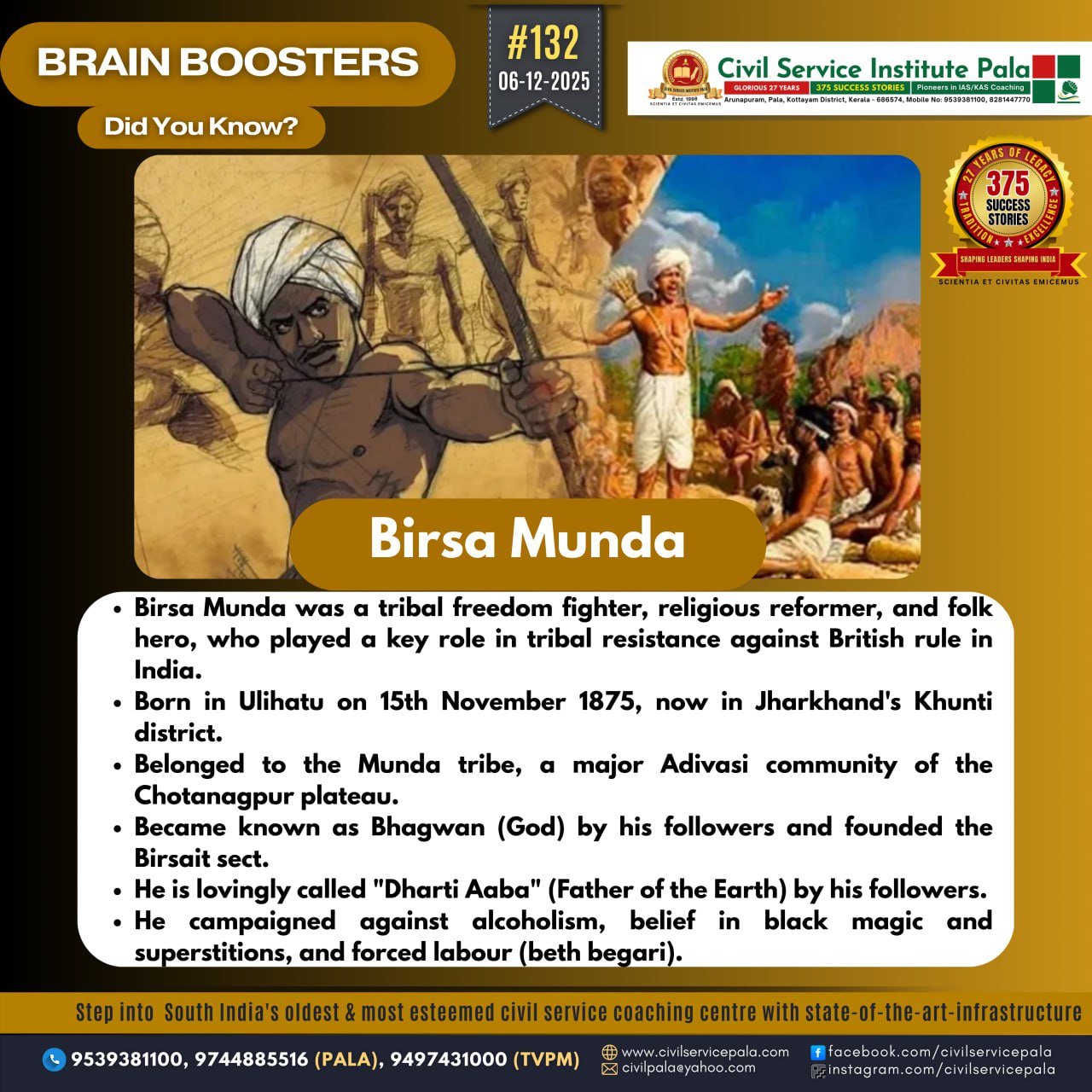
Birsa Munda (1875–1900)
Birsa Munda was a revered tribal leader, freedom fighter, and social reformer from the Munda tribal community of the Chotanagpur region (present-day Jharkhand). He played a crucial role in mobilizing the tribal population against British colonial rule and the exploitative zamindari system.
Early Life
Born on 15 November 1875 in Ulihatu, in present-day Jharkhand.
Belonged to the Munda tribe, which largely depended on forest resources and shifting agriculture.
British policies disrupting tribal land rights deeply impacted his early life.
Role as a Religious and Social Reformer
Birsa emerged as a spiritual leader and began to be known as “Dharti Aaba” (Father of the Earth).
His reforms aimed at:
Ending superstitions and harmful rituals.
Promoting monotheism and moral living.
Opposing Christian missionary influence and exploitation by moneylenders and landlords.
His spiritual influence united large sections of tribes under a common identity.
Munda Rebellion (Ulgulan – “The Great Tumult”)
Between 1899–1900, Birsa led a tribal uprising against:
British rule
Jagirdars (landlords)
Moneylenders
Forest laws that restricted traditional rights
The movement demanded:
Restoration of Khuntkatti land rights (community-based land ownership system of the Mundas)
End of forced labour
Self-rule and protection of tribal culture
This mass movement came to be known as Ulgulan.
Arrest and Death
Birsa was arrested in 1900 by the British.
He died in Ranchi jail on 9 June 1900, at the young age of 25.
Legacy
His movement compelled the British to introduce the Chotanagpur Tenancy Act (1908), which protected tribal land rights.
He is remembered as a symbol of tribal identity, rights, and resistance.
The Birsa Munda Airport (Ranchi) and Birsa Munda Tribal Museum are named in his honour.
15 November is celebrated as Jharkhand Foundation Day and Janjatiya Gaurav Diwas in his memory.
