



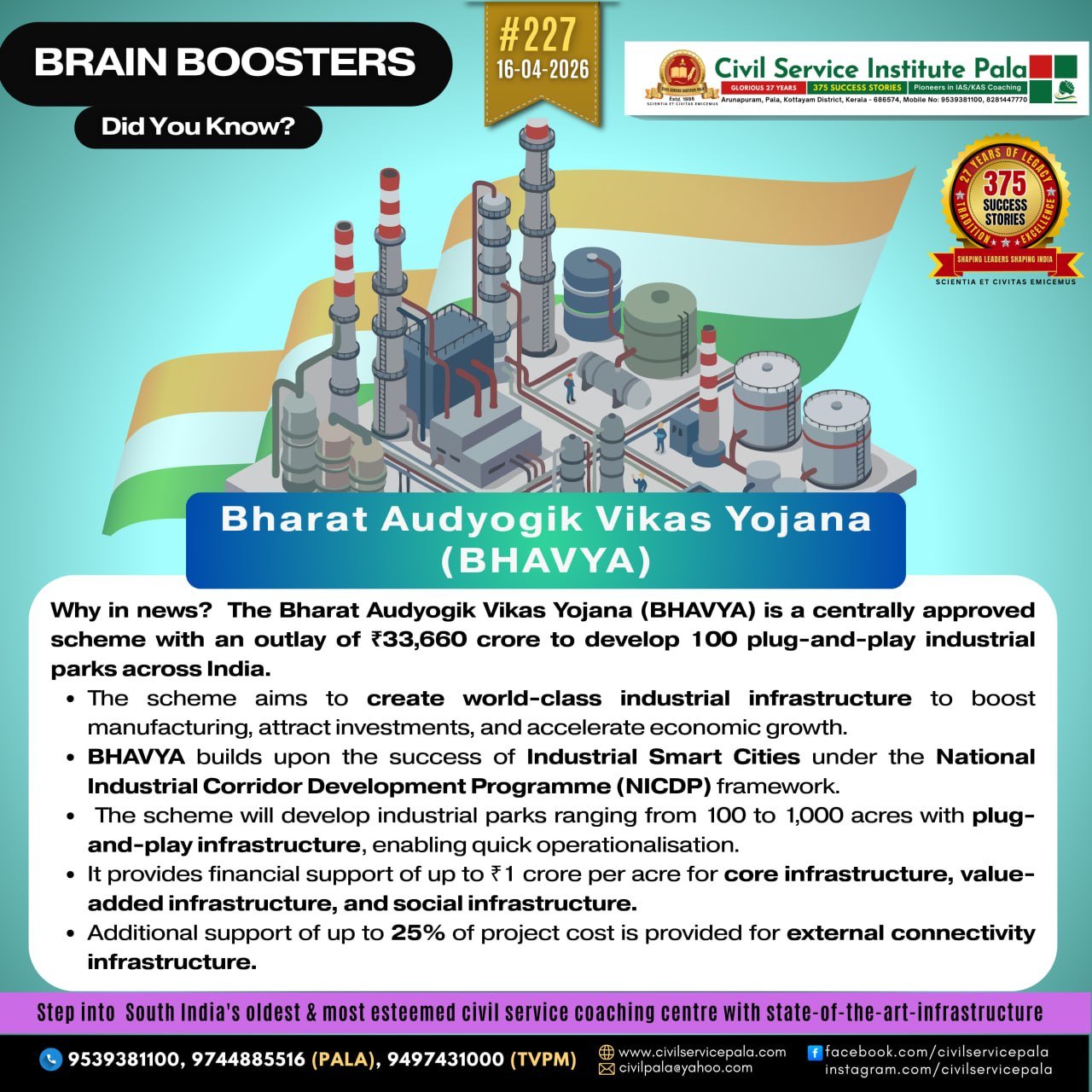
Bharat Audyogik Vikas Yojana (BHAVYA)
• The Bharat Audyogik Vikas Yojana (BHAVYA) is a centrally approved scheme with an outlay of ₹33,660 crore to develop 100 plug-and-play industrial parks across India.
• The scheme aims to create world-class industrial infrastructure to boost manufacturing, attract investments, and accelerate economic growth.
• Experts highlight that BHAVYA builds upon the success of industrial smart cities under the National Industrial Corridor Development Programme (NICDP) framework.
Challenges
• India faces high entry barriers for industries due to delays in land acquisition, approvals, and infrastructure gaps.
• Fragmented industrial ecosystems weaken supply chains and competitiveness.
• Experts suggest that lack of integrated infrastructure slows down manufacturing-led growth and job creation.
Features
• The scheme will develop industrial parks ranging from 100 to 1,000 acres with plug-and-play infrastructure, enabling quick operationalisation.
• Plug-and-play industrial parks refers to ready-to-use ecosystems where land, utilities, approvals, and infrastructure are pre-developed, enabling industries to start operations quickly without delays related to land acquisition or infrastructure setup.
• It provides financial support of up to ₹1 crore per acre for:
o Core infrastructure such as roads, drainage, utilities, ICT systems, and treatment facilities.
o Value-added infrastructure including factory sheds, testing labs, and warehousing.
o Social infrastructure like worker housing and support amenities.
• Additional support of up to 25% of project cost is provided for external connectivity infrastructure.
• Projects will be selected through a challenge mode, ensuring competitive, reform-oriented proposals.
• The scheme emphasizes ease of doing business . with streamlined approvals through single-window clearances and deregulation.
• Proposed Parks under BHAVYA scheme will align with PM GatiShakti for multimodal connectivity and logistics efficiency.
• Experts highlight the focus on green energy use, underground utility corridors, and sustainable industrial ecosystems.
Institutional Framework
• Implementation will be in partnership with states and private sector players, promoting cooperative federalism.
• National Industrial Corridor Development Corporation Limited (NICDC) under Department for Promotion of Industry and Internal Trade (DPIIT) will play a key role in execution.
• NICDC is already implementing 20 industrial corridor projects across 13 states, providing institutional experience.
Economic Significance
• The scheme is expected to generate large-scale employment across manufacturing, logistics, and services sectors.
• It will attract domestic and global investments by reducing setup time and cost for industries.
• Cluster-based development will strengthen domestic supply chains and regional industrialisation.
• Experts highlight that BHAVYA supports India’s goals of Atmanirbhar Bharat, export growth, and global competitiveness.
Beneficiaries
• Primary beneficiaries include MSMEs, startups, manufacturing firms, and global investors.
• Secondary beneficiaries include workers, logistics providers, service sector enterprises, and local communities.
Way Forward
• Experts suggest that effective coordination between Centre, States, and private sector is crucial for success.
• Timely land acquisition, infrastructure delivery, and policy stability will determine outcomes.
• Integration with logistics, exports, and MSME ecosystems can maximise long-term benefits.
