



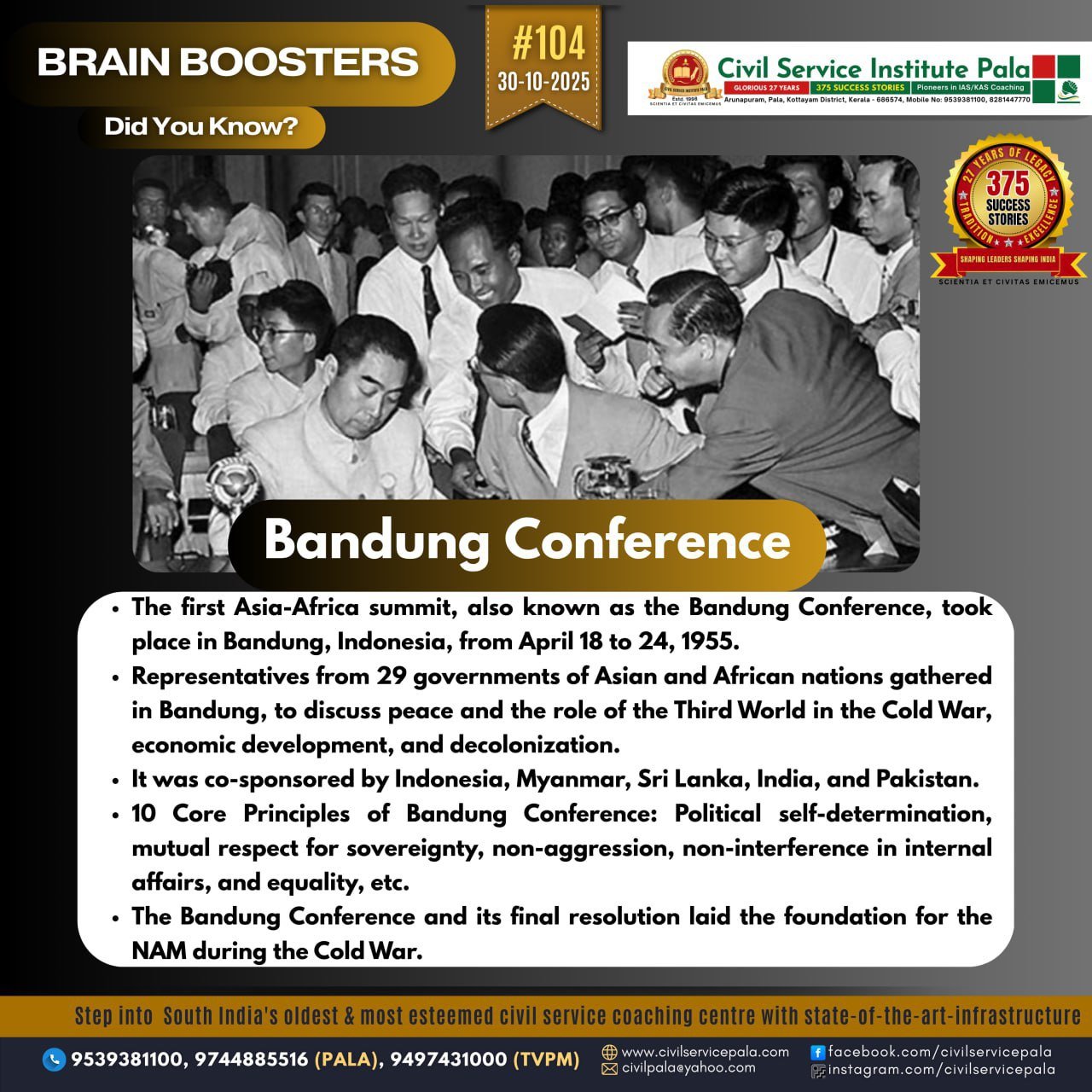
Bandung Conference
The Bandung Conference, held in April 1955 in Bandung, Indonesia, was a historic meeting of 29 Asian and African countries — most of which had recently gained independence.
It was a major milestone in world politics, especially during the Cold War period.
1. Birth of Afro-Asian Solidarity It was the first large-scale meeting of Asian and African nations. Promoted unity among newly independent countries that shared common colonial experiences.
2. Foundation for Non-Aligned Movement (NAM) The ideas discussed at Bandung later led to the creation of the Non-Aligned Movement (NAM) in 1961. Countries decided not to align with either the US or the USSR during the Cold War, promoting independent foreign policies.
3. Promotion of Peaceful Coexistence The conference emphasized peaceful coexistence, mutual respect, and non-interference in internal affairs. These principles became known as the “Ten Principles of Bandung”, promoting global peace and cooperation.
4. Voice for the Developing World Provided a platform for developing nations to express their concerns about colonialism, racism, and economic inequality. Asserted the need for a new international order based on justice and equality.
5. Strengthening Anti-Colonial Movements The conference supported liberation struggles in Asia and Africa. Condemned colonialism, apartheid, and racial discrimination, inspiring several independence movements.
6. Economic and Cultural Cooperation Encouraged South–South cooperation in trade, culture, and technology. Called for mutual assistance among developing nations to reduce dependence on Western powers.
