



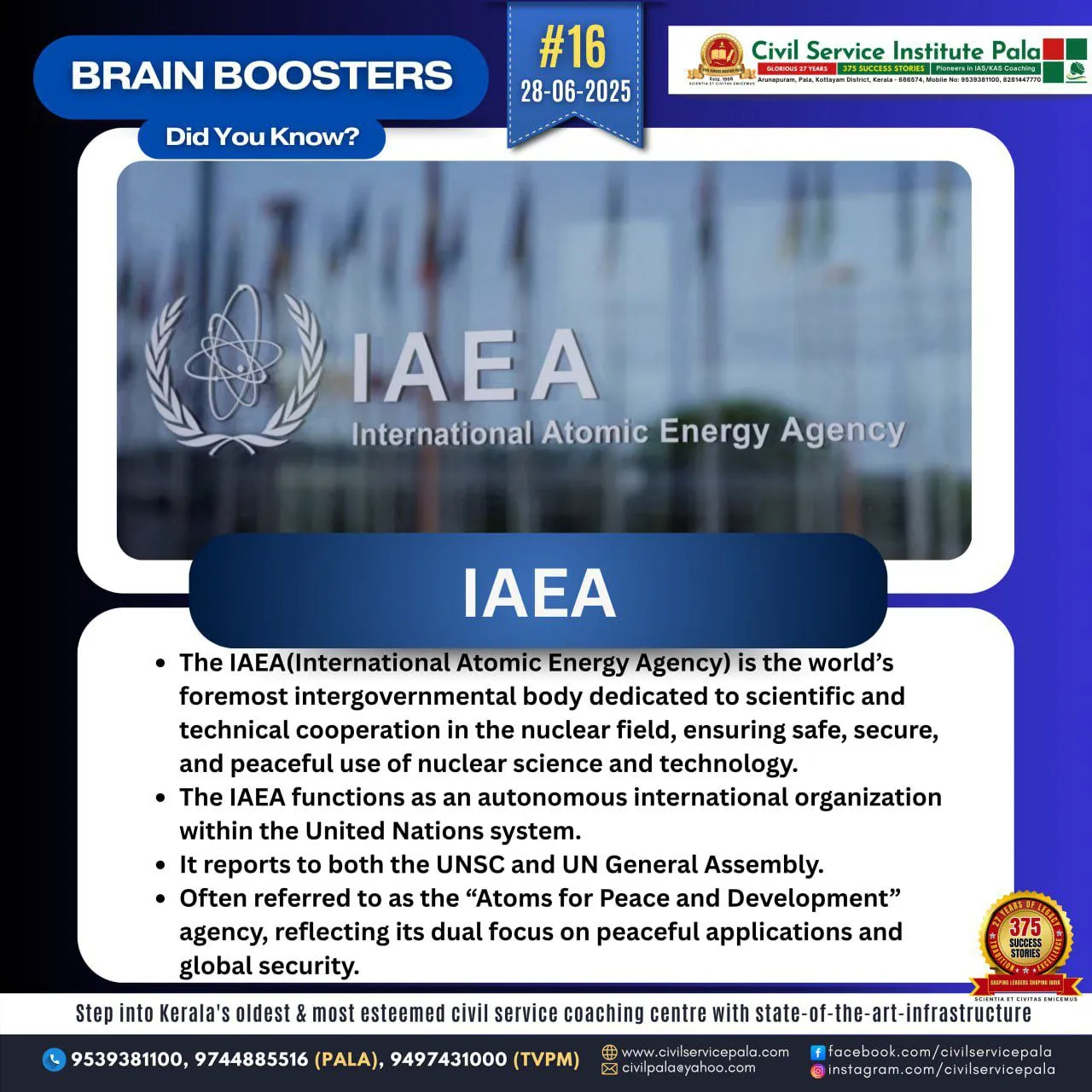
Atomic Energy Agency
The International Atomic Energy Agency (IAEA) is the premier intergovernmental organization responsible for promoting the peaceful use of nuclear technology while guarding against its misuse for weapons development. Founded under the umbrella of the United Nations system, the IAEA serves as the global hub for nuclear safety, security, and scientific cooperation.
Establishment and Structure
The IAEA’s foundational statute was approved on 23 October 1956, and it officially came into force on 29 July 1957. Its headquarters are located in Vienna, Austria, reflecting its central role in the international diplomatic landscape. As of 2025, the IAEA includes 178 member states, which highlights both its global influence and the widespread trust it commands among nations.
Legal Status and UN Role
Legally, the IAEA functions as an autonomous international organization within the UN system. It maintains formal reporting lines to both the UN General Assembly and the UN Security Council. This dual reporting structure reinforces its political neutrality and technical credibility. The agency is often referred to by its mission phrase, “Atoms for Peace and Development,” capturing its core objective of balancing peaceful nuclear advancement with international security.
Mandate and Objectives
The IAEA has a clear and urgent mandate:
Prevent the diversion of nuclear energy from peaceful uses to nuclear weapons or explosive devices.
Promote international cooperation in nuclear science and technology for peaceful applications such as energy, health care, and agriculture.
Enhance nuclear safety and emergency preparedness, particularly in response to radiological or nuclear incidents.
Support scientific research, capacity-building, and technical training, especially in developing countries, to ensure equitable access to nuclear benefits.
Through these goals, the IAEA not only curbs nuclear proliferation but also promotes sustainable development through responsible nuclear innovation.
Key Activities and Safeguards
One of the IAEA’s most critical roles is the implementation of nuclear safeguards—a system of inspections and monitoring designed to ensure that nuclear materials are not diverted to weapons programs. These safeguards are essential to enforcing the Nuclear Non-Proliferation Treaty (NPT), making the IAEA the first line of defense against nuclear proliferation.
The agency uses several advanced tools in this mission:
On-site inspections to verify declarations and monitor facilities.
Satellite imagery to observe undeclared activities or suspicious developments.
Data analysis and environmental sampling to detect traces of nuclear material.
These tools help the IAEA track nuclear programs worldwide with a high degree of accuracy, objectivity, and transparency.
