



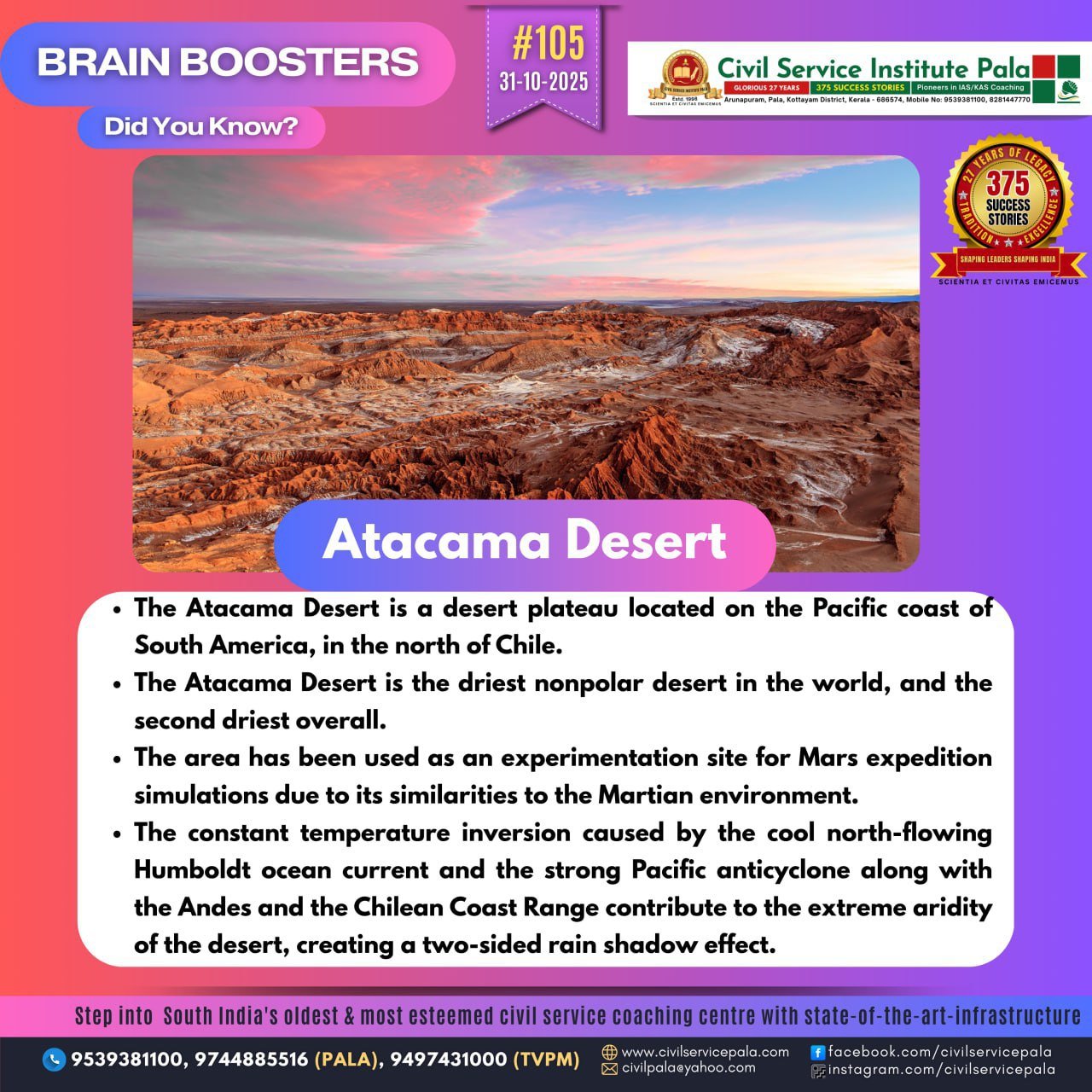
Atacama Desert
Location: Lies in northern Chile, along the Pacific coast of South America, between the Andes Mountains and the Chilean Coast Range. Area: Covers around 105,000 square kilometers (40,500 square miles).
Climate: Known as the driest non-polar desert in the world. Some weather stations in the Atacama have never recorded rainfall. Extreme temperature variations occur between day and night.
Key Features The desert’s extreme aridity is due to the rain shadow effect of the Andes and the cold Humboldt Current that prevents moisture formation. The soil composition and conditions are similar to those on Mars, making it a site for NASA’s Mars mission simulations. Contains salt flats, lava flows, and sand dunes, giving it a unique landscape.
The Atacama Large Millimeter/submillimeter Array (ALMA), one of the world’s most advanced astronomical observatories, is located here due to its clear skies and low humidity.
Flora and Fauna
Very sparse vegetation; only specialized plants like cacti, lichens, and salt-tolerant shrubs survive. Wildlife includes vicunas, gray foxes, flamingos, and a few adapted insects and reptiles.
Human Presence
The region has ancient Inca and pre-Inca archaeological sites. Important for mining, especially for copper, lithium, and nitrate deposits.
Towns like San Pedro de Atacama are popular tourist hubs. Interesting Fact In 2015, scientists discovered microbial life in some parts of the desert, suggesting that life could survive in similarly harsh extraterrestrial environments.
