



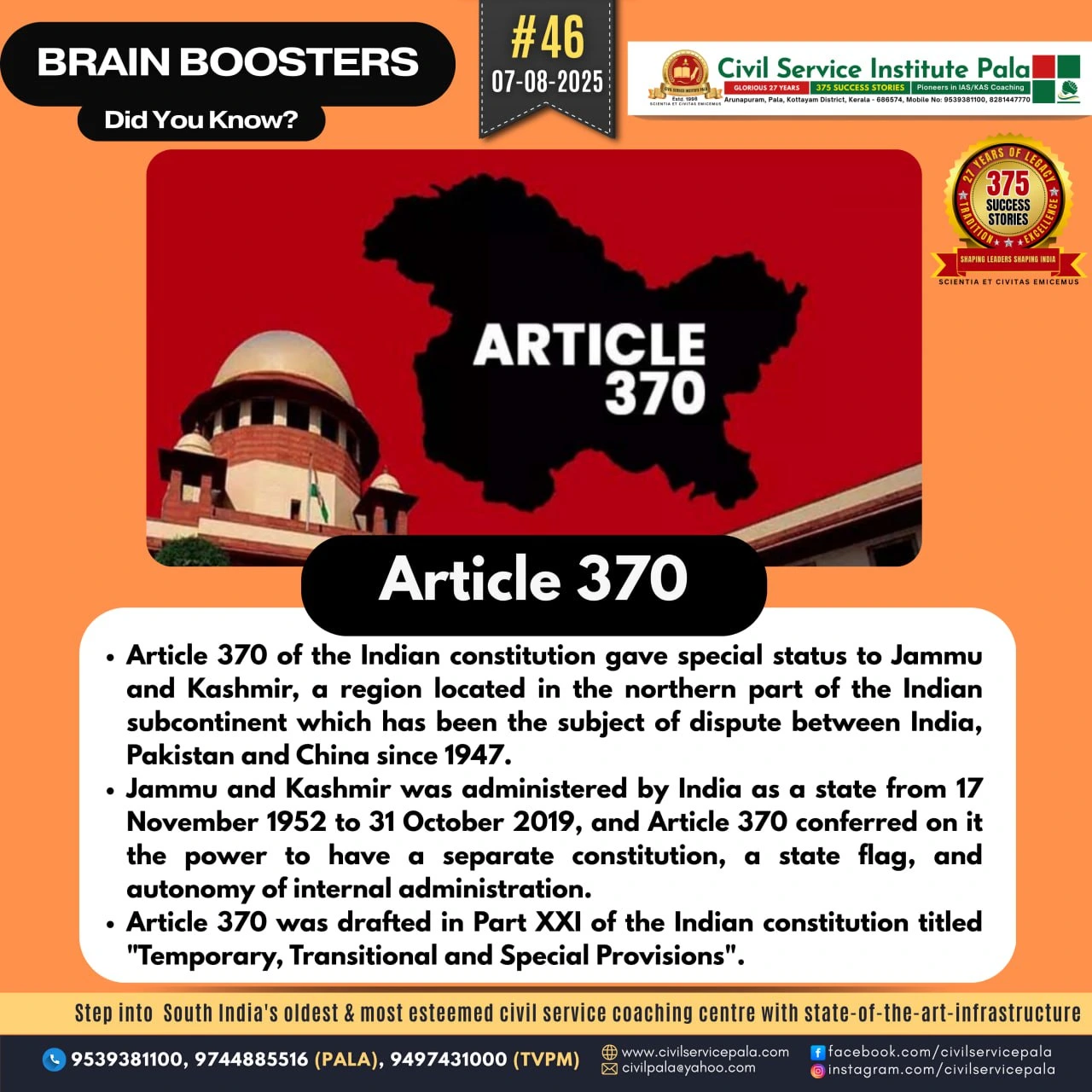
Article 370
What is Article 370?
Article 370 was a provision in the Indian Constitution that granted special autonomous status to the state of Jammu and Kashmir (J&K).
Key Features of Article 370:
Limited applicability of Indian laws: Parliament could make laws for J&K only on matters of defence, foreign affairs, and communications.
Separate Constitution: J&K had its own Constitution and flag.
Dual citizenship: Residents of J&K were citizens of India but also had separate rights under J&K laws.
No automatic application of constitutional amendments: Any changes to the Indian Constitution needed approval from J&K’s Constituent Assembly.
Special privileges: Only permanent residents could own land or get government jobs in J&K.
Abrogation of Article 370
On August 5, 2019, the Government of India, led by Prime Minister Narendra Modi and Home Minister Amit Shah, revoked Article 370 through a Presidential Order and a Parliamentary resolution.
Steps Taken:
Presidential Order (C.O. 272) – Applied all provisions of the Indian Constitution to J&K.
Parliamentary Resolution – Recommended the revocation of Article 370(3).
Jammu and Kashmir Reorganisation Act, 2019 – Split the state into two Union Territories:
Jammu and Kashmir (with legislature)
Ladakh (without legislature)
Impact of the Abrogation
Positive Impacts (As per Government and Supporters):
One nation, one Constitution: Full integration of J&K into India.
Equal rights: Central laws (like Right to Education, Reservation laws, etc.) became applicable.
Boost to development: Government aimed to attract investment and create job opportunities.
End to gender and minority discrimination: Women and Dalits in J&K now have the same rights as elsewhere in India.
Criticisms and Concerns:
Federal concerns: Critics argue it undermined federal principles by removing statehood without local consent.
Detentions and communication blackout: Political leaders were detained and internet was shut down for months.
Loss of autonomy: Many Kashmiris saw it as betrayal of past agreements.
Security issues: Fears of increased unrest in the region.
Current Status (as of 2025)
Union Territory: J&K remains a UT with a legislative assembly, though elections are still awaited.
Legal challenges: Petitions against the abrogation were heard in the Supreme Court, which upheld the move in December 2023.
Development push: Infrastructure and investment projects have increased, but political tensions continue.
Source:https://indianexpress.com/article/explained/six-years-after-article-370-abrogation-where-does-jk-stand-10169941/
