



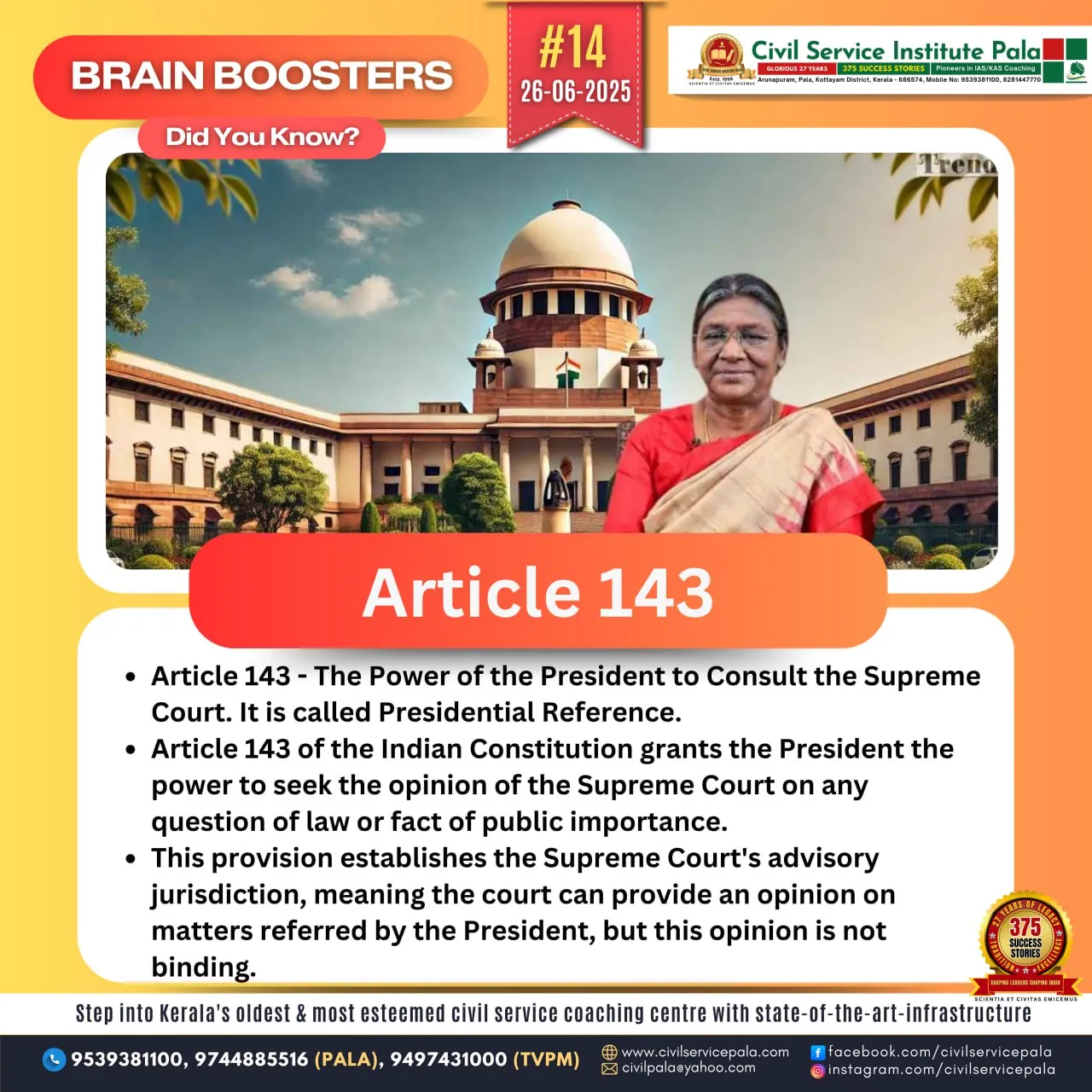
Article 143
Article 143 empowers the President of India to seek the opinion of the Supreme Court on important legal or constitutional questions. This is known as the Advisory Jurisdiction of the Supreme Court.
Key Provisions of Article 143-It has two clauses:
Clause (1):
The President can refer any question of law or fact that is of public importance or that involves the interpretation of the Constitution to the Supreme Court.
The Supreme Court may advise the President after such consideration.
This advice is not binding on the President.
Clause (2):
If a dispute arises under the Constitution that the President believes the Supreme Court should decide, especially one that would not normally come before the court, the President can refer it.
Example: Disputes between states, or between a state and the center.
Nature of the Advice
Advisory only: The Supreme Court’s opinion is not mandatory, but it carries great moral and legal weight.
The Court can choose to refuse to give an opinion if it feels the issue is inappropriate or lacks sufficient clarity.
Famous Cases Under Article 143
Berubari Union Case (1960) – On the legality of ceding Indian territory to Pakistan.
Presidential Reference on Ayodhya (1993) – The Supreme Court declined to answer the reference on whether a temple existed beneath the Babri Masjid.
Special Reference on the 2G Spectrum case (2012) – Related to the allocation of natural resources.
In Summary
Article 143 allows the President to consult the Supreme Court on complex legal matters of national importance. While the advice given is not binding, it helps ensure that major decisions are grounded in constitutional interpretation and judicial wisdom.
Source : https://www.scconline.com/blog/post/2025/05/18/article-143-supreme-court-advisory-jurisdiction/
