



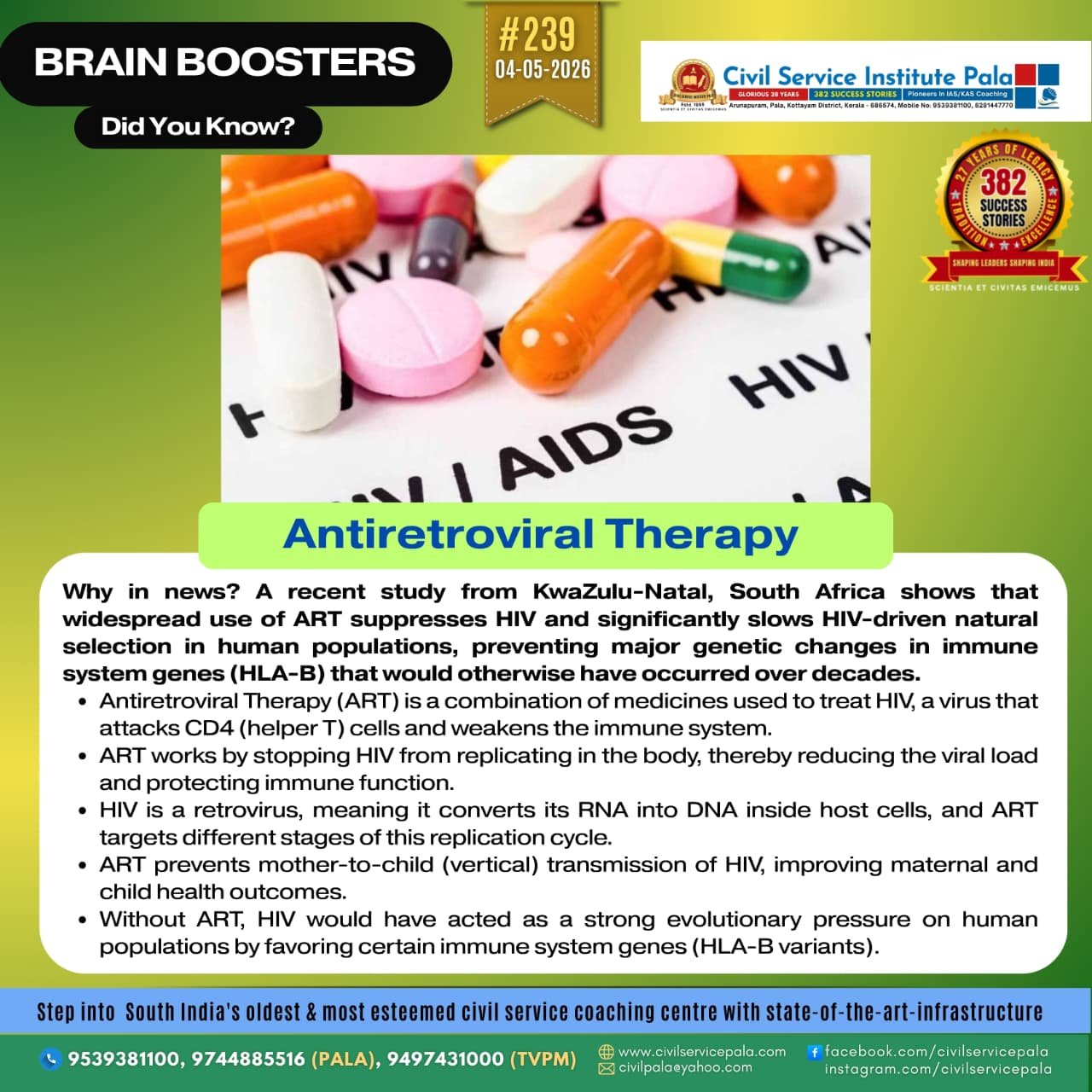
Antiretroviral Therapy (ART)
Why in news? A recent study from KwaZulu-Natal, South Africa shows that widespread use of ART suppresses HIV and significantly slows HIV-driven natural selection in human populations, preventing major genetic changes in immune system genes (HLA-B) that would otherwise have occurred over decades.
Background
• Antiretroviral Therapy (ART) is a combination of medicines used to treat HIV, a virus that attacks CD4 (helper T) cells and weakens the immune system.
• ART works by stopping HIV from replicating in the body, thereby reducing the viral load and protecting immune function.
• Although ART does not cure HIV, it enables patients to live long, healthy lives with near-normal life expectancy.
• HIV is a retrovirus, meaning it converts its RNA into DNA inside host cells, and ART targets different stages of this replication cycle.
How ART works?
• ART involves a combination of 2–4 drugs, which improves effectiveness and reduces the risk of drug resistance.
• Modern ART regimens are more potent, better tolerated, and available as fixed-dose combinations, improving patient adherence.
• ART can be administered as daily oral pills or long-acting injections given monthly or bi-monthly.
• When ART reduces viral load below detectable levels (<20 copies/mL), it leads to “viral suppression,” significantly improving health outcomes.
Significance
• ART preserves and restores immune function by allowing the body to regenerate CD4 cells.
• ART reduces the risk of opportunistic infections such as tuberculosis, which is a leading cause of death among HIV patients.
• ART lowers chronic inflammation, thereby reducing risks of cardiovascular, renal, and neurological diseases.
• ART prevents mother-to-child (vertical) transmission of HIV, improving maternal and child health outcomes.
• ART has transformed HIV from a fatal disease into a manageable chronic condition.
Key Issues
• Lifelong adherence to ART is necessary, as stopping treatment allows the virus to rebound.
• Poor adherence can lead to drug resistance, reducing treatment effectiveness.
• Access to ART and healthcare infrastructure remains uneven across regions.
• HIV persists in latent reservoirs in the body, preventing complete cure despite treatment.
Findings of the study
Scientific Insight: ART & Natural Selection
The introduction of ART has slowed this evolutionary pressure, making survival less dependent on genetic factors. According to the study :
• In the absence of antiretroviral therapy (ART), HIV would have acted as a strong evolutionary pressure on human populations by favoring certain immune system genes (HLA-B variants).
• Over a projected 45-year period (1990–2035), the proportion of individuals carrying protective HLA-B alleles would have increased significantly from about 23% to 42%, indicating rapid positive natural selection.
• At the same time, the proportion of individuals with disease-susceptible HLA-B alleles would have declined from around 28% to 18%, reflecting the gradual elimination of less advantageous genetic variants.
• In terms of allele frequency, protective variants were expected to double (from 0.12 to 0.24), while susceptible variants were projected to decrease substantially (from 0.15 to 0.092).
• This scale of genetic change over just a few decades is unusually rapid in human evolution and highlights the strong selective pressure exerted by infectious diseases like HIV.
• However, the widespread rollout of ART since the early 2000s has significantly reduced HIV-related mortality and transmission, thereby weakening this natural selection pressure.
• As a result, survival and reproduction are no longer strongly dependent on possessing protective HLA-B genes, slowing the rate of genetic change in the population.
• The study demonstrates that modern medical interventions like ART can alter or even halt evolutionary processes that would otherwise reshape human genetic composition.
